Showing posts with label picture book. Show all posts

Saturday, May 14, 2016

'Mr. Wuffles!' by David Wiesner

Wiesner, David. Mr. Wuffles!. Illustrated by David Wiesner. New York, Clarion Books, 2013. Print.


Image from:
www.davidweisner.com
I'm a little late to the party to heap praise on David Wiesner's unbelievably charming, funny, gorgeously illustrated, and fantastic picture book Mr. Wuffles!  If you're a fan of his earlier book Tuesday, with its whimsical humor, then you'll enjoy Mr. Wuffles!.

Weisner introduces us to the titular Mr. Wuffles before we even see the title page.  In a single page, Wiesner is able to give us the primary conflict of the story: Mr. Wuffles, like many cats, is extremely disinterested in cat toys.  His owner (or if you live with a cat, his servant/food and treat provider) tries to entice him with a brand-new toy, the price tag still attached.  Mr. Wuffles turns his nose up at the latest offering and walks away.  Over the title page and title page verso, we can see the new toy of the introduction page was just the latest in a long line of failed attempts to coax Mr. Wuffles to play with cat toys.  Weisner includes the price tags on all the previous toys, too, to emphasize that Mr. Wuffles disdains all cat toys.  The next page zooms in on a row of abandoned toys, but one does not look like the others.  What looks like a kitchen gadget turns out to be a tiny spaceship, with five tiny green aliens, thrilled and elated to have landed on another planet.

They are soon discovered by Mr. Wuffles, his eyes looming ominously in their window.  In the next frame, Wiesner shows the aliens tumbling in their ship, and we turn to page to find Mr. Wuffles intently studying the small ship.  He proceeds to happily play with the ship, and breaks their power source (or warp drive, for you Star Trek fans out there) in the process.  When he suddenly decides to have a nap, as cats are wont to do, the aliens make a break for it, and find refuge under a radiator, aided by a ladybug, who distracts Mr. Wuffles.

The aliens discover a world inside the walls of the house, complete with murals depicting the struggle of ants, ladybugs, and a few poor mice against Mr. Wuffles.  The aliens add their part of the story to the mural, and soon, the ants, aliens, and ladybug are sharing food and stories.  They hatch a plan to fix the spaceship's warp drive, and draw Mr. Wuffles' attention away so that one of the aliens can install the repaired warp drive.

Mr. Wuffles knows they're under the radiator.  He waits intently for them to emerge.

Will the aliens escape?  Does their warp drive work? Read Mr. Wuffles! and find out!

Wiesner's illustrations in watercolor and India ink are beautifully done.  Wiesner is able to give the aliens, who don't have much in the way of facial features, expressions that convey their feelings of the moment.  He creates a wonderful textures of Mr. Wuffles' fur, so that you want to touch the page to rub his fluffy tummy.  (Of course, Mr. Wuffles will probably bite you for your troubles.)  Wiesner absolutely nails a cat's behavior.  The apathy with toys they don't like, the leaping shock when you surprise them, the moment when they can't decide where to look when there's a commotion, the rapt focus when they do find something with which they'd like to play.  Wiesner is even able to give ants facial expressions, which makes him an extraordinary artist, in my opinion.

There are beautiful bits of detail in the drawings, such as the reflection of Mr. Wuffles' paws in the hardwood floor; the texture in the fibers of a piece of twine or a cheese cracker in the ants' treasure stash behind the walls; or the translucence of a child's marble.  It's no wonder that Wiesner earned a Caldecott honor for this book.

Another thing that makes this book so fantastic, is that it's light on dialog.  Well, dialog in English, anyway.  It's limited to Mr. Wuffle's owner and few short sentences.  The dialog between the ants, ladybug, and aliens is done in symbols or a series of what appears to be small brushstrokes on the paper.  The differences in their communication styles doesn't seem to hurt the ants, ladybug, or the aliens.  They understand each other perfectly.

If you're teaching narrative structure to kids whose first language is something other than English, this would be a great way to introduce it.  The lack of dialog is an asset in this book.  If you want to teach kids how to write dialog, this is also a great resource, because the actions are so clearly shown on the page, that it would be easy to give the assorted characters words.  Plus, the format of single-panel pages, alternated with multi-paneled pages that can easily be distributed to students as a group project.

I recommend this to anyone that lives with a cat, likes cats, loves sci-fi, loves picture books, loves seeing Jerry outsmart Tom -- oh gosh, I'll recommend this to everybody!  I'm certainly adding it to my picture book collection.

David Wiesner is also the author and illustrator of Tuesday (1992 Caldecott medal), Flotsam, Sector 7 (2000 Caldecott honor), and Freefall (1989 Caldecott honor).

Saturday, February 1, 2014

'Rapunzel' retold and illustrated by Paul O. Zelinsky

Zelinsky, Paul O.  1997.  Rapunzel.  Ill. by Paul O. Zelinsky.  New York: Puffin Books.  ISBN 9780142301937.

Photo by L. Propes
Rapunzel, as retold and illustrated by Paul O. Zelinsky from the European traditions of the tale of the young girl hidden in a tower, was the 1998 Caldecott Medal winner.  The Rapunzel tale has a long history, whose origins are shrouded in the mists of time.  In a long author's note, Zelinsky states it was published in France in the 1630s, but the tale itself is likely much, much older.

Rapunzel recounts the story of an infertile couple who finally conceive a much-wanted child.  Their house overlooks the garden of the neighboring garden, which just happens to be owned by a sorceress.  The wife is overcome with a desperate longing for the rapunzel growing in the garden (from the German word die Rapunzel -- "corn salad", a salad green that falls between arugula and watercress).  So desperate is the wife for the greens, that she proclaims she will die if she does not eat the rapunzel.  Naturally, the husband is quite concerned, but he loves his wife, so he scales the high wall surrounding the garden and steals an armful of the rapunzel.  The wife's cravings are only momentarily sated, and the husband is over the wall once more.  He is caught by the sorceress who allows the husband to take as much rapunzel as the wife desires in return for one thing: their child.  Once the child is born, the sorceress takes her away and raises her as her own.  When the girl -- Rapunzel -- is twelve years old, the sorceress locks her away in a tower.  Rapunzel sees no one aside from her adoptive mother until a prince hears her singing and finds out how to gain entrance to the tower.  Rapunzel and the prince fall in love.  He visits her each night, unbeknownst to the sorceress until Rapunzel slips and releases a tidbit of information that reveals her secret.  Enraged, the sorceress banishes Rapunzel, cutting off her long, long hair.  As for the prince, the sorceress uses Rapunzel's shorn braids to trick the prince into climbing into the tower where she informs him Rapunzel is lost to him forever.  The prince tumbles to the ground, blinding himself in the process.  He wanders around the forest for a year until he heard Rapunzel singing once more.  As he falls into her arms, two of her tears land on his eyes, healing his blindness.  He takes Rapunzel to his kingdom to be his wife and they, of course, live happily ever after.

Underneath the surface, Rapunzel is about the inevitability of growing up. It's no coincidence that the sorceress locks Rapunzel up at the age of twelve,"to preserve her from the effects of an awakening sexuality" (Publisher's Weekly, 1997).   Of course that isn't what happens.  Children still mature, no matter how high and isolated the tower.  In Zelinsky's version, Rapunzel and the prince perform an ersatz marriage ceremony and consummate the marriage.  It's not readily apparent to younger children, but older children and teenagers will pick up on the subtle hint that Rapunzel is pregnant when she mentions to the sorceress that her dress is too tight in the waist, a parallel to her biological mother's discovery that she, too, was pregnant.  School Library Journal's review commends Zelinsky for not, "sidestep[ing] the love between the maiden in the tower and the prince...  it is Rapunzel's signs of pregnancy that bring about her banishment from the tower and the prince's downfall" (Wilton 1997).  (On a side note, the only other place I've seen the sorceress actively admit to wanting to keep Rapunzel separate from the world is in the musical Into the Woods by Stephen Sondheim.  If you can find a copy of the version filmed to air on television in 1991, give it a whirl.  Bernadette Peters plays the sorceress, and the scene where she finds out about the prince and confronts Rapunzel is absolutely heartbreaking.)  If there's a moral to the story, it might very well be that the more tightly one holds on to someone, the more likely they are to lose them anyway.

Zelinsky does not portray the sorceress as a monster, at least not in the beginning.  Her love and affection for Rapunzel are obvious, as is the hurt and disappointment when the sorceress feels Rapunzel has betrayed her.  True, she is quite fearsome when she enters the scene at the beginning of the story, but in the scene where she carries the baby Rapunzel out of her parents' house, her body language is anything but.  Of all the characters in the story, Zelinsky gives the sorceress the greatest character development.  It would be so easy to make her the villain of the story.  To make her the evil witch who locked a girl away in a tower.  I think most parents would relate to wanting to keep their child safe from harm, but perhaps not to the rather extreme level of the sorceress.

Photo by: L. Propes
The combination of Zelinsky's text and the oil paintings illustrating the book make it seem like a much older publication.  The language takes its cues from a more formal and structured manner of speech, lending itself to the antique feel of the story.  The paintings are reminiscent of the Italian Renaissance, and the story itself takes place in a sun-drenched location.  The paintings contain lovely bits of detail, like the filigree engravings on the scissors the sorceress uses to cut Rapunzel's hair, or the embroidery on the cuffs of a dress.  Characters' faces are expressive and Zelinsky perfectly captures the movement of a dress or cloak as it billows in the wake of someone's passing.  Most of the paintings are intimate glimpses into the life of Rapunzel, but at times, Zelinsky includes one that encompasses the scale of how high the tower was, and how long Rapunzel's hair must have been.  When Rapunzel is banished, he paints her so small, all you can see is a hint of the lavender of her dress against the barren mountains, giving a visual cue to just how alone Rapunzel must have been in the world.  He uses the same effect with the prince, painting him three times in one scene, each version of the prince smaller and further away in the perspective than the last to denote how far the prince wandered.
Photo by: L. Propes

The book is listed as appropriate for ages 5 and up, but at 48 pages, and some rather long sections of text, it might be a bit too long for a kindergarten classroom.  Older children would probably enjoy the story and appreciate the artwork involved.

Zelinksy has been selected for a Caldecott Honor book three times: Swamp Angel (text by Anne Isaacs), Rumpelstiltskin, and Hansel and Gretel (text retold by Rika Lesser).

There are many options for activities with Rapunzel.  Students could find other versions of the story and compare them to Zelinsky's retelling.  Older students might enjoy viewing the Broadway musical Into the Woods (where the second act examines what happens after "happily ever after") and using that as a springboard to fracture the fairy tale, or even write their own version of it.  They could even write a version of life after "happily ever after".  Younger children could do illustrations, study Renaissance art or grow rampion (die Rapunzel in English).  Several age groups could write selected scenes from a different point of view and present it Rashomon-style.  Other activities and interviews with Zelinsky can be found here.

Students may enjoy visiting Zelinsky's website at http://paulozelinsky.com.

*********************************************************************************

"...this story is as much about the fierce love of mother for child as it is about the romantic passion between the imprisoned Rapunzel and the prince... The rich oil paintings evoke the portraits of Renaissance art.  The costumes are lavish, the interiors intricate. Rapunzel is both gorgeous and maidenly.  The sorceress is terrifying: the pictures also reveal her motherliness and her vulnerability, especially in the two double page narrative paintings that frame the drama.  One shows the sorceress taking the baby -- and we see how she lovingly cradles it in her arms..." -- Hazel Rochman, Booklist, November 15, 1997
*********************************************************************************

Works Cited:

Rapunzel. in Publishers Weekly [database online]. New York, 1997 [cited January 30 2014]. Available from 
        http://www.publishersweekly.com/978-0-525-45607-0.


Wilton, Shirley. 1997. Preschool to grade 4: Nonfiction. School Library Journal 43 (11) (11): 113, 
       http://ezproxy.twu.edu:2048/login?url=http://search.ebscohost.com/login.aspx? 
       direct=true&db=a9h&AN=9712086828&site=ehost-live&scope=site.


Thursday, January 23, 2014

'So, What's It Like To Be a Cat?' by Karla Kuskin, Illustrated by Betsy Lewin

Kuskin, Karla.  2005.  So, What's It Like To Be a Cat?.  Ill. by Betsy Lewin.  New York: Atheneum Books for Young Readers.  ISBN 0689847335.

Anyone who has ever owned a cat might wonder what goes on in their furry heads.  Why do they play with the plastic ring from a gallon carton of milk when you've gone to the trouble to purchase lovely toys for them?  Why won't they sleep in that perfectly comfortable and warm cat bed?  Why do they have to jump into that basket of laundry that you just took out of the dryer?  All those questions and more could be answered in So, What's It Like To Be a Cat?
The intrepid Mr. Bean (my cat)
photo by L. Propes

The book begins on the title page.  A chalkboard contains an assignment -- an interview.  As you turn the page, you see an eager boy, showing a slightly reserved grey-and-white cat to a chair.  The next shows the boy in his own chair, holding a pencil and notebook, ready to take down his subject's answers.  The book proceeds to ask questions any human might want to know of their cat.  There are times where the cat offers direct answers, but in keeping with the attitude of a cat, chooses at times to prance around the question.  In regards to our feline's humans, she doesn't hold back, telling her interviewer just what she thinks of them.  The reader is left with the impression that this particular cat does not wish to be anything else than what she is, and she is absolutely fine with that, thank you.

The publisher has chosen to use a different typeface for the interviewer and the cat, which could offer young readers a nice visual cue as to which character is speaking.  The interviewer's typeface is a childlike scrawl, while the cat's resembles an antique typewriter -- almost bordering on fussy.  Kuskin's text rhymes, but with no regular rhyme scheme.  This does not detract from the overall effect.  Most of the text is in rhymed couplets, interrupted by a line that doesn't rhyme with anything else in the stanza.  Sometimes the couplet spills from one stanza to another.  It gives the book a rollicking rhythm that is great fun to read aloud.  The style differs between our young interviewer and his subject.  The interview's style of speaking is appropriate for a child of his age, and the cat's speech is much more formal and slightly haughty.  Some of the vocabulary might be a bit above the intended audience, but with a little forethought, a reader-performer could produce some props that will help the audience understand the words in context.

Lewin's watercolor paintings are presented on a plain white background.  All the better to keep the focus on the interplay of the text and the illustrations.  The primary focus of this story is the interview between the cat and the young boy, and there are no backgrounds to offer distractions from the artwork and story.  Lewin imbues the cat with eloquent facial expressions that evoke a range of emotions from thoughtful consideration to regal disdain.  Lewin even makes sure that the pupils of the cat's eyes change size when she's drawn in a nighttime setting.  While most of the illustrations are static, Lewin provides a pictorial representation of the cat's replies to the boy, putting the cat into situations and poses any cat owner would recognize.  The pages where Lewin puts the cat into motion paint the cat in monochrome colors, with multiple renditions of the cat in some sort of motion dancing, prancing, and leaping across the page.  Other pages with motion use techniques familiar to anyone who grew up on a steady diet of Bugs Bunny -- the parts of the cat that move are drawn multiple times to depict the motions within a single illustration.  Lewin also places the cat into situations familiar to all pet owners: held upside down by a small child (with very grumpy expression on the cat's face); winding around her human's legs while she's trying to practice ballet; sleeping on another person's chest (and keeping the parent awake!); and even investigating one of the humans after a shower.  Keep an eye out for the alarmed mouse in the corner of a page asking if the cat eats Bits O' Mouse for breakfast (Kuskin 2005).  It is a nice, almost throwaway, addition to a question about a cat's eating habits.

Teachers could use this book as a way to introduce children to the idea of performing an interview, then either have them interview an actual person, character from another book, or imagine what their own dog, cat, or other pet might have to say.  A teacher could easily partner with an art teacher and have the class make a variety of cat-themed crafts that can complement the story quite easily.  Teachers could even use this to introduce a unit about cats in general.  There really are quite a few possibilities.

*********************************************************************************

"Two award winners team up to explore playfully the essence of being a cat.  The framework of an interview between a boy and a feline allows for a series of skillfully constructed calls and responses... The illustrations are set against crisp white backgrounds and each page offers a diverse layout that enhances the cadence of the poem...  A great choice for reading aloud." -- Carolyn Ward, School Library Journal, 2005

"The inquisitive boy in this rhyming tale decides to go right to the source... and, fortunately for him, finds that the interviewee is happy to share the secrets of her catlike ways.  This playful text has heaps of conceptual appeal; anyone who has ever spent time around animals will readily identify with the desire to know what goes on in their heads, and the Q&A format of the story mischievously plays on that desire." -- Hope Morrison, Bulletin of the Center for Children's Books, 2005

*********************************************************************************

Works Cited:


Kuskin, Karla. 2005. So, what's it like to be a cat?. Ill. by Betsy Lewin. New York: Antheneum Books for Young Readers.


Morrison, Hope. 2005. So, what's it like to be a cat?. Bulletin of the Center for Children's Books 59 (1) (09): 25-, http://ezproxy.twu.edu:2048/login?url=http://search.ebscohost.com/login.aspx?direct=true&db=brd&AN=510451039&site=ehost-live&scope=site.

Ward, Carolyn. 2005. So, what's it like to be a cat? School Library Journal 51 (8) (08): 99-, http://ezproxy.twu.edu:2048/login?url=http://search.ebscohost.com/login.aspx?direct=true&db=brd&AN=518482679&site=ehost-live&scope=site.


'This Is Not My Hat' by Jon Klassen

Klassen, Jon.  2012.  This Is Not My Hat.  Ill. by Jon Klassen.  Somerville: Candlewick Press.  ISBN 9780763655990.

Photo by: L. Propes
This Is Not My Hat is narrated by a cheeky small fish, who unabashedly admits he's stolen a hat from a much larger fish on the grounds that 1) the hat is too small for its owner, and 2) the owner won't miss it at all.  No sir.  Not at all.  The story starts with a bang as the fish, "wastes no time or words in confessing his crime..." (Janssen 2012).  Of course the big fish does notice his beloved hat is gone and swims off in pursuit.  The smaller fish is blithely unconcerned that he might get caught, certain that he will manage to swim to a place, "where the plants grow big and tall and close together" (Klassen 2012).  A place where he can hide and the larger fish cannot possibly hope to find him.

This 2013 Caldecott Award winner would be a perfect addition for any classroom library to teach a range of subjects from prediction to irony.  The sentences are set above the illustrations, offering a sly counterpoint to one another.  The illustrations of the big fish's reactions of discovering his hat is missing directly contradict the narration of the small fish.  Younger children will enjoy the on-the-edge-of-the-seat quality of the chase and the two-page "silent" illustrated spread that comes after  the larger fish has indeed caught up with the narrator that leaves the audience wondering if the bigger fish did catch the smaller fish, and if so, just exactly what happens.  Klassen does resolve the story, but manages to leave a small opening in the ending where a teacher can ask the class to imagine how the story is resolved.  The action rises gently as the smaller fish makes one pronouncement, followed by a contingency plan that pushes the plot forward.  The climax and resolution follow hard upon one another, but because Klassen chooses not to narrate either of those parts of the plot development, they float to the reader/audience as if on an ocean's current.

Klassen's illustrations are rendered in ink, then scanned into a computer, where he manipulates the images with Photoshop (Danielson, 2011).  The illustrations for This Is Not My Hat are fairly monochromatic greys and browns against a black background.  It sounds like it might not work, but it does.  The colors of the fish and vines jump off the page.  The illustrations are also somewhat flat (more in the manner of two-dimensional, rather than lack of vividness) and the effect is rather retro and reminiscent of picture books from an earlier age.  Facial expressions are done with a simple change of an eye, but it speaks volumes.  Klassen judiciously uses air bubbles to evoke the mood of the larger fish (fewer bubbles, the angrier he becomes) and to denote movement (faster movement, more bubbles).  Publishers Weekly said, "Klassen excels at using pictures to tell the parts of the story his unreliable narrators omit or evade" (Publishers Weekly 2012).  

This Is Not My Hat is seen as a sequel of sorts to Klassen's I Want My Hat Back.  (Incidentally, I Want My Hat Back was a Theodore Seuss Geisel finalist in 2012 and won the ALA Notable Books for Children award in 2012 and Publishers Weekly Best Children's Books in 2011.)  The Classroom Bookshelf blog lists activities and lessons using This Is Not My Hat and other picture books for a range of grades from preschool to 8th grade. 

I would highly recommend this book for any classroom, school, or personal library.  Younger children may realize what the smaller fish has done is wrong, and parents could use it as an introduction to discussing the consequences of one's actions to children from a variety of angles.  Even though children's books aren't reqired to be moralistic (Vardell 2008), Klassen manages to convey that no crime goes unpunished without getting preachy or shoving it in the face of his audience.

**********************************************************************************

Works Cited


Danielson, Julie. Seven questions over breakfast with jon klassen. 2011 [cited January 23 2014]. Available from http://blaine.org/sevenimpossiblethings/?p=2189

Janssen, Carolyn1. 2012. This is not my hat. School Library Journal 58 (9) (09): 116-, http://ezproxy.twu.edu:2048/login?url=http://search.ebscohost.com/login.aspx?direct=true&db=brd&AN=79888301&site=ehost-live&scope=site

Klassen, Jon. 2012. This is not my hat. Somerville: Candlewick Press. 

Vardell, Sylvia M. 2008. Children's literature in action: A librarian's guide. Westport: Libraries Unlimited. 


Sunday, January 19, 2014

'Kay Thompson's Eloise' by Kay Thompson, illustrated by Hilary Knight

Thompson, Kay.  1955.  Kay Thompson's Eloise.  Ill. by Hilary Knight.  New York: Simon & Schuster Books For Young Readers.  ISBN978671223502.

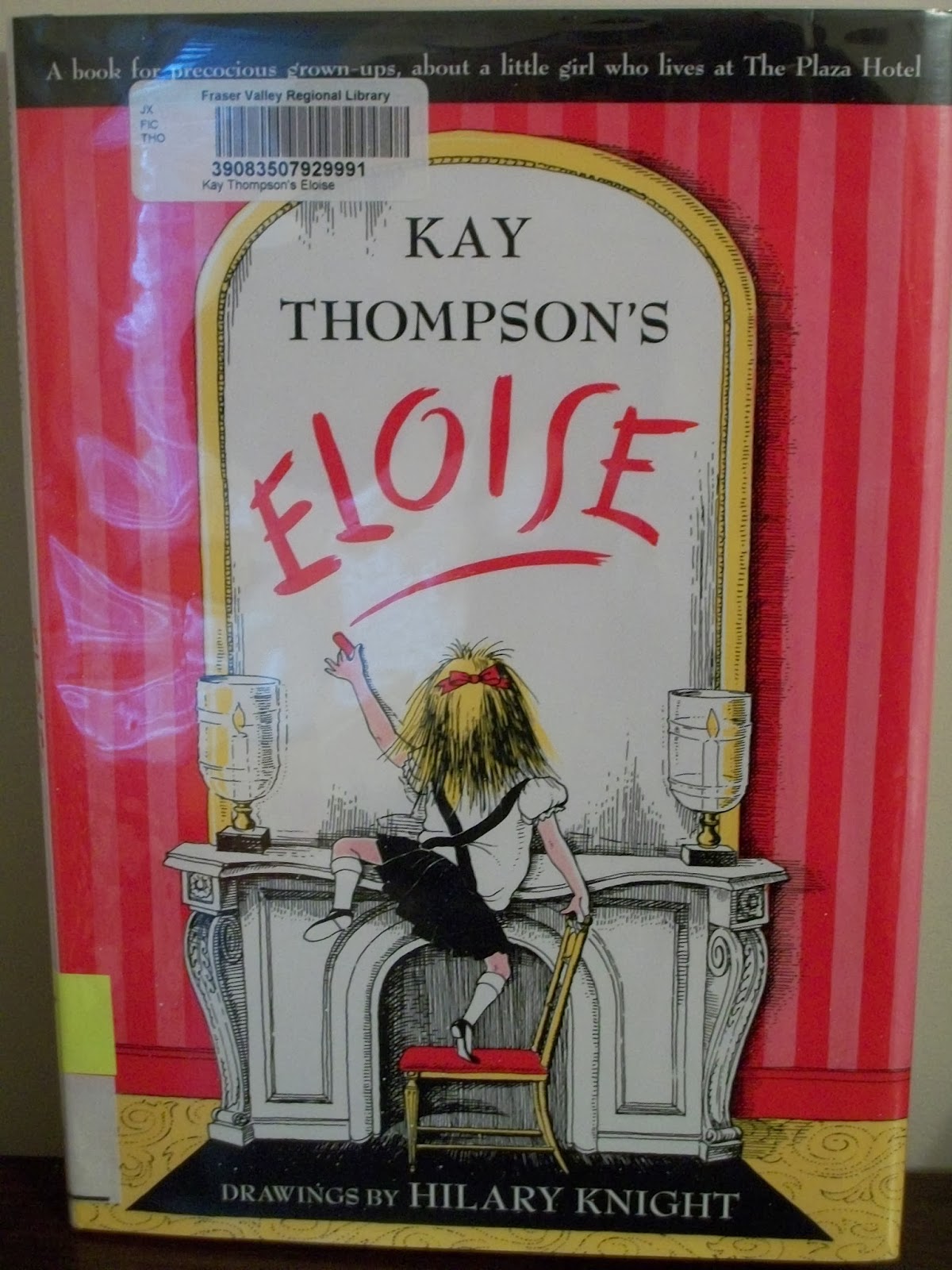
Kay Thompson's Eloise, more commonly known as simply Eloise, chronicles a day in the life of the eponymous titular character.  Eloise is a six year-old girl that lives in a penthouse at the Plaza Hotel in New York City with her nanny, dog Weenie, and turtle Skipperdee.  Eloise spends her day running around the hotel, stopping in at weddings, meeting rooms, ballrooms, and other areas of the Plaza.

Photo by: L. Propes
Eloise reminds me of animated films and television shows that may not necessarily be for children, despite the format.  A subtitle of the book calls it, "A book for precocious grown-ups about a little girl who lives at the Plaza Hotel".  Children will enjoy the descriptions of Eloise's unfettered adventures in the hotel and the fact that for all the trouble she can cause, Eloise never seems to get into any trouble, nor face any consequences -- truly a child's dream!  Adults might raise a slightly censorious eyebrow at Eloise's need to poke her nose in everybody's business and crash weddings and parties.  As cited in Thompson's obituary, Publishers Weekly in 1957 called Eloise an, "
...overprivileged 6-year-old, the terror of the Hotel Plaza in New York. She is also ill-mannered, ill-tempered and ugly. But she has her charm. She often means well, and her mother neglects her. Even though you know that you would do the same thing if she were yours, you can't help finding this appealing" (Pace 1998).  Even back then, readers were certainly aware of the dichotomy in Eloise's character -- simultaneously wanting to chide Eloise and hug her.

According to a New York Times article, Thompson intended Eloise to be meant for adults, the picture book format notwithstanding (D'Erasmo 2002).  She once even went so far as to re-shelve copies of Eloise from the children's section of a bookstore to the adult fiction section (D'Erasmo 2002).  Children in the 1950s might not have noticed Eloise's absent mother and never-mentioned father, but today's child could make a comment about it.  In her review of The Absolutely Essential Edition of Eloise, Sarah Ferrell commends Thompson for turning the traditional "poor little rich girl" narrative on its head.  There is nothing poor or little about Eloise.

Thompson gives Eloise a voice anyone familiar with a six-year old child will recognize.  It rambles in an unpunctuated, stream-of-consciousness trickle down the page.  Eloise, like most children, makes up words that onomatopoetically describe their actions much more effectively than the usual terms.  She is irreverent, sure of herself, and -- dare I say? -- delightfully imaginative.  All these qualities shine through in Thompson's text and Knight's illustrations.

Knight's drawings depict Eloise as a slightly chubby girl, with flyaway hair and a smile that hovers between a grin of genuine humor and a satisfied smirk.  The drawings are black-and-white with touches of red or pink in the bow in Eloise's hair or the scrawled drawings on her bedroom walls.  The drawings themselves are not detailed to the point of realism, but Knight evokes the opulence of the Plaza by choosing to focus on a few details, like the palm fronds of a cafe, the suggestion of a chandelier in a ballroom, or the windows and frescoes of a room hosting a wedding.  Knight provides a sketch for each of Eloise's adventures, and anything more detailed would detract from the text.  He even allows the reader to view Eloise's imaginative flights of fancy with simple, red outlines of the characters that inhabit Eloise's imagination.

Unlike many children's book authors and illustrators, Thompson and Knight collaborated on this and four additional books: Eloise in Paris, Eloise in Moscow, Eloise at Christmas, and Eloise Takes a Bawth.  If you're willing to part with a significant amount of money, the Plaza Hotel offers Eloise-themed birthday parties and an Eloise-themed suite.

*********************************************************************************
Works Cited:

D'Erasmo, Stacey. Little grown-ups live here. in The New York Times [database online]. 2002 [cited January 14 2014]. Available from http://www.nytimes.com/2002/10/06/magazine/06ELOISE.html?pagewanted=1.

Ferrell, Sarah. Hints from eloise. in The New York Times [database online]. 1999 [cited January 14 2014]. Available from http://www.nytimes.com/books/99/05/16/reviews/990516.16ferrelt.html.


Pace, Eric. Kay thompson, author of 'eloise' books dies. in The New York Times [database online]. 1998 [cited January 14 2014]. Available from http://www.nytimes.com/1998/07/07/arts/kay-thompson-author-of-eloise-books-dies.html.