Showing posts with label YA novel. Show all posts

Wednesday, May 4, 2016

'Carry On' by Rainbow Rowell

Rowell, Rainbow. Carry On: A Novel. New York, St. Martin's Griffin, 2015. Print.


Image from
www.rainbowrowell.com
Simon Snow is your average foster kid in England, shuttled from care home to care home during his summer holidays from Watford School of Magicks.  Did I say average?  Simon's one of the most powerful mages in England.  Or he would be if only he could get his magic under control.  Usually when Simon uses his magic, the spells don't work or they work too well.  He suspects his roommate at Watford, Baz, is a vampire, and Simon and Baz don't get along very well.  Needless to say, Simon's afraid that Baz is going to sink his fangs into his neck while he sleeps.  To add insult to injury, Simon believes his girlfriend, Agatha, has thrown him over for Baz.  His best friend, Penelope, constantly breaks school rules by sneaking into Simon and Baz's room.  On top of all that, there have been attacks by the Insidious Humdrum and strange dead spots have been appearing all over England where magic has just disappeared.

A series of strange events marks the beginning of Simon's final year at Watford, namely the fact that Baz's dead mother, Natasha, appears to Simon and delivers a cryptic message about the circumstances of her death for Simon to give to Baz; and an obviously ill Baz doesn't show up to the school until eight weeks into the term.  Once Baz returns to Watford, he, Simon, and Penelope team up to try and uncover the tangled mystery surrounding Natasha's death, while also trying to figure out how to defeat the Humdrum.

Rowell first introduced us to Simon Snow in her novel Fangirl, where it's a fictional fantasy series that bears more than a passing resemblance to the Harry Potter phenomenon.  Rather than write the book as the fictional author might have, Rowell has basically written a fan-fiction novelization of a fictional fantasy series she created.  Got that?  The Harry Potter influence is so strong in Carry On, that for the first third of the book, it's impossible not to mentally tally all the bits and pieces that are literary cousins to their Harry Potter counterparts.  Once Baz arrives on the scene, though, the story really picks up and races to the frantic and satisfying conclusion.

It's worth mentioning that although Rowell's magical world somewhat resembles that of Harry Potter, it diverges in significant ways.  Rowell's witches and mages live in the world of Normals, use smartphones, and create savvy Google searches.  Spells are common catchphrases or quotes from popular movies or songs, and witches and mages don't always use wands.

I was a little disappointed that Rowell didn't delve as deeply into the emotional lives of Simon or Baz as she did in her award-winning novel, Eleanor & Park.  Still, Simon and Baz's inner monologues probe their emotional attachments to each other and their families and friends.  As in her other novels, characters are allowed to unfold slowly across the pages of the book.  Character development is not rushed or forced, which also helps keep the reader on their toes as the resolution of the book approaches.

Readers of Rowell's other YA novels, Eleanor & Park, and Fangirl will probably love this novel.  So will readers of the Harry Potter series, if they can help themselves from comparing it to Harry Potter.  There's enough mystery to keep mystery fans engaged, too.

Sunday, October 18, 2015

'Stand Off' by Andrew Smith

Smith, Andrew. Stand Off. New York: Simon and Schuster BFYR, 2015. Print.
ISBN: 978-1-4814-1829-4

Image from:
www.simonandschuster.com
When we last saw Ryan Dean West, his best friend Joey Cosentino had just died under horrific circumstances, and Ryan Dean was struggling to grieve.  Fast forward to the following September, and it's Ryan Dean's last year at Pine Mountain.  It's his senior year, he's still dating Annie Altman, his dream girl, and hopefully, he can mend his relationship with his friends, Sean and JP.

Life has other plans for Ryan Dean.

Even though he's a senior, Ryan Dean has to room with Pine Mountain's newest child prodigy, Sam Abernathy in a tiny dormitory room with the other freshmen, and to add insult to injury, the only set of sheets Ryan Dean and his mother could find to fit the child-sized beds in the room are pink flannel with a winged unicorn called "Princess Snugglewarm."

Could it be any worse?

Oh, yes.  It can.

Sam (or the Abernathy as Ryan Dean calls him) is walking brochure for Pine Mountain.  Clean-cut, polite, an uncanny ability to create real food out of the bits and pieces left for the students on weekends, with a puppy-like eagerness to follow Ryan Dean around campus, who happens to need to sleep with the window wide open, as well as the door to their dorm room.  Sam confesses he cannot sleep without the window and door open, as he suffers from severe claustrophobia.

Oh, and there's N.A.T.E. (the Next Accidental Terrible Experience) who keeps following Ryan Dean around Pine Mountain, taking over his drawings, haunting his sleep.

There's also a chance encounter with Joey's parents and younger brother, Nico, who resembles Joey to such a degree, it's almost painful for Ryan Dean to be around him.  

On top of it all, Coach McAuliffe, the rugby coach, wants Ryan Dean to move from the left wing to the half-fly, which happened to be Joey's position, as well as take over as team captain, which was also Joey's position.  It's a bit much for Ryan Dean to handle.

He's not handling it well.  He's not handling it well, at all.  

The novel has a radically different mood than Winger.  In Winger, Ryan Dean is exuberant, flirtatious,  and a genuinely nice guy.  He's still a genuinely nice guy in Stand Off, albeit one still struggling with grief for his best friend.  Ryan Dean's world has drastically shrunk, especially since his two friends from rugby and Opportunity Hall (Chas and Kevin) graduated, and he's still estranged from Seanie and JP.  The novel appropriately feels claustrophobic, echoing not only the new influence of Sam Abernathy, but Ryan Dean's shrinking circle of friends.  The illustrations that provided so many of the humorous and whimsical moments in Winger have been reduced in number, and their tone has changed as well.  Most of the illustrations that do appear in the novel depict Ryan Dean's fight with N.A.T.E., although others depict some of his more humiliating moments. The book also covers a shorter time frame than Winger.  Whereas Winger took place over at least three months of school, Stand Off covers roughly three to four weeks, contributing to the overall compressed feel of the book.

This version of Ryan Dean is more mature, although he still has his endearingly awkward moments, such as when he deflects the amorous attentions of one of his rugby teammates, utilizing the lessons in consent they've learned from their sex-ed teacher.  Still, the more Ryan Dean faces his personal demons, the more he resembles the Ryan Dean we came to know and love in Winger, just one that's grown up a bit.  It's particularly evident in the scenes where his friend Seanie comes out to him, and the way he learns to cope with Sam's claustrophobia and accept Sam as a friend.

Smith does a really fantastic job depicting Ryan Dean's ongoing struggle to come to terms with Joey's death.  He also manages to send home the message that people often need a little help from their friends or professional therapists to manage things like grief or childhood-trauma-induced claustrophobia.  Rather than have other characters badger Ryan Dean, Smith lets their actions do the hard work of persuading Ryan Dean he doesn't have to face N.A.T.E. -- or indeed anything -- by himself without getting preachy.   As in Winger, Smith displays a deft and sensitive touch regarding characters' sexualities as a matter of fact.

If there are weaknesses in the book at all, they mostly lie in how Smith writes the girls, especially Annie.  They tend to be somewhat two-dimensional.  However, considering the source -- namely Ryan Dean's narration -- it's not necessarily a crippling weakness, or even a major one.  It's too easy to forget Ryan Dean is only fifteen years old, and that his attitudes often reflect his emotional maturity, which doesn't always mirror that of his intellectual maturity.  Smith manages to wrap up several of the loose ends introduced in the book, while decidedly NOT tying everything up in a nice, pretty bow.

This is a fine addition to anyone's collection of realistic YA fiction.  It's a lovely and refreshing break from the glut of paranormal fiction that's dominated YA in recent years.  I'm not sure if Smith is finished with the adventures of Ryan Dean West, but I, for one, would love to see Ryan Dean tackle college.

Monday, December 15, 2014

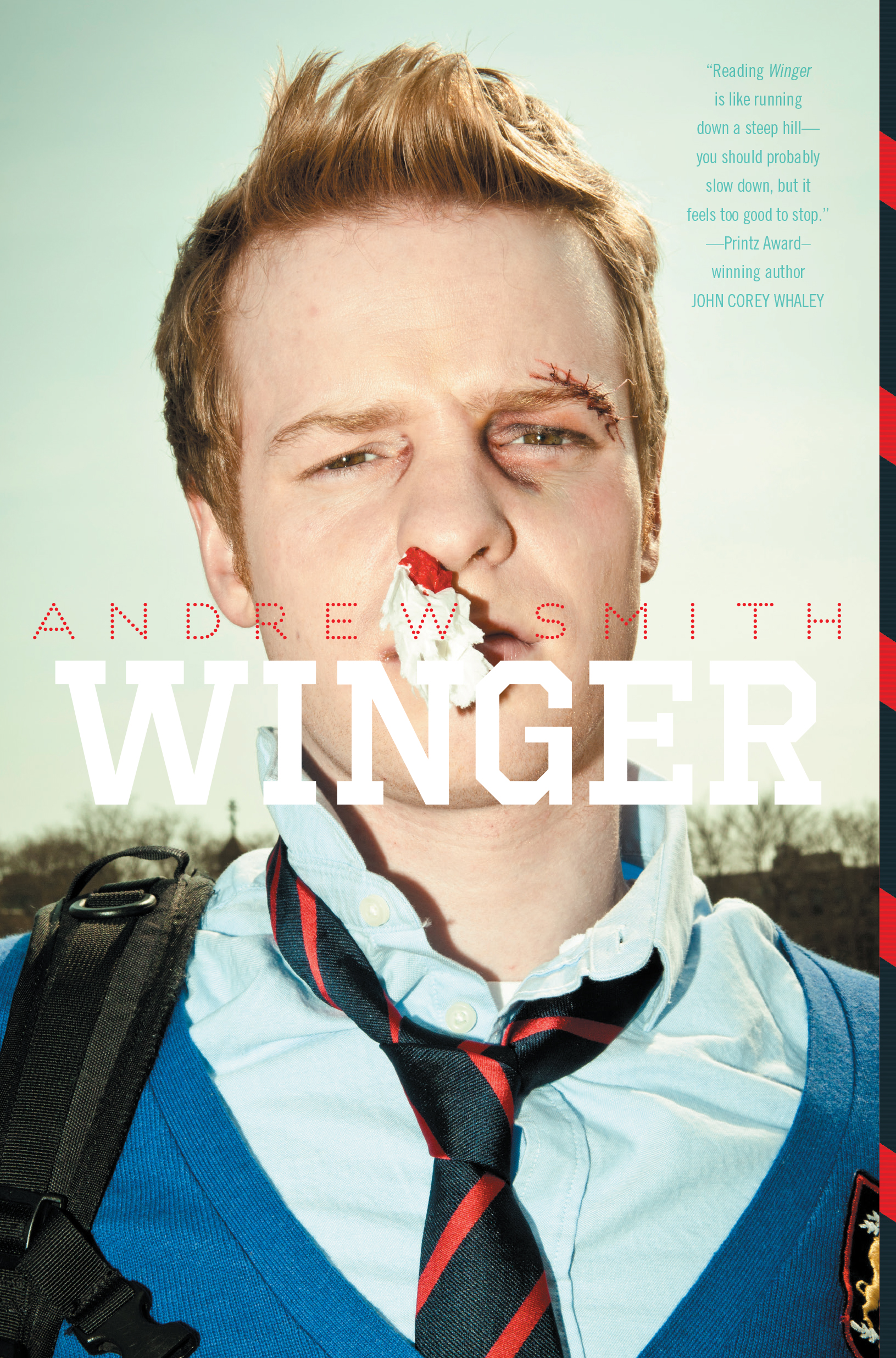
'Winger' by Andrew Smith

Smith, Andrew. Winger. New York: Simon and  Schuster, 2013. Print.
Photo by: Simon and Schuster

If you read the blurb on the back of the book that summarizes Winger, a few thoughts might run through your head.  It describes Ryan Dean West, a fourteen year-old junior at Pine Mountain, an exclusive boarding school in the Cascade Mountains of Oregon.  A few of the thoughts that went through my head were: #poorlittlerichboy and #firstworldproblems.

Ryan Dean (yes, that's his first name) doesn't mind attending Pine Mountain.  He doesn't have the best relationship with his parents to begin with, and his father is a politician in Boston.  Ryan Dean is a bit precocious and, as Pine Mountain is in a remote location, it effectively removes any chance of scandal back home.  Before you get the idea that Pine Mountain is a refuge for poor little rich kids, here are a few of their rules: no cell phones, no iPods, uniforms -- at all times, and all the students are required to participate in at least one sport.  Oh, and there's existence of Opportunity Hall, the dorm for "troublemakers".  Opportunity Hall, or O-Hall, is no picnic.  There are no locks on the doors, the shower curtains in the boys' bathroom are on the grungy side, and scary Mrs. Singer oversees the vacant girls' floor of O-Hall.

Ryan Dean has been assigned to live in O-Hall because of an incident the previous school year, and his roommate is none other than Chas Becker, a large, menacing senior, who Ryan Dean is convinced wants to kill him.  The book follows Ryan Dean and his exploits over the first few months of the school year at Pine Mountain.  Ryan Dean tries to not rouse the ire of Chas, fit in with the much older boys in O-Hall, keep his position on the varsity rugby team, and get his best friend Annie to admit she's mad about him.

Smith writes the book from the point-of-view of Ryan Dean, so we're privy to all his inner thoughts about girls, his classes, rugby, girls, the inhabitants of O-Hall, girls...  Smith captures Ryan Dean in all his adolescent glory.  His inner voice can be quite profane, but Ryan Dean is a sweet kid at heart, who can recognize his mistakes.  Ryan Dean is a wonderfully complex character, who struggles to find his niche at Pine Mountain.  He's too mature for the other fourteen year-olds, but still a kid in many ways to his classmates in the eleventh grade.  Ryan Dean has a wry, amusing take on life, perhaps especially when life decides to make situations as humiliating to Ryan Dean as possible.

Other characters are less well-drawn, especially the girls.  At first glance, it's possible that Smith ventured into Mary Sue territory, because all the girls are, in Ryan Dean's word, "hot".  Two girls in particular, Annie and Megan, are almost too perfect so that it hurts to look at them.  On further reflection, perhaps it's because we're looking at them through Ryan Dean's eyes, so of course they are presented in the burnished glow of Ryan Dean's admiration.  Chas is a grunting, seething, looming presence in the book.  Nick and Casey, two of the other boys in O-Hall, are painted as stereotypical aggressive jocks.  One of the characters that has the potential to be as complex and interesting as Ryan Dean is Joey Cosentino, who is a stereotype-defying gay teen, often serving as the voice of Ryan Dean's conscience.  Joey gently guides Ryan Dean into being a better man, while Ryan Dean wholeheartedly accepts Joey as one of his best friends.

Ryan Dean is an artist, so the book is littered with his illustrations that depict his rich imagination or his current state of mind as presented in various graphs.  The overall tone is endearing, engaging, and often hilarious.  There is a dark turn toward the end of the book, and Smith cuts things short with that event.  There is a sequel, Stand-Off, that should be published next fall.  Hopefully, Smith will let us see how Ryan Dean has coped with the events that marked the end of Winger.  

To borrow a phrase from Ryan Dean, I give Winger a four-out-of-five-chicken-potpies-on-the-Lisa-scale-of-you-should-read-this.  It makes a welcome departure from the glut of vampire and dystopian novels cluttering the YA shelves.

Tuesday, July 15, 2014

'Between Shades of Gray' by Ruta Sepetys

Sepetys, Ruta. Between Shades of Gray. New York: Speak, 2011. Print

The publication of Anne Frank: The Diary of a Young Girl opened to door to countless narratives of the experiences of Jewish children and adolescents during World War II: The Upstairs Room by Johanna Reiss, Number the Stars by Lois Lowry, The Boy in the Striped Pajamas by John Boyne, Yossel by Joe Kubert, and Maus by Art Speigelman. (Maus isn’t strictly about an adolescent, but it’s too well known to leave off the list.)  Yoshiko Uchida’s Journey to Topaz and Farewell to Manzanar by Jeanne Wakatsuki Houston and James D. Houston explore the experiences of Japanese-Americans who were imprisoned by the United States government following the attack on Pearl Harbor in 1941. 

Image from
www.penguin.com
There is another event, even more horrific, yet unknown to the larger world because of the intense secrecy of life behind the Iron Curtain -- the deportation of thousands upon thousands of Latvians, Estonians, and Lithuanians to Siberian gulags in 1941 after the Soviet Union invaded the Baltic states in 1940.  Esther Hautzig’s The Endless Steppe (1968) describes the forced relocation of her Polish family to Siberia.  Ruta Sepetys’ Between Shades of Gray follows the Vilkas family from their home in Kaunaus, Lithuania to the gulag at Trofimovsk, well north of the Arctic Circle, on the Laptev Sea. 

Lina Vilkas is fifteen years old, living a comfortable middle-class life in Kaunaus.  Her father, Kostas, is the provost of a university.  Lina is a gifted artist, who has just won a coveted place in a summer program Vilnius.  Her life is brutally upended when the NKVD (the precursor to the KGB) arrive at their home late at night to arrest the family, giving them only twenty minutes to pack.  Lina’s mother, Elena and brother, Jonas are also arrested.  The whereabouts of Kostas are unknown, but later we discover he’s also been arrested.  Their crimes?  Nothing more than being an educated, middle-class family.  To the Soviets they were “anti-Soviet”, and their presence needed to be uprooted in order to create a new society, loyal to the Soviet Union.  Lina, Elena, and Jonas are sent to a labor camp in Altai Krai, and Kostas is sent to another prison.  Unable to communicate with Kostas, Lina begins to draw pictures that are carefully coded messages, hoping that she will be able to send them to Kostas and he will join them.  Less than a year after arriving at Altai Krai, Lina, Elena, and Jonas are sent to the gulag in Trofimovsk, along with many other Lithuanians, Latvians, Estonians, and Finns.  Forced to work in inhumane conditions, each day is a fight for survival that many ultimately lose.

The conditions are terrible.  The prisoners are given inadequate shelter or forced to make their own with primitive tools and few resources.  They are starved, crammed into cattle cars for the weeks-long journey to Siberia.  Once in the gulags, there are no medicines.  The prisoners do not have the clothes or shoes to endure the harsh Siberian winter.  The only food they have is what the guards deign to give them in exchange for their work, generally a small portion of bread that isn’t enough to keep a mouse alive.  They scrounge for food, but must hide it, lest the guards find out and punish them.  Disease runs rampant: scurvy, dysentery, and malnutrition kill indiscriminately.  The prisoners are covered with lice and other vermin, which also spreads typhus.  Near the end of the winter in Trofimovsk, a Dr. Samodurov comes to inspect the gulags, refusing to report that all is well, and demands that the guards properly feed the prisoners.  At this point, Elena has died and Kostas is reported to have been killed in prison.  Jonas is alive, but barely and Lina is hanging on by her fingernails.

Between Shades of Gray examines a little-known event through “a personal miniature portrait of a teenage girl” (Janoskova 278).  It’s not intended to present a representative portrait of the Baltic deportations, but illuminate a hidden bit of history that remained shrouded in secrecy for more than fifty years until the dissolution of the Soviet Union.  A year after Stalin invaded the Baltic states, he ordered the systematic removal of their educated population: teachers, librarians, professors, lawyers, artists, other intellectuals, and even members of the military.  In an interview with School Library Journal, Sepetys stated, “Stalin considered… [them] as a threat, and he was essentially going to get rid of them” (Margolis 22).  Most of the Baltic prisoners stayed in the gulags for twelve years.  When Stalin died, they were released and allowed to return home.  Survivors were unable to speak openly of their experiences then, and “Even now, more than two decades after the end of Soviet occupation, [they] exhibited great fear in opening up to Sepetys” (Roper 20).  For years, to speak “about their experience meant immediate imprisonment or deportation back to Siberia.  As a result, the horrors they endured went dormant” (Sepetys 340).  In an author’s note at the end of the novel, Sepetys writes Stalin killed more than twenty million people through his purges and the Baltics lost “more than a third of their population” (341).  The Baltic deportations to Siberia have personal meaning to Sepetys.  Her paternal grandfather escaped Lithuania, but the other members of his family were sent to gulags in Siberia (Roper 20).  Many of the events depicted in the novel are real, taken from the many interviews she did in Lithuania with survivors (Hill, “Does It Matter” 332).  The people in the novel, with the exception of Dr. Lazar Samodurov, are fictional.  The doctor was a real person, and many Lithuanians credit him with saving their lives.

Sepetys writes the novel in first-person from Lina’s point-of-view.  This allows the reader to experience things as they happen and through Lina’s eyes.  This lends the text a great deal of immediacy.  Had Sepetys written this in a third-person voice, it might have thrown up a barrier between the narration and the reader, effectively distancing the reader from the action.  With Lina’s narration, the reader is placed in the same position of the unknown and uncertainty as Lina.  Lina was somewhat sheltered, so the cruelty she experiences at the hands of the NKVD is sharp and revolting.  When Sepetys begins the novel with the Vilkas’ arrests, the lack of background information and exposition -- the hows and whys of the arrest -- leave the reader, like Lina, unsettled and unsure of what is going to happen next.  This makes the story even more compelling, because we’re pulled into events that Lina herself doesn’t completely understand and learn about them at the same time as Lina.  Many times, there is more to a character than first meets Lina’s eyes (Schneider 103).  Sepetys illustrates this with several characters, but the two that are fleshed out the most are Andrius Arvydas, a fellow prisoner, and Nikolai Kretzsky, a Soviet guard. 

Andrius and his mother are passengers in the same cattle car as Lina and her family.  Once they arrive in Altai Krai, Andrius and his mother receive special treatment from the guards, much to Lina’s disgust.  Lina promptly labels them as traitors.  It’s only later that she learns Mrs. Arvydas “prostitutes herself with the officers in order to gain food for her son” that they also share with the other prisoners (Steinberg 170).  Andrius scathingly tells Lina, “they threatened to kill me unless she slept with them.  And if they get tired of her, they still might kill me.  So how would you feel, Lina, if your mother felt she had to prostitute herself to save your life?” (Sepetys 159).  He goes on to ask Lina, “How does my mother feel, lying with the men who murdered her husband?... You have no idea.  You have no idea how much I hate myself for putting my mother through this, how every day I think of ending my life so she can be free.  But instead, my mother and I are using our misfortune to keep others alive” (Sepetys 159).  

Kretzsky often shows kindness to the prisoners, but usually only when the others cannot see him.  When the other guards are present, he tries to mask his kindness behind cruelty.  He often looks the other way when he sees prisoners scavenging for firewood in the guards’ woodpile.  Kretzsky does not agree with the deportations and is just as much a prisoner in Altai Krai and Trofimovsk as the Lithuanians.  Kretzsky was caught in Altai Krai assisting prisoners, and his punishment was an effective exile to Trofimovsk. 

Without exposition to inform the reader of Lina’s life before her imprisonment, Sepetys uses flashbacks, scattered throughout the narrative.  The flashbacks themselves occur at irregular intervals, “Triggered like blasts of memory by random words and situations” (Janoskova 277).  The flashbacks not only establish Lina’s family as firmly middle-class, but exposes Kostas’ political leanings and how much they place the family in danger.  In one flashback, Lina recalls her father’s reaction to a satiric drawing she’s done of Stalin: “What if someone found it in the trash like I did?  A wind could have blown this to the foot of Stalin… You’ve drawn your father and his friends mocking the leader of the Soviet Union! Are there others?” (Sepetys 92).  It serves to contrast the way in which Lina currently carefully conceals messages in her drawings, and hides the actual drawings so they won’t attract unwanted attention against her previous carefree attitude that her actions have little or negligible consequences. 

Sepetys mostly uses straightforward language to describe the bleak situation of Lina and her family.  In the rare instance that she does elevate Lina’s words to something more poetic, it creates a verbal political cartoon, such as when they arrive at the train station outside Kaunaus and Lina describes their deportation as “a rug being lifted and a huge Soviet broom sweeping us under it” (Sepetys 23).  By keeping the prose forthright, and not soaring into flights of literary fancy, Sepetys allows the brutality and cruelty of the situation to speak for themselves: “The lice brought typhus.  The repeater fell ill… Four days later, I saw his naked body, eyes wide open, stacked in a heap of corpses.  His frostbitten hand was missing.  White foxes had eaten into his stomach, exposing his innards and staining the snow with blood” (309).  It almost feels that if Sepetys had used more poetic language it might have cheapened the experience by trying to take the edge off the conditions.  It’s a spare and unflinching depiction of the conditions of the gulags and embellishment is unnecessary. 

The book ends with an epilogue that reveals the fate of Lina and Jonas.  It feels tacked-on and “answers certain questions too neatly” (Janoskova 278).   It brings up far more questions than it answers, which wouldn’t be a bad thing if the questions were philosophical in nature, but they’re related to the plot.  How did Lina and Jonas get back to Lithuania?  How were they able to survive the conditions in the northern Siberian gulag?  Why were they released?  I wish Sepetys had addressed these questions in the epilogue, rather than this insufficient tying of loose ends.  Its brevity is extremely anti-climactic and disappointing.  It’s at odds with the rest of the novel that exposed the treatment of the Lithuanians so clearly.  That being said, the ending of the book would have been much more satisfying and effective if we’d been left in the dark about Lina and Jonas.  I was pushed into doing my own brief research into the Lithuanian deportations and gulags in general, and learning something new is always a good thing.  I also wonder, since art is such a huge part of the story, if it would have added to the book to illustrate it in the manner of Sherman Alexie’s The Absolutely True Diary of a Part-Time Indian, with drawings here and there that contribute to the overall tone of the novel without turning it into a full-fledged graphic novel. 

The book itself is somewhat emotionally difficult to read.  The ruthlessness of the gulags is unremitting and there is little respite in the novel.  Another thing that makes the book difficult to digest is the lack of background information.  I wouldn’t want to offer this book as an option in a class reading or whole-class reading without having information about the Lithuania deportations available to read either before or immediately after reading Between Shades of Gray.  The book also brings up questions of the culpability of the United States and Great Britain in the deportations.  The Soviet Union was able to effectively use the chaos of World War II and the United States’ isolationist tendencies to take over three independent countries and effectively get rid of a large portion of their populations.  Furthermore, the book also brings up questions of how the war made strange bedfellows of the United States, Great Britain, and the Soviet Union. 

The book would make an excellent addition to a class reading list about World War II or genocides in general.  It’s a welcome voice in a field that’s dominated by the narrative of Nazi Germany and provides a different experience of World War II.  It would make an excellent companion novel to George Orwell’s Animal Farm, to put a human face on the totalitarian society portrayed in Orwell’s novel. 

As a piece of historical fiction, Between Shades of Gray is well-researched and it shows in the details Sepetys adds to the novel.  She not only interviewed her family members who had been in the gulags, but other gulag survivors and Lithuanian historians; participated in a re-enactment of the gulag; and visited many of the prisons in Siberia (Hill, “Authenticity” 445; Hill, “Does It Matter” 332; Margolis 22; Roper 20).   Many of the real-life details Sepetys heard in the interviews found their way into the novel (Hill, “Does It Matter” 332).  Sepetys has also said that she felt an immense responsibility to history and her ancestry to tell the story as accurately as possible (Roper 20).  It all comes together in an authentic story of a long-ignored period of history.

Did I enjoy the book?  Insomuch as the book served its purpose: to provide a window into a historical period, then yes, I did.  I’m not sure you could say a book about something so awful is “enjoyable”.  It is a compelling read?  Absolutely.  I had a hard time putting it down once I started reading.  It’s the kind of book that lingers with you long after you close the book, making you question yet again how a person can view another human being as something less than human. 

***********************************************

Works Cited

Hill, Rebecca A. "The Color of Authenticity in Multicultural Children's Literature." Voice of Youth Advocates 34.5 (2011): 445-7. Education Source. Web. 14 July 2014.
Hill, Rebecca. "Does it Matter Where You Come from?" Voice of Youth Advocates 34.4 (2011): 332-3. Education Source. Web. 14 July 2014.
Janoskova, Eva. "Between Shades of Gray by Ruta Sepetys." Use of English 63.3 (2012): 277-8. Education Source. Web. 14 July 2014.
Margolis, Rick. "Super Sad Love Story." School Library Journal 57.3 (2011): 22-. Academic Search Complete. Web. 14 July 2014.
Roper, Ingrid. "YA Novel Unearths Lost Chapter in History." Publishers Weekly 258.9 (2011): 20-. Education Source. Web. 14 July 2014.
Schneider, Dean. "Between Shades of Gray." Horn Book Magazine 87.3 (2011): 103-. Academic Search Complete. Web. 14 July 2014.
Sepetys, Ruta. Between Shades of Gray. New York: Speak, 2011. Print.
Steinberg, Renee. "Between Shades of Gray." School Library Journal 57.3 (2011): 170-. Academic Search Complete. Web. 14 July 2014.


Monday, July 7, 2014

'Airborn' by Kenneth Oppel

Oppel, Kenneth. Airborn. Toronto: HarperCollins Publishers, Ltd., 2004. Print.

Cover Photo from
HarperCollins Canada
Kenneth Oppel’s Airborn is a novel that follows in the tradition of classic adventure novels, such as 20,000 Leagues Under the Sea or Treasure Island.  Except for a few details.  Oppel’s novel, the first in a series, introduces us to an alternate reality where airships (otherwise known as zeppelins or blimps) are the primary means of long-distance travel and not sailing ships.  The airships even use hydrous -- an alternate universe element that nonetheless sent me running for a periodic chart just to make sure it was, in fact, imaginary.  What we call the Atlantic and Pacific Ocean are known as the Atlanticus and Pacificus, and the city of Vancouver, British Columbia is called Lionsgate City, the hometown of the hero of Airborn, Matt Cruse.  (It didn’t take me long to figure out Lionsgate City was the alternate universe version of Vancouver.  There’s the Lionsgate Bridge near Stanley Park, a set of mountain peaks called the Lions, and Matt mentions the grey, rainy weather on one of his visits home, which is the dominant weather pattern of Vancouver from roughly October to April.)

When Airborn begins, Matt Cruse has been serving as a cabin boy aboard the airship Aurora, under the guidance of Captain Walken.  The Aurora has a special place in Matt’s heart.  It was the ship where his father, a sailmaker, had served and died in a terrible accident.  We first see Matt when he spies a hot-air balloon in an unexpected location.  Matt is instrumental in helping to rescue the occupant inside the balloon’s gondola.  The gentleman inside the gondola is ill and dying, and before the Aurora docks in Lionsgate City, he dies.  And, that, as far as Matt knows, is that. 

A year later, Matt is still a cabin boy, but there’s a promise of promotion to junior sailmaker.  Everyone on board thinks Matt deserves this chance.  He knows the airship inside and out, spending all his spare time learning how to fly her, soaking up as much knowledge about the intricacies of airship travel as possible.  Matt, is seems, was born to be an airship captain one day.  Literally.  He was born on an airship when his parents left Europe for North America (Oppel 48).  The fly in the ointment is Bruce Lunardi, a graduate of the Airship Academy, and the son of owner of the Aurora, who has been installed into the vacant junior sailmaker position meant for Matt.

One of the passengers on the voyage to Sydney is Miss Kate de Vries, who happens to be the granddaughter of the gentleman in the hot-air balloon that Matt rescued a year earlier.  Kate is on a quest to find the strange creatures her grandfather saw near an unchartered island on his journey and she is determined that nothing will stand in her way.  Not even Miss Simpkins, the chaperone accompanying her.

Halfway through the voyage, the Aurora is boarded by the infamous pirate Vikram Szpirglas and his crew.  It sets off a chain of events that tests Matt’s skills as an air sailor, risking his life to save his beloved Aurora and everyone on board.

Airborn falls just inside the boundaries of the genre known as steampunk. Steampunk literature, as defined by Emily Rozmus, often contains a mishmash of “old and new, technology and mythology” (31).  Steampunk has its roots in the novels of H.G. Wells and Jules Verne and by the “1990s writers… began to weave Victorian settings and the technologies which evolved from the Industrial Revolution to create a new type of reading experience” (Rozmus 31).  Steampunk can also take place in a speculative future, where technology never advanced past the Industrial Revolution, but steam power is used in innovative ways.  Steampunk is a little bit science fiction, a little bit fantasy, with a healthy dose of adventure. The steampunk setting is just off-kilter enough to establish that this isn’t the usual sci-fi/fantasy novel, but still recognizable to readers as a familiar time and place.  Far from being a niche genre, steampunk has recently taken a life of its own, including cosplay at Comic-Con International in San Diego, and indeed most other comic cons.

Steampunk also features airships, not just Industrial Revolution era steam technology (Rozmus 32).  Most of the action of Airborn takes place on an airship.  Airborn has two sequels, and in reading their descriptions, it looks as if Oppel dives more deeply into the classic elements of steampunk literature as the series continues.  While steampunk generally takes place in the Victorian era, Airborn is set during the Edwardian/pre-World War I years.  

One of the issues Oppel addresses rather adroitly in Airborn is the class divide. He never uses the novel as a cudgel to beat his audience over the head with class inequality, but subtle mentions here and there or the words of a character offer critiques of the social structure that limits Matt’s opportunities.  When Matt discovers his promotion to junior sailmaker has fallen through, Captain Walken tells him, “Forty years ago, if you didn’t have money -- and my family had none -- you began as a cabin boy.  I did it, just like you.  Then you could rise by dint of hard work and honesty and skill.  Now there is the Airship Academy -- and getting in takes not just skill, but money or connections or both… they can teach them certain things.  But not character.  Not hard work, and not the mettle it takes to sail a ship aloft across continents and oceans” (Oppel 41).  Kate invites Matt to her cabin for a late-night hot chocolate, which Matt refuses due to a non-fraternization policy between crew and passengers aboard the ship.  When Kate protests, Matt ruminates that in “her world… she got her own way, and nothing was impossible… could she even imagine how other people lived?” (Oppel 65).  Needless to say, this draws inevitable parallels to James Cameron’s film Titanic, which also features an upper-class girl flouting social conventions with a lower-class boy onboard an ocean liner (“Airborn” 66).  Airborn doesn’t suffer in comparison. 

Oppel’s characterizations of Matt, Kate, and Szpirglas are the best ones in the novel.  Other characters, like Miss Simpkins and some of the other passengers, come off as one-note caricatures of upper-class society, more concerned for their antique furniture or observing their definition of propriety than the lives of the passengers.  Matt isn’t just another adolescent boy yearning for adventure.  He has to work to support his mother and two younger sisters after his father’s untimely death.  He’s steady, responsible (mostly), and has a keen thirst to learn everything he can about airships.  Matt is not a reckless character and is unwilling to take unnecessary risks with the lives of other people.  It’s also implied that Matt hasn’t truly grieved for his father.  When Matt’s father died, they were unable to recover his body, so a small corner of Matt’s mind still clings to the fantasy that his father’s spirit can only accompany Matt while he’s flying.  Kate is a spunky and resourceful heroine, the kind that wouldn’t be out of place in a 1930s film (early Katharine Hepburn).  She’s also quite serious about science and zoology, and harbors a desire to study it at a university someday, much to the chagrin of her “proper” society parents.  Oppel writes her as someone who does not like to hear the word “no”, but balances it with Kate wanting to direct her stubborn behavior toward something good.  There are a few places where Kate’s somewhat entitled mindset overrides Matt’s experienced judgment.  The captain’s respect for Matt falls a few notches, because he views Matt as complicit in Kate’s activities that are causing trouble for the rest of the crew.  In the character of Bruce Lunardi, Matt learns that money cannot purchase happiness.  While Bruce has all the social advantages Matt does not, they haven’t helped him find a purpose in life; whereas Matt knows exactly what he wants to do with his life. 

Szpirglas is an excellently written villain.  Perhaps one of the most complex characters of the novel, Szpirglas is suave, charming, and a devoted father to his young son.  He’s also a cold, calculating killer. The best scenes of the novel involve Szpirglas and his pirates.  Just their presence creates a crackling tension that’s all the more heightened, given that most of the action takes place several hundred feet over the open ocean, where falling overboard will lead to certain doom. 

The plot is a fairly “simple adventure story about a boy and the airship he loves and calls home and some adventures he shares with a young passenger” (Nilsen, Blasingame, and Donelson 103).  The best and most briskly moving sections of the plot generally take place onboard the Aurora, especially when Szpirglas is on the scene.  There is a middle section where Oppel spends considerable time weaving together the two plot strands of the novel: Szpirglas and his pirates and confirmation of the existence of the flying creatures Kate’s grandfather saw before he died.  Like Matt, I was eager to get off the island and back into the air.  This section wasn’t boring, but it didn’t have the same sense of urgency that the sections onboard the Aurora did.  If the creatures had turned out to be a figment of Kate’s grandfather’s imagination, I don’t feel the story would have suffered as a result.  Kate’s grandfather left such vivid descriptions of them and their ceaseless flight that it would still be possible to draw parallels between the creatures and Matt’s need to stay aloft and stay one step ahead his own grief at losing his father.  Thankfully, Oppel “places the emphasis squarely on the adventure rather than the romance” (“Airborn” 66).  I found it slightly hard to believe that Matt would worry so much about Bruce Lunardi flirting with Kate when Matt’s home, the ­Aurora, was in danger of being destroyed.  I didn’t find the idea of Matt being intrigued by Kate to be out of the realm of possible or believable, but I found the romance angle to be slightly absurd in the context of the rest of the story. 

Overall, I found the book to be an enjoyable read and felt Oppel leaves the audience wanting more.  Thankfully, there are two more books about Matt Cruse: Skybreaker and ­Starclimber.  This was my first real experience with steampunk and I would like to explore more books in the genre. 

Oppel has a website that contains news from the author, events, and a teacher resource page that has downloadable and reproducible (for educational purposes) material.  Other books written by Oppel include: The Boundless, This Dark Endeavour­, Such Wicked Intent, Silverwing­, Sunwing, Firewing, and Darkwing.  Airborn was a Printz honor book in 2005 and the winner of the 2004 Governor General’s Literary Award for Children’s Text.


*****************************************

Works Cited
"Airborn." Publishers Weekly 251.17 (2004): 66-7. Academic Search Complete. Web.
Nilsen, Alleen Pace, James Blasingame Jr., and Ken Donelson. "2004 Honor List: An Encouraging Illustration of Extended Horizons." The English Journal 95.1 (2005): 103-8. JSTOR. Web.
Oppel, Kenneth. Airborn. Toronto: HarperCollins Publishers, Ltd., 2004. Print.

Rozmus, Emily. "What is Steampunk, and Do I Want it in My Library? (Chances are it's Already there!)." Library Media Connection 30.2 (2011): 31-3. Education Source. Web.