Showing posts with label boarding school. Show all posts

Wednesday, May 4, 2016

'Carry On' by Rainbow Rowell

Rowell, Rainbow. Carry On: A Novel. New York, St. Martin's Griffin, 2015. Print.


Image from
www.rainbowrowell.com
Simon Snow is your average foster kid in England, shuttled from care home to care home during his summer holidays from Watford School of Magicks.  Did I say average?  Simon's one of the most powerful mages in England.  Or he would be if only he could get his magic under control.  Usually when Simon uses his magic, the spells don't work or they work too well.  He suspects his roommate at Watford, Baz, is a vampire, and Simon and Baz don't get along very well.  Needless to say, Simon's afraid that Baz is going to sink his fangs into his neck while he sleeps.  To add insult to injury, Simon believes his girlfriend, Agatha, has thrown him over for Baz.  His best friend, Penelope, constantly breaks school rules by sneaking into Simon and Baz's room.  On top of all that, there have been attacks by the Insidious Humdrum and strange dead spots have been appearing all over England where magic has just disappeared.

A series of strange events marks the beginning of Simon's final year at Watford, namely the fact that Baz's dead mother, Natasha, appears to Simon and delivers a cryptic message about the circumstances of her death for Simon to give to Baz; and an obviously ill Baz doesn't show up to the school until eight weeks into the term.  Once Baz returns to Watford, he, Simon, and Penelope team up to try and uncover the tangled mystery surrounding Natasha's death, while also trying to figure out how to defeat the Humdrum.

Rowell first introduced us to Simon Snow in her novel Fangirl, where it's a fictional fantasy series that bears more than a passing resemblance to the Harry Potter phenomenon.  Rather than write the book as the fictional author might have, Rowell has basically written a fan-fiction novelization of a fictional fantasy series she created.  Got that?  The Harry Potter influence is so strong in Carry On, that for the first third of the book, it's impossible not to mentally tally all the bits and pieces that are literary cousins to their Harry Potter counterparts.  Once Baz arrives on the scene, though, the story really picks up and races to the frantic and satisfying conclusion.

It's worth mentioning that although Rowell's magical world somewhat resembles that of Harry Potter, it diverges in significant ways.  Rowell's witches and mages live in the world of Normals, use smartphones, and create savvy Google searches.  Spells are common catchphrases or quotes from popular movies or songs, and witches and mages don't always use wands.

I was a little disappointed that Rowell didn't delve as deeply into the emotional lives of Simon or Baz as she did in her award-winning novel, Eleanor & Park.  Still, Simon and Baz's inner monologues probe their emotional attachments to each other and their families and friends.  As in her other novels, characters are allowed to unfold slowly across the pages of the book.  Character development is not rushed or forced, which also helps keep the reader on their toes as the resolution of the book approaches.

Readers of Rowell's other YA novels, Eleanor & Park, and Fangirl will probably love this novel.  So will readers of the Harry Potter series, if they can help themselves from comparing it to Harry Potter.  There's enough mystery to keep mystery fans engaged, too.

Sunday, October 18, 2015

'Stand Off' by Andrew Smith

Smith, Andrew. Stand Off. New York: Simon and Schuster BFYR, 2015. Print.
ISBN: 978-1-4814-1829-4

Image from:
www.simonandschuster.com
When we last saw Ryan Dean West, his best friend Joey Cosentino had just died under horrific circumstances, and Ryan Dean was struggling to grieve.  Fast forward to the following September, and it's Ryan Dean's last year at Pine Mountain.  It's his senior year, he's still dating Annie Altman, his dream girl, and hopefully, he can mend his relationship with his friends, Sean and JP.

Life has other plans for Ryan Dean.

Even though he's a senior, Ryan Dean has to room with Pine Mountain's newest child prodigy, Sam Abernathy in a tiny dormitory room with the other freshmen, and to add insult to injury, the only set of sheets Ryan Dean and his mother could find to fit the child-sized beds in the room are pink flannel with a winged unicorn called "Princess Snugglewarm."

Could it be any worse?

Oh, yes.  It can.

Sam (or the Abernathy as Ryan Dean calls him) is walking brochure for Pine Mountain.  Clean-cut, polite, an uncanny ability to create real food out of the bits and pieces left for the students on weekends, with a puppy-like eagerness to follow Ryan Dean around campus, who happens to need to sleep with the window wide open, as well as the door to their dorm room.  Sam confesses he cannot sleep without the window and door open, as he suffers from severe claustrophobia.

Oh, and there's N.A.T.E. (the Next Accidental Terrible Experience) who keeps following Ryan Dean around Pine Mountain, taking over his drawings, haunting his sleep.

There's also a chance encounter with Joey's parents and younger brother, Nico, who resembles Joey to such a degree, it's almost painful for Ryan Dean to be around him.  

On top of it all, Coach McAuliffe, the rugby coach, wants Ryan Dean to move from the left wing to the half-fly, which happened to be Joey's position, as well as take over as team captain, which was also Joey's position.  It's a bit much for Ryan Dean to handle.

He's not handling it well.  He's not handling it well, at all.  

The novel has a radically different mood than Winger.  In Winger, Ryan Dean is exuberant, flirtatious,  and a genuinely nice guy.  He's still a genuinely nice guy in Stand Off, albeit one still struggling with grief for his best friend.  Ryan Dean's world has drastically shrunk, especially since his two friends from rugby and Opportunity Hall (Chas and Kevin) graduated, and he's still estranged from Seanie and JP.  The novel appropriately feels claustrophobic, echoing not only the new influence of Sam Abernathy, but Ryan Dean's shrinking circle of friends.  The illustrations that provided so many of the humorous and whimsical moments in Winger have been reduced in number, and their tone has changed as well.  Most of the illustrations that do appear in the novel depict Ryan Dean's fight with N.A.T.E., although others depict some of his more humiliating moments. The book also covers a shorter time frame than Winger.  Whereas Winger took place over at least three months of school, Stand Off covers roughly three to four weeks, contributing to the overall compressed feel of the book.

This version of Ryan Dean is more mature, although he still has his endearingly awkward moments, such as when he deflects the amorous attentions of one of his rugby teammates, utilizing the lessons in consent they've learned from their sex-ed teacher.  Still, the more Ryan Dean faces his personal demons, the more he resembles the Ryan Dean we came to know and love in Winger, just one that's grown up a bit.  It's particularly evident in the scenes where his friend Seanie comes out to him, and the way he learns to cope with Sam's claustrophobia and accept Sam as a friend.

Smith does a really fantastic job depicting Ryan Dean's ongoing struggle to come to terms with Joey's death.  He also manages to send home the message that people often need a little help from their friends or professional therapists to manage things like grief or childhood-trauma-induced claustrophobia.  Rather than have other characters badger Ryan Dean, Smith lets their actions do the hard work of persuading Ryan Dean he doesn't have to face N.A.T.E. -- or indeed anything -- by himself without getting preachy.   As in Winger, Smith displays a deft and sensitive touch regarding characters' sexualities as a matter of fact.

If there are weaknesses in the book at all, they mostly lie in how Smith writes the girls, especially Annie.  They tend to be somewhat two-dimensional.  However, considering the source -- namely Ryan Dean's narration -- it's not necessarily a crippling weakness, or even a major one.  It's too easy to forget Ryan Dean is only fifteen years old, and that his attitudes often reflect his emotional maturity, which doesn't always mirror that of his intellectual maturity.  Smith manages to wrap up several of the loose ends introduced in the book, while decidedly NOT tying everything up in a nice, pretty bow.

This is a fine addition to anyone's collection of realistic YA fiction.  It's a lovely and refreshing break from the glut of paranormal fiction that's dominated YA in recent years.  I'm not sure if Smith is finished with the adventures of Ryan Dean West, but I, for one, would love to see Ryan Dean tackle college.

Monday, December 15, 2014

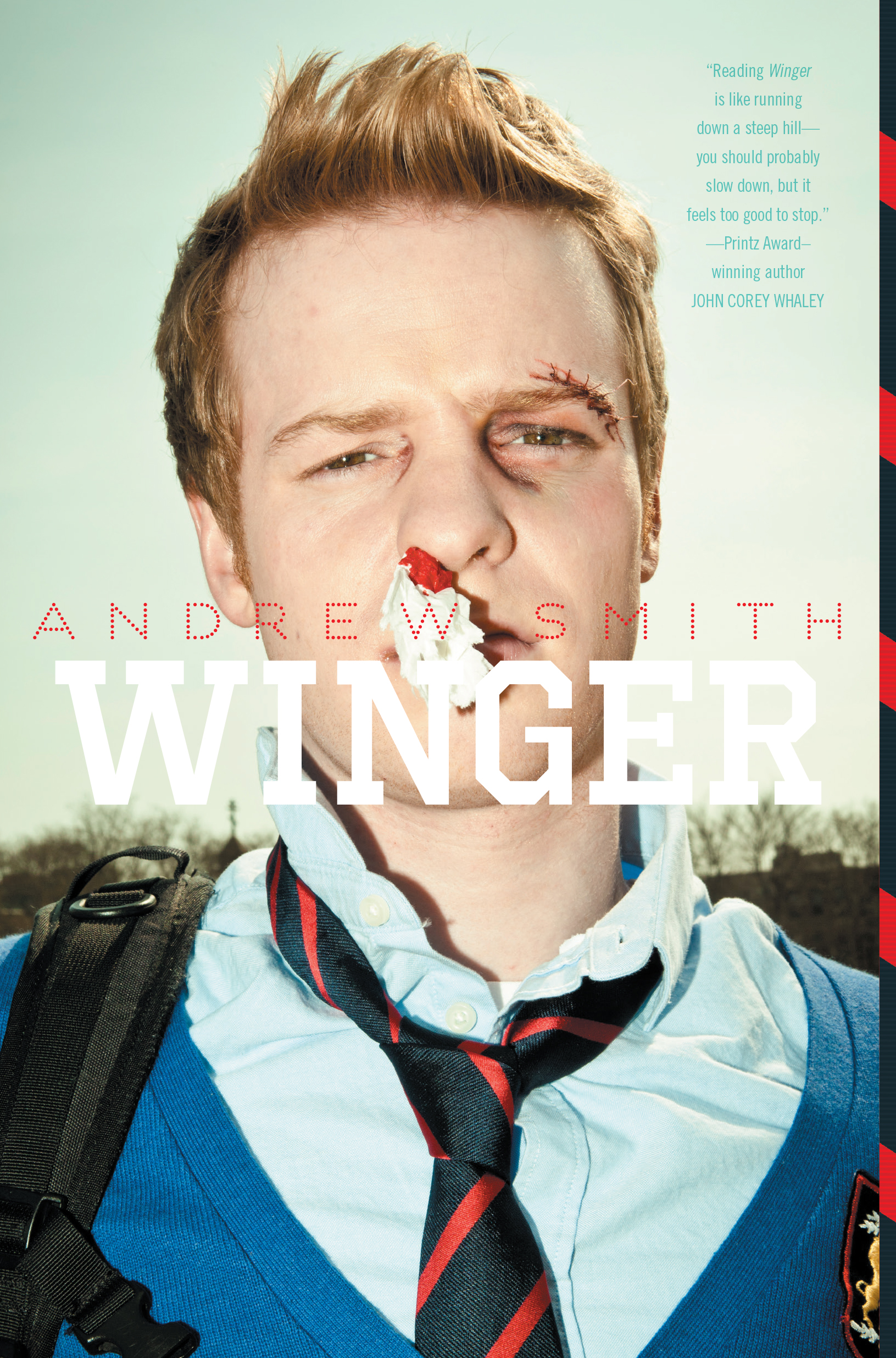
'Winger' by Andrew Smith

Smith, Andrew. Winger. New York: Simon and  Schuster, 2013. Print.
Photo by: Simon and Schuster

If you read the blurb on the back of the book that summarizes Winger, a few thoughts might run through your head.  It describes Ryan Dean West, a fourteen year-old junior at Pine Mountain, an exclusive boarding school in the Cascade Mountains of Oregon.  A few of the thoughts that went through my head were: #poorlittlerichboy and #firstworldproblems.

Ryan Dean (yes, that's his first name) doesn't mind attending Pine Mountain.  He doesn't have the best relationship with his parents to begin with, and his father is a politician in Boston.  Ryan Dean is a bit precocious and, as Pine Mountain is in a remote location, it effectively removes any chance of scandal back home.  Before you get the idea that Pine Mountain is a refuge for poor little rich kids, here are a few of their rules: no cell phones, no iPods, uniforms -- at all times, and all the students are required to participate in at least one sport.  Oh, and there's existence of Opportunity Hall, the dorm for "troublemakers".  Opportunity Hall, or O-Hall, is no picnic.  There are no locks on the doors, the shower curtains in the boys' bathroom are on the grungy side, and scary Mrs. Singer oversees the vacant girls' floor of O-Hall.

Ryan Dean has been assigned to live in O-Hall because of an incident the previous school year, and his roommate is none other than Chas Becker, a large, menacing senior, who Ryan Dean is convinced wants to kill him.  The book follows Ryan Dean and his exploits over the first few months of the school year at Pine Mountain.  Ryan Dean tries to not rouse the ire of Chas, fit in with the much older boys in O-Hall, keep his position on the varsity rugby team, and get his best friend Annie to admit she's mad about him.

Smith writes the book from the point-of-view of Ryan Dean, so we're privy to all his inner thoughts about girls, his classes, rugby, girls, the inhabitants of O-Hall, girls...  Smith captures Ryan Dean in all his adolescent glory.  His inner voice can be quite profane, but Ryan Dean is a sweet kid at heart, who can recognize his mistakes.  Ryan Dean is a wonderfully complex character, who struggles to find his niche at Pine Mountain.  He's too mature for the other fourteen year-olds, but still a kid in many ways to his classmates in the eleventh grade.  Ryan Dean has a wry, amusing take on life, perhaps especially when life decides to make situations as humiliating to Ryan Dean as possible.

Other characters are less well-drawn, especially the girls.  At first glance, it's possible that Smith ventured into Mary Sue territory, because all the girls are, in Ryan Dean's word, "hot".  Two girls in particular, Annie and Megan, are almost too perfect so that it hurts to look at them.  On further reflection, perhaps it's because we're looking at them through Ryan Dean's eyes, so of course they are presented in the burnished glow of Ryan Dean's admiration.  Chas is a grunting, seething, looming presence in the book.  Nick and Casey, two of the other boys in O-Hall, are painted as stereotypical aggressive jocks.  One of the characters that has the potential to be as complex and interesting as Ryan Dean is Joey Cosentino, who is a stereotype-defying gay teen, often serving as the voice of Ryan Dean's conscience.  Joey gently guides Ryan Dean into being a better man, while Ryan Dean wholeheartedly accepts Joey as one of his best friends.

Ryan Dean is an artist, so the book is littered with his illustrations that depict his rich imagination or his current state of mind as presented in various graphs.  The overall tone is endearing, engaging, and often hilarious.  There is a dark turn toward the end of the book, and Smith cuts things short with that event.  There is a sequel, Stand-Off, that should be published next fall.  Hopefully, Smith will let us see how Ryan Dean has coped with the events that marked the end of Winger.  

To borrow a phrase from Ryan Dean, I give Winger a four-out-of-five-chicken-potpies-on-the-Lisa-scale-of-you-should-read-this.  It makes a welcome departure from the glut of vampire and dystopian novels cluttering the YA shelves.