Showing posts with label science-fiction. Show all posts

Sunday, June 18, 2017

'Scythe' by Neal Shusterman

Imagine a world where humanity has conquered death.  There's no more disease, hunger, poverty, ageing, or death by accident.  Sounds really neat, right?

Image from:
simonandschuster.ca
Until you consider there's also no pain.  Or joy.  Or any intense feelings.  People sort of drift along in life, "turning the corner" (resetting to a younger physical age) every so often, marrying and remarrying.  Just living their lives.  The only possible wrinkle in someone's life is when a Scythe drops by.

If a Scythe shows up in your home, school, or office, it usually means someone is going to die. You see,  a Scythe is tasked with "gleaning" -- killing -- people, in order to keep the population under control.

Every so often, a Scythe takes on an apprentice, in order to teach them the ways of being a Scythe and how to glean according to their moral codes.  One just doesn't take a life indiscriminately.  There's a method to the madness.  Honorable Scythe Faraday raises more than a few eyebrows when he takes in two apprentices.  Usually a Scythe only takes one apprentice.  For the next year, Citra Terranova and Rowan Damisch will endure training in the physically and mentally demanding art, science, and philosophy of ending another person's life.   Whichever one of the two succeeds in passing a test at the end of the year will become a new Scythe.  The other will go home.

At least that's the way it's supposed to work.  Until Scythe Goddard  proposes a resolution at one of the Scythes' conclaves that the successful apprentice must glean the unsuccessful one.  This sets the rest of the book careening toward it's suspenseful conclusion.

Neal Shusterman never ceases to impress me with his world building.  At first glance, this is a perfect world, until Shusterman reveals, the levels of corruption roiling under the perfect surface. Everything Shusterman creates -- from nanites that heal every injury and cure diseases to the Thunderhead, which has evolved from the Cloud (thanks, Apple!) into a benign, omniscient presence that governs society -- are just within the realm of possible, so you aren't grappling with the science of science fiction and are able to dive into the knotty philosophical questions that come with being a Scythe: is there room for compassion; why can't a Scythe feel that being a Scythe is a calling; and is it possible to enjoy one's job as a Scythe?

Even though the laws of Scythedom are presented as a absolute, the laws and rules of Scythes, like everything, are open to interpretation, which is where a lot of the conflict arises.  And to throw another wrench into the plot, Scythes aren't subject to the laws that govern the rest of society and only live by ten ironclad commandments.  They even live outside the realm of the all-knowing and all-seeing Thunderhead.

The book is heavy on intrigue, but (thankfully!) light on romance.  Which makes sense, because Scythes, rather like Jedi, aren't supposed to have emotional attachments to other people.  Shusterman also throws in bits of subtle humor to keep the book from being weighed down by all the intrigue, training, and philosophy.  For example, when one new Scythe chooses their Patron Historic -- the name they will use as a Scythe taken from significant people in history that have special meaning to the new Scythe -- he chooses to be known as Scythe Colbert.  I snorted with laughter, and I'm sure Stephen Colbert appreciates the shout-out.  That being said, the humor is more likely to make the corner of your mouth curl up, rather than laugh out loud.

Structurally, the book goes back and forth between  Citra, Rowan, Faraday, Scythe Curie, and other characters.  Each chapter opens with an excerpt from the diary of a Scythe, usually Scythe Curie, known as the Grand Dame of Death.  It's fascinating to see the different points-of-view of Scythdom and how different Scythes interpret their moral codes.

Given that most of the book's narration comes from Rowan or Citra, I found Rowan to be much more multi-layered than Citra.  Perhaps that comes from how Shusterman portrays Rowan as both repelled by the idea of gleaning, and yet, his sense of compassion inexplicably draws him to it.  Citra, on the other hand, despises the idea of becoming a Scythe.  Her struggles have less to do with becoming a Scythe, and more from her determination to do it "right." 

This book drew me in so subtly and cleverly, that I didn't even realize I hadn't been able to put it down until I finished it.

Scythe so impressed the Printz committee, that they gave it an honor, even though their habit is to not award the first book in a series.  It more than deserves its 2017 Printz Honor.

If you're looking for something that draws you in and doesn't let go, this is a book for you.

Scythe is the first of Shusterman's Arc of the Scythe series.  Mark your calendars, y'all: the second book in the planned trilogy, Thunderhead, is set to release on March 6, 2018. (Edit: Amazon says February 6, 2018!)

If you want to explore other books by Shusterman, read his National Book Award winning Challenger Deep, or the Unwind series.


Monday, June 30, 2014

'Uglies' by Scott Westerfeld

Westerfeld, Scott. Uglies. New York: Simon Pulse, 2005. Print.
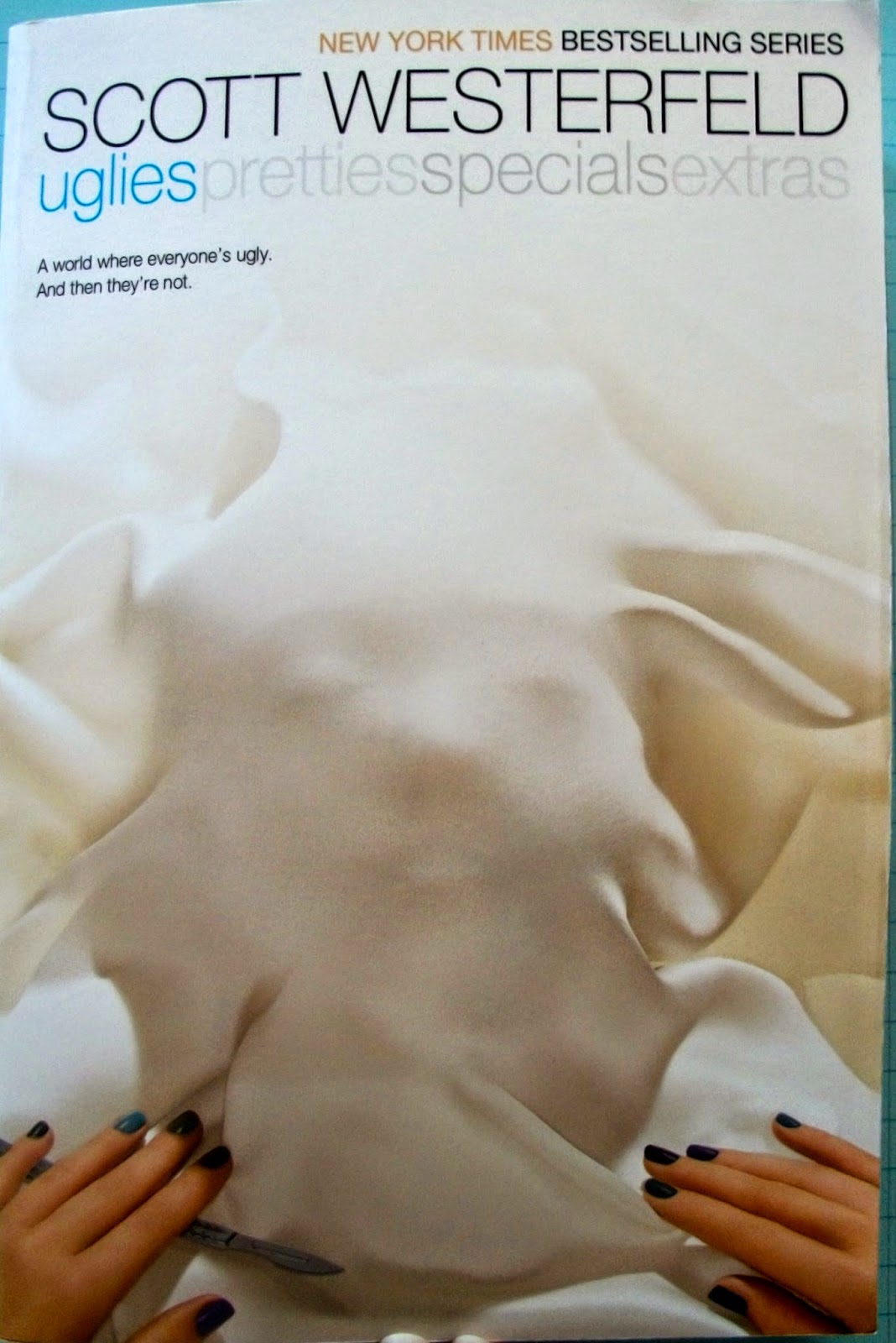
Photo by: L. Propes
If your image of a dystopian novel or film conjures up images of Blade Runner -- grimy, crumbling cities -- Uglies is quite a departure from the stereotypical dystopia.  Set in a distant future where hoverboards are a thing of reality and the cities run solely on solar power, Uglies is the first in a series of four novels that examine the perceptions of beauty, government control, and the role of the individual in society.

Tally lives in Uglyville, the area of the city where all teenagers live from the age of 12 until their 16th birthday, whereupon they will be taken to the hospital and undergo a brutal surgery that will not only make them "pretty", but radically change their bodies.  (The descriptions of the surgery are not for the faint of heart.  It's not terribly graphic, but if watching old episodes of ER make you squeamish, you might want to skim those lines in the book.)  Tally's best friend Peris had the surgery on his birthday, three months ago and now lives in New Pretty Town, a glittering community where the new Pretties live after their surgery.  Tally misses Peris, and sneaks into New Pretty Town to see him.  Needless to say, she isn't supposed to be there.  Tally manages to leave without being caught by the authorities for being out of bounds and runs into Shay, another Ugly waiting to become Pretty.  Shay is different from Tally: she is content with her looks, isn't waiting with bated breath to become a Pretty, and has plans to run away to a mystical place called the Smoke where people can choose to keep their original face and maintain control over their lives.

When Shay runs away just days before her 16th birthday, the consequences fall hard on Tally, who is brought into Special Circumstances where the sinister Dr. Cable offers her an ultimatum: find the Smoke and lead Special Circumstances to its location, or stay an Ugly forever.  To Tally, who has dreamed of nothing more than becoming a Pretty, this is a fate almost worse than death.  Tally manages to reach the Smoke where she discovers life in New Pretty Town isn't all it's cracked up to be.

In this novel, Westerfeld's gifts lie in the descriptions of the landscapes and the character's actions.  From the beginning, with the portrayal of life in New Pretty Town signals that this isn't your run-of-the-mill dystopia.  As the heroine, Tally isn't necessarily dissatisfied with her life.  She never contemplates leaving the city until forced to do so by the Special Circumstances.  Tally isn't going to rebel against the government initially, because to her, she has nothing about which to be rebellious.  The small details of government intrusion are part and parcel of her existence.  It doesn't occur to Tally to even consider the constant tracking of her person and activities might have a more ominous purpose other than safety.  Nor does it occur to Tally to question the need to make all the residents of the city uniformly beautiful.  At least not until she lands in the Smoke and encounters David, who was born in the Smoke and shows Tally there's another way to live life and gain satisfaction from it.  Unfortunately, as a character, Tally is somewhat passive.  She rarely acts on her own, unless someone forces her hand.  This isn't to say she isn't intelligent. She is.  Shay leaves Tally a cryptic message with directions to the Smoke that Tally successfully and easily interprets, and when presented with pieces of information, Tally can easily connect the dots and come to her own conclusions about things.

The setting in Uglies is one of the most well-done aspects of the book.  It's not too terribly difficult to picture towering houses that seem lighter than air, filled with shrieking, pretty teenagers.  The glimpse we see of life in New Pretty Town resembles a university fraternity straight out of Hollywood, in a never-ending cycle of fancy dress and formal parties.  It's also not hard to see the remains of the Rusty Ruins or the settlement at the Smoke, due to Westerfeld's vivid descriptions.

Other ways in which the setting provides the structure for another underlying theme of the novel are the Rusty Ruins and a field of genetically modified snow-white orchids.  The Rusty Ruins were once a major city, its inhabitants killed and structures left to moulder as a reminder of how ecologically destructive people used to be.  The explanation is that someone created a bacteria to infect petroleum, which would then render it unstable.  The petroleum (and its products) "exploded on contact with oxygen.  The spores were released on the smoke, and spread on the wind" (Westerfeld 329).  Society and life as the Rusties knew it was gone.  The orchids were a valuable flower, whose bulbs recall the tulip mania of seventeenth century Holland.  They were so valuable that someone tinkered with their genetic structure to make them adapt to various growing conditions.  The result is that the orchids are now a noxious weed that chokes out any other life form turning the area into a biological wasteland.

Finally, there's the reason why the people in the city undergo such extensive plastic surgery: "A million years of evolution had made it part of the human brain.  The big eyes and lips said: I'm young and vulnerable, I can't hurt you, and you want to protect me.  And the rest said: I'm healthy, I won't make you sick... It was biology, they said at school. Like your heart beating, you couldn't help believing all these things, not when you saw a face like this.  A pretty face" (Westerfeld 16).   There are echoes of Ray Bradbury's Fahrenheit 451 in Westerfeld's Pretty culture.  In Fahrenheit 451, books are banned so as not to upset people by the ideas in them.  In Uglies, "everyone is happy, because everyone looks the same: They're all pretty" (Westerfeld 254).  One of the clever bits is how the government succeeds in convincing every child that they are indeed Ugly.  They've been conditioned from birth to think they are ugly ducklings just waiting to become a swan when they turn 16.  Furthermore, they're taught in school that "Everyone judged everyone else based on their appearance.  People who were taller got better jobs, and people even voted for some politicians just because they weren't quite as ugly as everybody else... people killed one another over stuff like having different skin color... So what if people look more alike now? It's the only way to make people equal" (Westerfeld 43).  The government also does something to their brains during the initial plastic surgery to make the people seem "sure of themselves... confident, and at the same time disconnected from... ugly real-life problems" (Westerfeld 258).  It turns the teenagers into docile, contented people, who reinforce the status quo.  Jennifer Mattson's review in School Library Journal calls it an "eerily harmonious... society" (1287).

Westerfeld has also carefully appropriated technology from films, like the hoverboards from Back to the Future II, and added his own touches, like the crash bracelets Tally wears to keep from falling to the ground if she falls off her hoverboard or bungee jackets that mimic the experience of bungee jumping, but are used as a safety device in case of a fire.  Westerfeld doesn't allow the technology to overshadow the story, and it doesn't veer out of the realm of impossibility.  The hoverboards use a magnetic system that utilizes the metals in the earth and water.  It grounds the plot in a foreseeable future.  She can even control her wall screen (think really massive computer monitor) with eye blinks.

The characterizations are somewhat stereotypical.  Tally as the young adult who leaves home in search of something (Nilsen et al. 348).  David, the native Smokie, has the advantage of having grown up independent of the city, yet his parents are refugees from the city.  He's been taught everything Tally and Shay have, but his knowledge is heavily peppered with a dose of reality, not what the city wants him to believe.  Shay is the Friend archetype, whose actions ultimately propel Tally into action (Nilsen et al. 348).  David's parents, Maddy and Az, can be classified as Sages (Nilsen et al. 348).  It's their story that allows the puzzle pieces to fall together in Tally's mind.  The novel's main weakness to me is that the characters never quite rise above their archetypes and develop into complex characters.  This could change as the series continues.

The novel weighs in at just over 400 pages, which is not an insignificant amount to some readers.  Westerfeld keeps the pace up through his animated depictions of the action.  The book isn't very dialog-heavy, and the pace of the book rests on the action sequences.  I'd like to note here that when I say action, I don't mean it reads like an Indiana Jones movie.  It's the descriptions of Tally's life, what Shay and Tally do before Shay runs away, and Tally's journey to the Smoke that make up the action that keeps the book moving along briskly.  It does lag a bit in places, especially when Tally and Shay make repeated references to the selfish silliness that caused the destruction of the Rusties.  Westerfeld's ecological message becomes blunted after hearing yet again how dumb the Rusties were.

One thing that is interesting in the book is that today's fashion models are not considered the epitome of beauty in Tally's age.  Quite the contrary.  In a poignant scene after Tally arrives at the Smoke, Shay shows her magazines from our time, full of what we consider "pretty", or rather what the media tells us is pretty.  They're amazed at how thin these women are, how unhealthy they look.  This scene is a pointed jab at conventional ideas of beauty and leads a reader to question if someone like Nicole Kidman would be considered unhealthily thin, just what is the city's idea of perfect beauty and proportion?

The two overarching themes of ecological damage and standards of beauty seem to be fighting one another for supremacy in the novel.  Hopefully Westerfeld can link them together in the later books.  Seeing as how this is the first of four novels, there's a lot of exposition in this novel that hopefully lays a good foundation for the other three.

Teachers can use Uglies one of two ways.  They can use it to discuss body image and the definition of beauty and how it changes from culture to culture, and even from era to era.  Teachers can also use it as part of a unit on ecology and the environment.  Laura McConnell, a middle school librarian, uses the Uglies series in a display about environmental issues, pairing the books with non-fiction titles about renewable energy (School Librarian's Workshop 12).

Westerfeld's other novels include: the rest of the Uglies series -- Pretties, Specials, Extras; the Leviathan series --  Leviathan, Behemoth, and Goliath; the Midnighters series -- The Secret Hour, Touching Darkness, and Blue Noon.  Uglies was also turned into a graphic novel, but presented from Shay's point-of-view called Uglies: Shay's Story.

You can visit Westerfeld's webpage.  It has a schedule of his upcoming events, book trailers and discussion questions.

***********************************************

Works Cited
"Ideas on Display." School Librarian's Workshop 29.6 (2009): 12-. Education Source. Web. 27 June 2014.
Mattson, Jennifer. "Uglies (Book)." Booklist 101.14 (2005): 1287-. Education Source. Web. 27 June 2014.
Nilsen, Alleen Pace, et al. Literature for Today's Young Adults. Boston: Pearson, 2013. Print.
Westerfeld, Scott. Uglies. New York: Simon Pulse, 2005. Print.


Sunday, April 13, 2014

'When You Reach Me' by Rebecca Stead

Stead, Rebecca. (2009). When You Reach Me. New York: Yearling.  ISBN: 9780375850868 (pbk)

Photo by: L. Propes
They say a single butterfly flapping its wings in China can set off events thousands of miles away on the other side of the globe.  In science fiction, there is often a single moment in time -- the flapping of a butterfly's wings, so to speak -- that can change the future, and not always for the better.  Time travel is an oft-used trope in science fiction.  Whether it's the slingshot around the sun employed by Gene Roddenberry's Star Trek, Dr. Sam Beckett and his Project Quantum Leap, a British telephone box inhabited by a Time Lord, or a tiny, magical hourglass in Harry Potter, time travel is often used as a way to re-set history or find that tiny moment in time where a single action can send a person's future down one road or another.

Rebecca Stead's When You Reach Me is a novel that involves a character who eventually figures out how to manipulate time and space, written in a low fantasy style.  While the concept of time travel forms the underlying plot of the novel, it is primarily a coming-of-age story about Miranda, who lives in New York City with her mother in the late 1970s.  Miranda lives a relatively normal life.  She has her best and oldest friend, Sal.  Things have an order and logic that Miranda finds comforting.  Everything changes the day Marcus punches her friend Sal in the stomach for no particular reason.

As the novel progresses, Miranda makes some new friends in Annemarie and Colin, discovers why Sal has been avoiding her since the incident with Marcus, helps her mother prepare to appear on the television show The $20,000 Pyramid, uncovers the identity of the crazy man that lives on the street corner near her apartment, and learns that things -- and people -- are not always the what they seem.  She even discovers common ground with the girl she dislikes.  Miranda also begins to understand that  that material possessions do not necessarily translate into parental love and affection.

The novel's structure revolves around a letter Miranda is supposed to write to an unnamed person, describing the events of the past several months.  She starts forming the letter in her head, reexamining what has happened to her in the light of a recent revelation, but insists she isn't going to write the letter, until she realizes who asked her to write the letter and why.  The action shifts smoothly from Miranda's present, while she drafts the letter, to the previous months.  Stead's writing effectively mimics the way a person's mind can switch to a new topic at the mention of a specific person or event.  The entire book becomes the process by which Miranda writes the letter and comes to the decision to give it to the right person, as she connects seemingly unrelated events to one another that pinpoint the recipient of the letter.  Stead gives the reader a delayed climax.  What you think might be the climax is only the beginning of the actual climax, which occurs near the end of the novel.

Stead's novel is populated by a cast of characters from the sullen and misunderstood Marcus to the privileged Annemarie and Julia to the patient and tolerant Richard.  The audience sees them through Miranda's eyes, so we see them from the perspective of a twelve year-old girl, discovering who the characters are, beyond their first impression, as Miranda does.  The characters are appropriate for their age and time period.  The children are just reaching an age where they want to test their boundaries, and Stead perfectly captures Miranda's voice as she explores her new-found maturity.  The characters are complex, often tossing off flippant remarks without a thought for the consequences.  Their actions come back to haunt them, and Stead shows them dealing with the ramifications in a realistic manner.  This allows the characters to grow and adapt as their situations change.  The children behave like typical young adolescents.  In one particularly poignant moment,  as Miranda prepares for her new friend Annemarie to come for a sleepover, Miranda's new-found shame at the bedraggled state of the apartment she shares with her mother in relation to the luxurious environment of Annemaries' radiates painfully from the page.

The setting is late 1970s New York, and Stead gives it the tiny details that evoke the era.  The deli where Miranda, Annemarie, and Colin spend their lunch hours, streakers, the odd crazy person on the street corner, and the expressions the children and adults use in their day-to-day lives, capture the image of the 1970s.  The descriptions of Miranda's mother's clothing and hair, and the pervasive presence of shag carpeting also help complete the mental picture of the era.  Younger readers might find themselves amazed at the amount of freedom Miranda and her classmates have to leave campus for lunch and wander unsupervised about the city without so much as a mobile phone on their pocket.

Stead's theory of time travel, as presented in the book, isn't terribly difficult to understand.  Some might have to re-read the theory, as presented by Marcus and Julia a few times, but the visuals Stead uses to illustrate the theory explain it well.  Stead keeps the time-travel element to a minimum, making the book more about  Miranda and how she wrestles with the decision whether or not to write the letter to the mystery person.

Overall, the book begins a bit slowly, but the pace soon picks up and the book races to its conclusion.

The Junior Library Guild has a study guide teachers can use with their classes while reading  When You Reach Me.  It includes cross-curricular lessons, like why the Miranda warning is so important that Miranda's mother named her for it.  Random House also provides a study guide, with several cross-curricular ideas teachers can use.  Teachers can use When You Reach Me as a way to discuss social activism, city planning, the theory of relativity, or as an introduction to Madeline L'Engle's A Wrinkle in Time.

Students might also want to read Stead's other novels: Liar and Spy and First Light.  When You Reach Me won the 2010 Newberry Award, in an interesting parallel with A Wrinkle in Time, which also won the Newberry Award in 1963.  So much of this novel was influenced by A Wrinkle in Time, that students might also want to read it, and the other novels of the Time Quintet: A Wind in the Door, Many Waters, A Swiftly Tilting Planet, and An Acceptable Time.

_________________________________________________________________________________
"Rebecca Stead brilliantly weaves details of setting from memories of her own teen years on the Upper West Side, including a strange individual and her mom's appearance with Dick Clark on The $20,000 Pyramid.  The story's science fiction aspect will not become readily apparent until almost the very end, but it is crucial to the plot.  Reading A Wrinkle in Time is not necessary in order to enjoy the book, but it does make it more fun." -- James Blasingame, Journal of Adolescent & Adult Literacy, 2011
"The first indication that this book is going to get deeply, seductively weird is when broody classmate Marcus engages the heroine, Miranda, in a discussion about a flaw in the logic of A Wrinkle in Time...  Miranda's life is an ordinary round of family and school...  But when her best friend is bizarrely punched by another boy on the street, and when she starts receiving anonymous notes that seem to foretell the future, it's clear that all is not as it seems...  Closing revelations are startling and satisfying but quietly made, their reverberations giving plenty of impetus for the reader to back to the beginning and catch what was missed." -- Roger Sutton, Horn Book Magazine, 2009
"Miranda experiences a lot in sixth grade.  She loses her best friend, her mom goes on a game show, she learns there is a dentist's office inside her school, and she enjoys her first job.  Stead has written a story about a typical 12-year-old girl; although... there is some compelling mystery the reader is hard-pressed to discover.  The best parts of the story are the characters.  There is Miranda herself who is thoughtful and smart, but she doesn't think much of it.  Marcus is a troubled boy but no one really seems to know him.  There are best friends Julia and Annemarie, but their friendship is put to a serious test when Julia acts snobby once too often.  And, there is the mysterious writer of the notes Miranda keep finding... The topics are interesting, and the short chapters keep the pace flowing quickly." -- Shelly Glantz, Library Media Connection, 2009
"Stead's novel is as much about character as story. Miranda's voice rings true with its faltering attempts at maturity and observation. The story builds slowly, emerging naturally from a sturdy premise. As Miranda reminisces, the time sequencing is somewhat challenging, but in an intriguing way. The setting is consistently strong. The stores and even the streets-in Miranda's neighborhood act as physical entities and impact the plot in tangible ways." -- Caitlin Augusta, School Library Journal, 2009
_________________________________________________________________________________
References:

 Augusta, Caitlin. 2009. When you reach me. School Library Journal 55 (7) (07): 93-, http://ezproxy.twu.edu:2048/login?url=http://ezproxy.twu.edu:2060/login.aspx?direct=true&db=a9h&AN=43415849&site=ehost-live&scope=site.


Blasingame, James. 2011. When you reach me. Journal of Adolescent & Adult Literacy 54 (6) (03): 461-4, http://ezproxy.twu.edu:2048/login?url=http://ezproxy.twu.edu:2060/login.aspx?direct=true&db=a9h&AN=59423911&site=ehost-live&scope=site.

Glantz, Shelley. 2009. When you reach me. Library Media Connection 28 (2) (10): 74-, http://ezproxy.twu.edu:2048/login?url=http://ezproxy.twu.edu:2060/login.aspx?direct=true&db=a9h&AN=44773789&site=ehost-live&scope=site.