Tuesday, June 17, 2014

'Monster' by Walter Dean Myers, Illustrated by Christopher Myers

Myers, Walter Dean. Monster. Illus. Christopher Myers.  New York: HarperTeen, 1999.


There is a mirror over the steel sink in my cell.  It’s six inches high, and scratched with the names of some guys who were here before me.   When I look into the small rectangle, I see a face looking back at me but I don’t recognize it.  It doesn’t look like me.  I couldn’t have changed that much in a few months.  I wonder if I will look like myself when the trial is over (Myers 1-2).

This is our first introduction to Steve Harmon, a sixteen year-old boy on trial for murder in New York City.  Walter Dean Myers’ acclaimed novel, Monster, follows Steve through his trial, where he wrestles with the question of whether or not he is, as labeled by the prosecuting attorney, a monster.  At first glance, it seems as if Steve was in the wrong place at the wrong time, but flashbacks interspersed through the trial testimony, reveal small details that aren’t discussed in the trial, nor in the journal Steve keeps during the trial, a journal his lawyer admonishes him “not to write anything in… that [he does] not want the prosecutor to see” (Myers 137).  The small disparities between the journal entries and the testimony call into question Steve’s declared innocence and leads the reader to ponder the question: is he truly innocent of the crime or guilty?

Monster, the winner of the inaugural Printz Award, is a searing indictment of the justice system, the prison system, and the social structure that “links the credibility of males to displays and postures of toughness, physical strength, and the threat or use of violence” (Earp and Katz qtd. in Groenke, Maples, and Henderson 34).  The novel also questions the morality many of the prisoners employ in their ability to “separate themselves from their acts that permitted them to commit those acts in the first place” (Goodson 28).  Myers noticed a common thread in the stories he heard from various prisoners he interviewed as part of the research for Monster.  In an interview with Lori Atkins Goodson, he states,

I was shocked to find out how many of the inmates whose stories I was hearing were surprised to find themselves in prison… They uniformly thought of themselves as good people who had made some mistake, which had taken them afoul of the law… It was a common occurrence to find an interviewee speaking of himself… in the first person when talking about their upbringing, and then switching to the third person when speaking of the crime of which they had been convicted (28).

Myers states that it was this disconnect from their actions that formed the backbone of Monster  (Goodson 28).  Myers writes the novel as a hybrid of Steve’s journal entries and a screenplay that Steve also writes as the trial progresses. (Steve also happens to attend a magnet school where he studies filmmaking.)  The different formats represent Steve’s ability to separate himself from the scene of the crime.  The journal is written in first person, but the screenplay places Steve firmly in the third person, although it shows, in Steve’s words, his experience of the trial (Myers 4).  As Steve is the director, screenwriter, and star of his movie, he is able to shape the audience’s perception of the other members of his “cast” though the use of stage directions and camera angles or descriptions of the other cast members that focus on details, like Osvaldo’s gang tattoos (Schneider 20).    

This disconnect is also evident in the testimony of the witnesses called by the prosecution.  Many of them have been accused of crimes themselves, but have finagled a deal with the prosecution to exchange their testimony for a lighter sentence or a plea deal.  It is not always clear whether or not the witnesses are actually telling the truth, other than their testimony that claims they are.  The witnesses exemplify a central tenant of the novel: how do we know when someone is telling the truth?  Furthermore, the witnesses could very well be truthful, but their status as an inmate colors the reader’s (and jury’s) perceptions of their testimony.  Osvaldo, one of the prosecution’s witnesses, is timid and in fear of his life on the stand, but Steve’s flashback of an encounter with Osvaldo reveals a very different persona, one that scoffs at Steve for his reluctance to engage in the kind of lifestyle accepted by the other males in the neighborhood and has a confrontational attitude.

One of the other themes of the novel centers on the idea that all young men of color are the same in the eyes of a jury.  Kathy O’Brien, Steve’s lawyer, spends much of the trial attempting to make the jury see Steve as separate from his co-defendant, James King.  It is a task made more difficult by the fact that both Steve and James are African-American and “look like most of the other prisoners in the jail, so how is the jury to tell that he is any different from the unsavory witnesses and other defendants?” (Schneider 20). Steve even notes in more than one instance that his own lawyer is unsure of his guilt or innocence, perhaps subconsciously grouping Steve with James because of Steve’s race and a belief that a person will say or do anything to avoid a lengthy jail sentence.   

Part of Steve's journal
Photo by: L. Propes
Susan Groenke and Melissa Youngquist classify Monster as a postmodern novel due to Myers’ use of the following characteristics of postmodern literature: identity in flux as a theme, genre eclecticism, interplay between word and image, and active readers (506-507).  Steve’s identity is never settled during the novel, and even at the end, he is not able to definitively answer who he really is (Groenke and Youngquist 506).  Groenke and Youngquist characterize Steve as in a constant struggle to “understand who he is as an African American male, a star student, and a loving son and brother in a society that tells him he can only be one of two things: a thug or a sellout” (506).  As discussed earlier, the novel employs multiple formats to expose the reader to Steve and his personality.  The epistolary sections provide a glimpse into Steve’s inner thoughts and feelings, revealing his terror at the thought of spending the next twenty years behind bars.  The rest of the text of the novel employs a conventional screenplay format that serves to distance Steve in the journal from the Steve in the trial.  Flashbacks that show Steve in scenes with his family, James King (the other person on trial), and other people from his neighborhood provide a level of ambiguity that contributes to the questions of Steve’s innocence.  Christopher Myers’ illustrations show photographs of Steve in various places: the prison, the drugstore (presumably the day of the robbery and murder), and even a courtroom drawing of Steve and his attorney when his verdict is read.  The photographs, which are paired with relevant text, also aim to create an image of Steve that leads the reader to further question Steve’s motives and innocence (Groenke and Youngquist 507).  All of these elements combine together to force the reader to “fill in the gaps and pull together discrete parts or narrative strands” in order to come to a conclusion about Steve (Groenke and Youngquist 507). 

A page of screenplay format
Photo by: L. Propes
Myers comments in an essay at the end of the novel, “kids don’t think about things until after they happen… That’s typical of kids -- you do things first, then you think about it.  By the time you think about it, you’re in big trouble. I think the problem with so many young people is that violence gets to be a resource.  When nothing else works for you, violence always does, and you’re always drawn to it” (292).  Those fingerprints, so to speak, are all over Monster.  Steve does something (although it’s left ambiguous in the novel just what he does) that implicates him in the robbery and murder, but doesn’t think about the ramifications of where he was at that specific moment until well after the event and he’s sitting in jail.  At the end of the novel, Steve is still examining his actions.  The other characters -- Osvaldo, James, Bobo, and the other inmates in the prison -- personify the second part of Myers’ statement.  They have grown so accustomed to committing acts of violence and getting what they want out of it, that it’s become their go-to method of coping with life.  Steve comments on the level of violence within the prison in his journal: “Violence in here is always happening or just about ready to happen.  I think these guys like it -- they want it to be normal because that’s what they’re used to dealing with” (Myers 144). 

One of Christopher Myers'
illustrations
Photo by: L. Propes
Monster is an interesting novel that presents “kids that were not ‘good’, ‘smart’, and growing up in the perfect home” (Blumenstetter 39).  It gives students, especially minority students, a character who looks like them, their friends, or family members and shows a “world they live in every day” (Blumenstetter 39).  One level of difficulty students might have with it lies in the postmodern structure of the novel, as displayed in Groenke and Youngquist’s experience teaching Monster to a ninth-grade English class (508-510).  The novel is largely linear in its structure, but the flashbacks are not conspicuously set apart from the trial testimony, so it might be confusing to some readers to see an event that isn’t directly related to the trial in the middle of a trial. If students are not familiar with the structure of a screenplay or a script, they might have a bit of an adjustment period with the technical terminology Steve uses in the stage directions and camera angles.  There are small bits of dark humor scattered through Steve’s journal entries when the inmates discuss their cases.  One anecdote in particular exemplifies this in which a man who was charged with armed robbery, assault, and menacing, among other things, claims that because the jewelry store had an automatic locking system, he wasn’t able to actually steal anything and didn’t have a gun anyway, he shouldn’t be charged with a crime. The text is rich with bits and pieces like this that can instigate debate in a classroom apart from the main question of the novel.  Students who are fans of Law and Order marathons will probably love this book. 


Teachers who choose to offer Monster as either a whole-class reading or an option in a literature circle can have their students research statistics for the incarceration rates of minorities and the crimes for which they’ve been convicted.  They can also debate Steve’s guilt or innocence, using evidence gleaned from the novel.  Students can also present ideas to help students like Osvaldo before he becomes part of the system.  Some classes might need structured guidance to read this novel, given its unorthodox format. 

Monster not only won the Printz Award, it also won a Coretta Scott King honor and was a National Book Award finalist. 

If a teacher wants to compare the relative merits of the Printz winner and honor books from 2000, the honor books were: Speak by Laurie Halse Anderson, Skellig by David Almond, and Hard Love by Ellen Wittlinger. 

Myers is also the author of: Fallen Angels, Sunrise Over Fallujah, Scorpions, Slam!, Bad Boy, Autobiography Of My Dead Brother, Riot, and Darius & Twig, just to name a few.  For a complete list of his published works, please visit his website.  Myers is a prolific author of award-winning fiction and nonfiction.

 *******************************************

Works Cited
Blumenstetter, Kerri Gallagher. "Walter Dean Myers Writes for Inner-City Students." Social Science Docket 12.2 (2012): 39-40. Web. Education Research Complete. 16 June 2014.
Goodson, Lori Atkins. "Walter Dean Myers: A Monster of a Voice for Young Adults." The ALAN Review. 36.1 (2008): 26-31. Web. Free E-Journals. 16 June 2014.
Groenke, Susan L., Joellen Maples, and Jill Henderson. "Raising “Hot Topics” through Young Adult Literature." Voices from the Middle 17.4 (2010): 29-36. Web. National Council of Teachers of English (NCTE). 16 June 2014.
Groenke, Susan Lee, and Michelle Youngquist. "Are we Postmodern Yet? Reading Monster with 21st-Century Ninth Graders." Journal of Adolescent & Adult Literacy 54.7 (2011): 505-13. Web. Education Research Complete. 16 June 2014.
Myers, Walter Dean. Monster. Ills. Christopher Myers. New York: HarperTeen, 1999. Print.
Schneider, Dean. "The Novel as Screenplay: Monster and Riot by Walter Dean Myers." Book Links 19.2 (2010): 20-3. Web. Academic Search Complete. 16 June 2014.

Wednesday, June 11, 2014

'Forever...' by Judy Blume

Blume, Judy. Forever.  New York: Atheneum Books for Young Readers, 1975.

Photo by: L. Propes
“Sybil Davison has a genius I.Q. and has been laid by at least six different guys” (Blume 1).  As I read the first sentence, I felt my jaw drop slightly, and I furtively glanced at the lady sitting next to me on the flight from Calgary to Vancouver.  I joined legions of young adults engrossed by Blume’s “direct, straightforward fashion about the fears and frustrations associated with teenage sex” (Kaplan 26).  From the very first sentence, Judy Blume sets a decidedly frank and honest tone about teenagers and sex in her groundbreaking and controversial novel Forever.

Katherine Danzinger and Michael Wagner are both upper middle-class, college-bound, responsible teenagers, who meet at a New Year’s Eve party and feel an immediate attraction to one another.  They begin dating and embark on a thorough exploration of each other, which leads to sex in all its awkward teenage glory.  Katherine and Michael are in love with all the heightened passion of teenagers.  They swear their love for each other and vow it’s forever, even to the point of Katherine's desire to apply to the same colleges as Michael so they won’t be separated.  Katherine’s parents eventually demand she take a summer job as a tennis instructor at the arts camp that her younger sister Jamie attends.  This job becomes the catalyst that forces Katherine to examine just what the word “forever” really means and how she honestly feels about Michael.  Will forever last through the summer, or will it fade like the leaves when autumn comes and drift away?

Somehow, Forever never entered my teenaged reading orbit.  This was my first exposure to it beyond seeing it on the ALA’s most challenged book lists.  I had to double-check the copyright date, just to make remind myself it was, in fact, nearly forty years old.  Blume wrote the book in response to her daughter’s wish to see a book where a teenaged girl chooses to have sex and, in a revolutionary twist for the time, nothing bad happens to her (Sutton 26).  Elissa Gershowitz calls Forever “divisive, with some people seeing it as pornographic trash, and others… viewing it as worthy, groundbreaking young adult fiction” (87).  Divisive puts it mildly.  Forever has been on the ALA’s 100 Most Challenged Books list for more than twenty years. 

Historically, novels where a teenaged female character chooses to have sex typically depicted the girl experiencing some sort of “punishment”, usually getting pregnant and being forced to marry the young man in question.  Forever was considered a radical shift from the usual fare for teenaged readers (Kurtz and Schuelke 229; Sullivan 461).   Katherine and Michael are not only shown enjoying sex with each other; there are no moral repercussions (Sullivan 461).  In Forever, “Blume’s… realism and matter-of-fact tone is a complete departure from disguising sexual activity in abstract prose or keeping it behind the scenes” (Sullivan 461).  Blume calls a spade a spade, so to speak, and doesn’t hide body parts behind cute euphemisms.  Blume doesn’t just deal with sex in an even-handed, unsentimental manner.  She treats many other topics, such as abortion and contraception with equal aplomb.  Blume writes Katherine’s visit to Planned Parenthood for a prescription for birth control pills with its subsequent pelvic exam in the same frank, matter-of-fact tone she uses for Katherine and Michael’s sexual activities, but still allows Katherine’s nervousness about the exam to come through the dialog.  The aforementioned Sybil even deliberately gets pregnant, but is able to conceal it due to her penchant for baggy, loose clothing, just for the experience, planning the entire time to put the baby up for adoption.  Sybil’s choice to have the baby is presented by Blume as just that: Sybil’s choice, with no sermonizing or blatant moralizing.  To present Forever as a “just-the-facts-ma’am” novel would be to do it a disservice and reduce it to a “how-to” novel.  Sex and birth control are presented factually, but Blume allows Katherine to examine her feelings about sex and love as the novel comes to its conclusion.

Katherine has a remarkable amount of agency.  In several instances, she refuses to have sex with Michael until she feels she’s mentally ready, not just physically.  When they do finally have sex, Katherine not only insists on condoms, but she also resolves to obtain an additional method of birth control.  Katherine’s family plays a large role in this.  Her mother is honest with Katherine about sex, and even reveals a little of her own sexual history.  She warns Katherine “sex is a commitment… once you’re there you can’t go back to holding hands” (Blume 84).  The conversations with Katherine and her mother allow Blume to briefly address the societal double standards regarding boys, girls, and sex: “good” girls wait until marriage, “bad” girls don’t, and boys are supposed to gain all the experience they can (37; 83).  Katherine’s mother dismisses the idea that a girl who chooses to have sex is inherently a bad person.  While she doesn’t give Katherine tacit permission to have sex, she doesn’t forbid it either (Blume 84).  She merely says, “I expect you to handle it with a sense of responsibility though… either way” (Blume 84).  Her grandmother sends Katherine Planned Parenthood pamphlets in the mail and initiates discussions about preventing unplanned pregnancies and sexually transmitted infections.  Katherine’s mother and grandmother exemplify the running theme of the novel: safe sex is a part of a healthy, committed relationship.

Overall, adults are largely absent in the novel, only playing a relatively minor role.  This is also probably one of the more idealized facets of the novel.  Michael’s own parents don’t even make an appearance until his graduation.  Rather than have Katherine “park”, Katherine’s parents encourage her to bring her “friends home than sit in a car somewhere” (Blume 19).  On trips and vacations with family or friends, the adults basically house the teenagers in separate areas of the house, seemingly with no rules or guidelines.  Katherine’s parents only voice their concerns about her relationship with Michael by wishing she wouldn’t confine herself to dating one boy. 

The title Forever embodies so many things: the heightened and halcyon emotions teenagers attach to the idea of love, the exaggerated concept of a set period of time lasting much longer than it does, and the idea that forever is attainable.  Katherine and Michael both experience this over the course of the novel, beginning when they declare to love one another forever.  While Katherine argues with her father about the summer job and he tells her it will only last seven weeks, Katherine retorts, “Seven weeks may not be a lot to you but to me it’s forever!” (Blume 152). 

The plot of the novel is somewhat thin, revolving around Michael and Katherine’s sexual exploits.  A subplot involving Katherine and Michael’s friends, Erica and Artie, and the questions of Artie’s sexuality is underdeveloped.  (Although an attentive reader will be able to guess by reading between the lines.)  Even the ramifications of Sybil’s pregnancy are largely unaddressed.  Blume herself has admitted that this isn’t her best work.  In an interview with School Library Journal, she said her comment to the Margaret A. Edwards Award committee when hearing that she was being presented the award based on Forever was, “Really? That’s not my best book” (Sutton 26). 

Stylistically, Blume writes the way she perceives people speak, full of ellipses, pauses, and interruptions (Sutton 27).  The book contains a lot of dialog, which makes the book read quickly, but at the same time, it can be a little difficult to keep track of which character is talking, especially without any kind of qualifier to identify the speaker.  One example is the following exchange between Katherine and a former classmate Tommy Aronson:

I picked up the extension in my parents’ bedroom and cleared my throat before I said, “Hello…”
“Katherine?”
“Yes?”
“This is Tommy Aronson… remember me?”
“I remember.”
“I’m home for the weekend.”
“The weekend’s just about over.”
“I’m not going back until tomorrow morning.”
“Have a nice trip.”
“I see you haven’t changed.”
“Have you?”
“Why don’t you come out with me tonight and decide for yourself?”
“Sorry… I can’t make it.”
“Oh, come on… I’ll behave.”
“It’s not that…”
“Then what?”
“I’m going with someone.”
“Oh… anyone I know?”
“No.”
“Well… in that case… what’s your girlfriend’s number?”
“I have a lot of girlfriends.”
“The little one… you know…”
“Erica?”
“That’s the one” (Blume 109-110).

Blume even uses Michael and Katherine’s letters during the summer to demonstrate the ebb and flow of their feelings for one another.  Their letters are long and detailed in the beginning of the summer, and gradually Katherine’s grow shorter and the gaps between them such that Michael feels the need to surprise her at the summer camp with a visit.  When Katherine’s words and actions say otherwise, the letters reveal a part of her that has begun to question whether or not her love for Michael is forever.  Katherine is the only character who undergoes any sort of character development, just by the act of examining her feelings and how they affect her relationship with Michael or anyone else.  Michael behaves as a typical seventeen year-old boy whose modus operandi is to have sex with his girlfriend.  Let me be clear -- in no way can Michael’s behavior be construed as taking advantage of Katherine, nor did he at any moment force her to do something against her will.  When Katherine asked or told him to stop, he did.  However, Michael employs a subtle manipulation, pushing the envelope just a little more each time (hands under her sweater one time, up her skirt the next, kissing minus several articles of clothing) until Katherine agrees to have sex.

Forever holds up remarkably well, despite its age.  With the exception of a few terms here and there (calling condoms “rubbers” and VD), there is very little that makes the novel sound dated.  The one scene that really dates the novel as a pre-AIDS era work is the scene in Planned Parenthood where the main concern is preventing pregnancy, not sexually transmitted diseases.  Blume mentions that people have felt the book ought to be banned because it doesn’t address this, but adds, “Forever is about people.  It is about feelings.  It is not a sex manual.  Does it mean we shouldn’t read… [it] because… [it] doesn’t address AIDS?  Just because the rules have changed?  You can’t do that” (Sutton 27).  Blume has since added an author’s note in later editions to address those concerns, emphasizing condom use and encouraging teenagers to contact Planned Parenthood for more detailed information. 

Jason Kurtz and Nicholle Schuelke theorize novels like Forever are an important part of teenage emotional development.  For them Forever “serve[s] as [a representation] of reality and provide opportunities for vicarious explorations of an emerging sexuality identity without necessarily participating in these ‘firsts’ in the real world… These vicarious experiences through realistic young adult fiction can empower them to consider the choices one must make” (229).  For this reason, I would suggest that Forever could be read as part of a class in human sexuality or a comprehensive sexual education class.  Students will be able to use Katherine and Michael as proxies in their discussions. 

Blume maintains a website where she addresses issues like censorship and writing. 

Judy Blume is the recipient of the 1996 Margaret A. Edwards Award.

Other books with a similar theme as Forever are: Doing It by Melvin Burgess, Anatomy of a Boyfriend by Daria Snadowsky, A Bad Boy Can Be Good for a Girl by Tonya Lee Stone, Nick and Norah’s Infinite Playlist by Rachel Cohn and David Levithan, Good Girls by Laura Ruby, and Story of a Girl by Sarah Zarr (Kurtz and Schuelke 230). 

---------------------------------------------------------------------------------------------------------

Works Cited
Blume, Judy. Forever. New York: Atheneum Books for Young Readers, 1975. Print.
Gershowitz, Elissa. "What Makes a Good "Bad" Book?" Horn Book Magazine 89.4 (2013): 84-90. Web. Academic Search Complete. 9 June 2014.
Kaplan, Jeffrey S. "Ted Hipple was Right! How I Broke the Rules and Lived Happily FOREVER and Ever!" The English Journal 83.5 (1994): 25-7. Web. JSTOR. 9 June 2014.
Kurtz, Jason, and Nicholle Schuelke. "Blume, Burgess, and Beyond." Voice of Youth Advocates 34.3 (2011): 228-30. Library & Information Science Source. Web. 9 June 2014.
Sullivan, Ed. "Going all the Way: First-Time Sexual Experiences of Teens in Fiction." Voice of Youth Advocates 26.6 (2004): 461-3. Web. Library & Information Science Source. 9 June 2014.
Sutton, Roger. "Forever . . . Yours: An Interview with Judy Blume." School Library Journal 42 (1996): 24-7. Web. Academic Search Complete. 9 June 2014.

Saturday, June 7, 2014

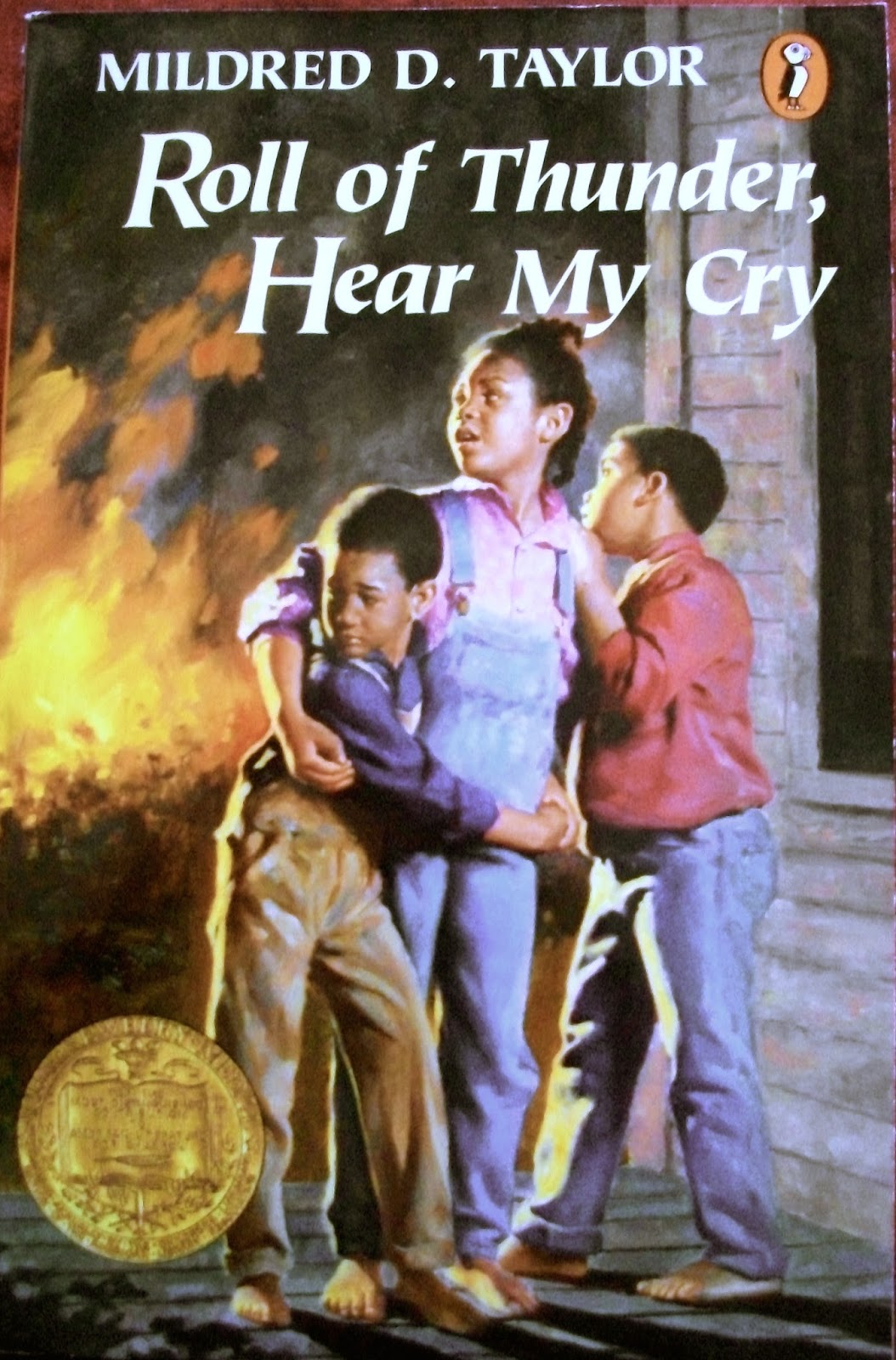
'Roll of Thunder, Hear My Cry' by Mildred Taylor

Taylor, Mildred.  Roll of Thunder, Hear My Cry. New York: Puffin Books, 1976.

Photo by: L. Propes
The first African slaves arrived on American shores in 1619 at Jamestown in the Virginia colony.  The consequences of slavery, Jim Crow laws, and the Civil Rights era still reverberate to this day.  Mildred Taylor's Roll of Thunder, Hear My Cry stands at the crossroads of the aftermath of the Civil War and Reconstruction and the Civil Rights movement of the 1960s.  Set in 1933-1934, the 1977 Newberry Award winning novel details the life of the Logan family, as seen through the eyes of nine-year-old Cassie.

Roll of Thunder, Hear My Cry begins as the four Logan children -- Stacey, Cassie, Christopher-John, and Little Man (Clayton Chester) -- are walking to school on the first day of the term.  From the beginning, Taylor uses her young protagonists to show the effects of segregation and the repressive laws and policies on African-American families in this community near Vicksburg.  Each new injustice slowly unfolds until the book climaxes with the arrest and attempted hanging of Stacey's friend T.J. for the murder of a store owner in the nearby town of Strawberry.  Taylor pulls no punches in showing the reader the rigidly segregated social structure.  The Logan children are forced to scramble out of the way of the school bus that takes the white children to their school while the driver barrels down the dirt road in a sadistic daily game of chicken.  The children in the school are given cast-off textbooks from the white school, which are not only tattered and out-of-date, but the condition of each book is noted in the front cover, along with the race of the recipient.  Little Man and Cassie object to the condition of the books and the fact they have received the books only because they're no longer useful to the white school.  The community is also on high alert because so-called "night riders" (most likely the KKK) recently dragged three men from their homes and set them on fire in retaliation for one of them purportedly flirting with a white woman.

The Great Depression has the Logan family and many of the other families of their community, both white and African-America, firmly in its grip.  Most of the other African-American families subsist by sharecropping cotton on the farms owned by white farmers, many of whom harbor not-so-secret desires to return to the social structure of the antebellum South.  The Logan family, however, owns two hundred acres of land, and are in the process of paying the mortgage on an additional two hundred acres.  Unlike most of their neighbors, the Logans are not beholden to a landowner for seed, tools, or land, and consequently are somewhat better off financially.  This also affords them the ability to find small ways to resist the deeply ingrained institutional racism of the community.  In spite of their slight economic advantages, the Logan family must still exercise great caution when it comes to their acts of rebellion, lest they pay for it by the loss of their land.

Over the course of the novel, the reader follows Cassie as she is exposed to more and more social and institutionalized racism.  Cassie and her brothers are quite isolated and "have been unusually sheltered from [racism's] stings" (Barker  124).  Taylor uses Cassie as a surrogate for children who may not have experienced the struggles that the Logans have, and under the guise of Cassie's naiveté, is able to illustrate some of the harsher aspects of pre-Civil Rights era Mississippi (Barker 124).  Cassie is understandably outraged by the effects of racism, and several family members attempt to persuade her to go along with it in an effort to protect her, "adding a sting of betrayal to her cruel experience" (Barker 124).  As the novel reaches its conclusion, Cassie is now painfully aware of why she and other members of the community must behave just so, and "although she does not understand racism, it is presently and will be in the future a significant part of her life" (Brooks and Hampton 88).

Taylor uses other characters, most notably David Logan (Cassie's father, and based on Taylor's paternal grandfather) and T.J. as archetypes from African and African-American folk tales to deepen Cassie's understanding of the world in which she resides (Brooks and Hampton 88).  Wanda Brooks and Gregory Hampton compare T.J. to "a trickster character... similar to Brer' Rabbit.  His primary function... is to act as the catalyst for trouble" (88).  T.J.'s myriad escapades -- from failing the previous school year to becoming involved with two much older boys from a neighboring white sharecropping family -- serve to provide the reader with a character who makes terrible and costly mistakes that demonstrate to Cassie the full force of the racism that envelops her family.  David represents the hero as depicted in African folklore (Barker 128).  The hero is "smaller and certainly less powerful, eventually triumph over their stronger and more powerful foes through sheer cunning and wit... they ponder, plan, and act -- sometimes quickly, sometimes deliberately -- and most often succeed in their endeavor" (Harper as qtd. in Barker 128).  During the climax of the novel, David chooses to act covertly to halt the lynching of a neighbor, rather than directly confront the men.

David and his brother Hammer also foreshadow the two factions of the future Civil Rights era: nonviolent civil disobedience and those who felt equality should come by any means necessary.  There are several instances in the novel where David feels compelled to physically strike back against the perpetrators of violence and/or humiliation against his family, he knows the result will likely be his death.  Conversely, Hammer, who fought and was injured in World War I and now lives in Chicago where he has "a man's job and they pay [him] a man's wage for it", only reluctantly acquiesces to his brother's methods instead of meeting violence with violence (Taylor 166).  The women in the novel, specifically Mary Logan, Cassie's mother and a teacher at their school, also engage in numerous acts of targeted civil disobedience, at great personal and professional risk, to confront the segregated policies that govern their lives.  Jani L. Barker states, "Black readers who engage in identification with the Logans and their resistance to racism gain the benefits of seeing their culture featured positively and realistically.  They see people who look like them living life authentically, with strength, love, and dignity" (128).

The overarching theme of the book centers on "experiencing, confronting, and overcoming racism" (Brooks and Hampton 89).  Taylor "refuses a simple binary of black as good and white as evil.  Racism itself is presented as evil, but black and white characters within the evil system demonstrate that no race has a monopoly on virtue or vice" (Barker 129).  Taylor offers this perspective through T.J., whose actions often hurt members of the African-American community, and Jeremy Simms, the son of a white sharecropper who rejects his family's racist views and makes unsuccessful overtures of friendship to Stacey and the other Logan children.  Taylor places this ambivalence regarding race and good and evil in a conversation between Mary and Cassie, after Cassie experiences a painfully humiliating event in Strawberry.  Mary baldly states her views by telling Cassie, "White is something just like black is something.  Everybody born on this earth is something and nobody, no matter what color, is better than anybody else" (Taylor 127).  However, while David does not explicitly instruct his children to avoid becoming friends with Jeremy, his admonishment to Stacey to tread lightly where friendship with Jeremy is concerned also demonstrates Taylor's refusal to reduce racism to a simple black or white issue.  David tells Stacey
Right now you and Jeremy might get along fine, but in a few years he'll think himself a man but you'll probably still be a boy to him. And if he feels that way, he'll turn on you in a minute... We Logans don't have much to do with white folks.  You know why? 'Cause  white folks mean trouble.  You see black folks hanging 'round with whites, they're headed for trouble.  Maybe one day whites and blacks can be real friends, but right now the country ain't built that way.  Now you could be right 'bout Jeremy making a much finer friend than T.J. ever will be.  The trouble is, down here in Mississippi, it costs too much to find out... So I think you'd better not try (Taylor 158).  
David leaves the final decision up to Stacey, but his feelings about the matter are quite clear, and in many ways, diametrically opposite of Mary's.

Personally, I found Roll of Thunder, Hear My Cry to be profound and deeply thought-provoking.  I had to stop reading it from time to time in order to absorb the developments of the plot.  Taylor writes Cassie with equal measures of sass, wit, and wounded innocence.  The rhythm of the language rolls and shifts off the characters' tongues, and subtle, but noticeable, differences in speech patterns are given to each character.  Most of the character development is given to Cassie and Stacey, as they learn to navigate the world around them.  The characters are clearly delineated in their personalities to help keep them separate in a reader's mind.  There is a vast cast of characters that populate this novel.  Keeping track of them can be a bit challenging from the sheer amount of them if a reader isn't paying attention.  I also rather liked that Taylor ended the novel on an unsettled note, rather than neatly tying everything up with a bow.  It would have been unrealistic otherwise.

Halfway through Roll of Thunder, Hear My Cry, I thought it could make for a good comparative literature unit in high school English classes to compare this novel with Harper Lee's To Kill a Mockingbird.  They are both set in the 1930s in the South (Mississippi and Alabama respectively), with young narrators attempting to understand the racist policies and philosophies that permeate and dictate how they live.  They also each have an African-American character accused of a crime he did not commit, with devastating consequences.  I also think it would make a fine entry into a unit of African-American history through literature, with A Raisin in the Sun by Lorraine Hansberry; or Fences, Joe Turner's Come and Gone, or The Piano Lesson by August Wilson for older students.  Middle grades could read Roll of Thunder, Hear My Cry in English classes while they study the Great Depression in history classes.

In addition to Roll of Thunder, Hear My Cry, Taylor wrote several other books about the Logan family, all drawn from her own family's experiences in Mississippi: Let the Circle Be Unbroken, The Land, The Road to Memphis, The Friendship,  Song of the Trees, The Well, and Mississippi Bridge.  She also wrote The Gold Cadillac.

--------------------------------------------------------------------------------------------------------------------------
Works Cited

Barker, Jani L. "Racial Identification and Audience in Roll of Thunder, Hear My Cry and the Watsons Go to Birmingham—1963." Children's Literature in Education 41.2 (2010): 118-45. Web.

Brooks, Wanda, and Gregory Hampton. "Safe Discussions rather than First Hand Encounters: Adolescents Examine Racism through One Historical Fiction Text." Children's Literature in Education 36.1 (2005): 83-98. Web.

Taylor, Mildred. Roll of Thunder, Hear My Cry. New York: Puffin Books, 1976. Print.

Sunday, April 13, 2014

'When You Reach Me' by Rebecca Stead

Stead, Rebecca. (2009). When You Reach Me. New York: Yearling.  ISBN: 9780375850868 (pbk)

Photo by: L. Propes
They say a single butterfly flapping its wings in China can set off events thousands of miles away on the other side of the globe.  In science fiction, there is often a single moment in time -- the flapping of a butterfly's wings, so to speak -- that can change the future, and not always for the better.  Time travel is an oft-used trope in science fiction.  Whether it's the slingshot around the sun employed by Gene Roddenberry's Star Trek, Dr. Sam Beckett and his Project Quantum Leap, a British telephone box inhabited by a Time Lord, or a tiny, magical hourglass in Harry Potter, time travel is often used as a way to re-set history or find that tiny moment in time where a single action can send a person's future down one road or another.

Rebecca Stead's When You Reach Me is a novel that involves a character who eventually figures out how to manipulate time and space, written in a low fantasy style.  While the concept of time travel forms the underlying plot of the novel, it is primarily a coming-of-age story about Miranda, who lives in New York City with her mother in the late 1970s.  Miranda lives a relatively normal life.  She has her best and oldest friend, Sal.  Things have an order and logic that Miranda finds comforting.  Everything changes the day Marcus punches her friend Sal in the stomach for no particular reason.

As the novel progresses, Miranda makes some new friends in Annemarie and Colin, discovers why Sal has been avoiding her since the incident with Marcus, helps her mother prepare to appear on the television show The $20,000 Pyramid, uncovers the identity of the crazy man that lives on the street corner near her apartment, and learns that things -- and people -- are not always the what they seem.  She even discovers common ground with the girl she dislikes.  Miranda also begins to understand that  that material possessions do not necessarily translate into parental love and affection.

The novel's structure revolves around a letter Miranda is supposed to write to an unnamed person, describing the events of the past several months.  She starts forming the letter in her head, reexamining what has happened to her in the light of a recent revelation, but insists she isn't going to write the letter, until she realizes who asked her to write the letter and why.  The action shifts smoothly from Miranda's present, while she drafts the letter, to the previous months.  Stead's writing effectively mimics the way a person's mind can switch to a new topic at the mention of a specific person or event.  The entire book becomes the process by which Miranda writes the letter and comes to the decision to give it to the right person, as she connects seemingly unrelated events to one another that pinpoint the recipient of the letter.  Stead gives the reader a delayed climax.  What you think might be the climax is only the beginning of the actual climax, which occurs near the end of the novel.

Stead's novel is populated by a cast of characters from the sullen and misunderstood Marcus to the privileged Annemarie and Julia to the patient and tolerant Richard.  The audience sees them through Miranda's eyes, so we see them from the perspective of a twelve year-old girl, discovering who the characters are, beyond their first impression, as Miranda does.  The characters are appropriate for their age and time period.  The children are just reaching an age where they want to test their boundaries, and Stead perfectly captures Miranda's voice as she explores her new-found maturity.  The characters are complex, often tossing off flippant remarks without a thought for the consequences.  Their actions come back to haunt them, and Stead shows them dealing with the ramifications in a realistic manner.  This allows the characters to grow and adapt as their situations change.  The children behave like typical young adolescents.  In one particularly poignant moment,  as Miranda prepares for her new friend Annemarie to come for a sleepover, Miranda's new-found shame at the bedraggled state of the apartment she shares with her mother in relation to the luxurious environment of Annemaries' radiates painfully from the page.

The setting is late 1970s New York, and Stead gives it the tiny details that evoke the era.  The deli where Miranda, Annemarie, and Colin spend their lunch hours, streakers, the odd crazy person on the street corner, and the expressions the children and adults use in their day-to-day lives, capture the image of the 1970s.  The descriptions of Miranda's mother's clothing and hair, and the pervasive presence of shag carpeting also help complete the mental picture of the era.  Younger readers might find themselves amazed at the amount of freedom Miranda and her classmates have to leave campus for lunch and wander unsupervised about the city without so much as a mobile phone on their pocket.

Stead's theory of time travel, as presented in the book, isn't terribly difficult to understand.  Some might have to re-read the theory, as presented by Marcus and Julia a few times, but the visuals Stead uses to illustrate the theory explain it well.  Stead keeps the time-travel element to a minimum, making the book more about  Miranda and how she wrestles with the decision whether or not to write the letter to the mystery person.

Overall, the book begins a bit slowly, but the pace soon picks up and the book races to its conclusion.

The Junior Library Guild has a study guide teachers can use with their classes while reading  When You Reach Me.  It includes cross-curricular lessons, like why the Miranda warning is so important that Miranda's mother named her for it.  Random House also provides a study guide, with several cross-curricular ideas teachers can use.  Teachers can use When You Reach Me as a way to discuss social activism, city planning, the theory of relativity, or as an introduction to Madeline L'Engle's A Wrinkle in Time.

Students might also want to read Stead's other novels: Liar and Spy and First Light.  When You Reach Me won the 2010 Newberry Award, in an interesting parallel with A Wrinkle in Time, which also won the Newberry Award in 1963.  So much of this novel was influenced by A Wrinkle in Time, that students might also want to read it, and the other novels of the Time Quintet: A Wind in the Door, Many Waters, A Swiftly Tilting Planet, and An Acceptable Time.

_________________________________________________________________________________
"Rebecca Stead brilliantly weaves details of setting from memories of her own teen years on the Upper West Side, including a strange individual and her mom's appearance with Dick Clark on The $20,000 Pyramid.  The story's science fiction aspect will not become readily apparent until almost the very end, but it is crucial to the plot.  Reading A Wrinkle in Time is not necessary in order to enjoy the book, but it does make it more fun." -- James Blasingame, Journal of Adolescent & Adult Literacy, 2011
"The first indication that this book is going to get deeply, seductively weird is when broody classmate Marcus engages the heroine, Miranda, in a discussion about a flaw in the logic of A Wrinkle in Time...  Miranda's life is an ordinary round of family and school...  But when her best friend is bizarrely punched by another boy on the street, and when she starts receiving anonymous notes that seem to foretell the future, it's clear that all is not as it seems...  Closing revelations are startling and satisfying but quietly made, their reverberations giving plenty of impetus for the reader to back to the beginning and catch what was missed." -- Roger Sutton, Horn Book Magazine, 2009
"Miranda experiences a lot in sixth grade.  She loses her best friend, her mom goes on a game show, she learns there is a dentist's office inside her school, and she enjoys her first job.  Stead has written a story about a typical 12-year-old girl; although... there is some compelling mystery the reader is hard-pressed to discover.  The best parts of the story are the characters.  There is Miranda herself who is thoughtful and smart, but she doesn't think much of it.  Marcus is a troubled boy but no one really seems to know him.  There are best friends Julia and Annemarie, but their friendship is put to a serious test when Julia acts snobby once too often.  And, there is the mysterious writer of the notes Miranda keep finding... The topics are interesting, and the short chapters keep the pace flowing quickly." -- Shelly Glantz, Library Media Connection, 2009
"Stead's novel is as much about character as story. Miranda's voice rings true with its faltering attempts at maturity and observation. The story builds slowly, emerging naturally from a sturdy premise. As Miranda reminisces, the time sequencing is somewhat challenging, but in an intriguing way. The setting is consistently strong. The stores and even the streets-in Miranda's neighborhood act as physical entities and impact the plot in tangible ways." -- Caitlin Augusta, School Library Journal, 2009
_________________________________________________________________________________
References:

 Augusta, Caitlin. 2009. When you reach me. School Library Journal 55 (7) (07): 93-, http://ezproxy.twu.edu:2048/login?url=http://ezproxy.twu.edu:2060/login.aspx?direct=true&db=a9h&AN=43415849&site=ehost-live&scope=site.


Blasingame, James. 2011. When you reach me. Journal of Adolescent & Adult Literacy 54 (6) (03): 461-4, http://ezproxy.twu.edu:2048/login?url=http://ezproxy.twu.edu:2060/login.aspx?direct=true&db=a9h&AN=59423911&site=ehost-live&scope=site.

Glantz, Shelley. 2009. When you reach me. Library Media Connection 28 (2) (10): 74-, http://ezproxy.twu.edu:2048/login?url=http://ezproxy.twu.edu:2060/login.aspx?direct=true&db=a9h&AN=44773789&site=ehost-live&scope=site.

Tuesday, April 8, 2014

'American Born Chinese' by Gene Luen Yang

Yang, Gene Luen. (2006). American Born Chinese. New York: Square Fish.  ISBN 9780312384487

Photo by: L. Propes


Identity is a touchy subject.  The world around us sees a version of ourselves that can be the opposite of the version we think we project.  Identity is at the heart of Gene Luen Yang's brilliant graphic novel American Born Chinese.  The book wrestles with the questions of what it means to straddle two cultures -- American and Chinese -- without sublimating one for the other.

The back-of-the-book summary makes the graphic novel sound as if it contains three separate stories.  It does.  From the beginning of the book, it's clear that each story shares the same theme of trying to fit into a culture that cannot see past the superficial façade.  But the three stories are ultimately tied together in a mix of high and low fantasy to bring the story to its resolution.

The Monkey King, after being rejected by the gods, embarks on a quest to make his subjects more like people and himself more god-like in an effort to force the gods to accept him as one of them.  He even challenges Tze-Yo-Tzuh, the creator of all existence, to a duel.

Jin Wang was born in San Francisco to immigrant parents from Taiwan, who came to the United States to attend graduate school.  When Jin is nine, his parents move to a suburb, and Jin goes from being just another Chinese-American kid in Chinatown to one of only two Asian-American students in his school. (The other Asian-American student is Suzy Nakamura.)  In his new school, Jin must confront a litany of humiliating stereotypes from his classmates and even his teachers.  The arrival of Wei-Chin Sun reveals the depth to which Jin identifies as an American, even as he embraces his Chinese heritage.
Photo by: L. Propes
Jin and Wei-Chin, wearing
Yao Ming jerseys

Danny is an All-American teenager.  Tall, blonde, good-looking.  He plays a mean game of basketball and girls admire him.  The blot on his existence is his cousin Chin-Kee's annual visit from China.  Chin-Kee's extraordinarily disruptive visits damage Danny's reputation to the point where he must transfer to a new school for the next year.

While it might seem as if each storyline is a separate story, bound by a common theme, the plot lines intersect in a way that seem believable in the low fantasy world Yang has created.  Jin's story is central to the overall novel, illustrating the maze that he must navigate in American culture with his Chinese background.  Jin's cultural traditions are often at odds with the image he desires to project in school.  His struggles to fit into his desired social scene are echoed in the stories of the Monkey King and Danny.  Jin travels from pride and a common identity in Chinatown to outside status in his suburban schools and back to an understanding of what his heritage means to him.

The main characters -- Jin, Wei-Chin, the Monkey King, and Danny -- are all distinctive, intricate characters, which is quite a feat, given the short time we spend with each of them.  Yang lets them evolve with skill and complexity.  Chin-Kee is a grotesque caricature, reminiscent of the stereotype of a  Chinese immigrant from the late nineteenth century, and Yang uses this for a clear purpose, forcing Danny to confront why he represses his Chinese identity and to fight back against every indignity Danny has been subjected to from people who cannot see Danny beyond the color of his skin, name, or facial features.  Danny, it turns out, isn't the blonde All-American high school student as portrayed in the novel.  Years ago, Danny gave up his soul to become what he thinks he wants to be.  Who he really is neatly ties the three stories together into a satisfying conclusion.

Yang also remembers to infuse just enough comedy to balance the achingly poignant search for identity.  There are a few moments that bring a smile to the reader's lips.  Most are brief, almost throwaway moments, but they provide just enough of a break in the tension to prevent the story from becoming a study in abject misery.  Even Jin's struggles with his identity are subject to a humorous poke from Yang: when waiting for Wei-Chin at a Chinese bakery, Jin, who can speak Mandarin, but not read it, tries to order from a menu written in Chinese, only to have to waitress scoff at his lack of Chinese literacy when Jin points to the words, "cash only".

Photo by: L. Propes
From left: Jin Wang,
Suzy Nakamura, and Wei-Chin Sun
The text is just as much part of the artwork as the actual drawings.  Yang uses Chinese characters when the Monkey King invokes one of the kung-fu disciplines.  Text rendered in English, but it is intended to be spoken Mandarin is bracketed to give the reader a visual cue that the characters are no longer speaking English.  Each character, from the Monkey King and all the Chinese deities to Jin and his childhood friends from Chinatown and all the students in the suburban school are drawn as diverse and separate people.  None of them look alike and Yang takes pains to give each character distinct clothes and hairstyles.  It's an eye for the detail that helps the reader sort out the many characters that populate this novel.  The characters' body language often speaks for the characters when words fail.  The older Jin and Wei-Chin at the end of the novel are still recognizably their younger counterparts, and Yang ages them well.

American Born Chinese could be used in conjunction with many of Laurence Yep's books about growing up as a Chinese-American to study one facet of the immigrant experience.  The book can also provide the impetus to begin a discussion of racial stereotypes, and why Yang chose to appropriate one of the more monstrous stereotypes in an act of satire to make his point.

American Born Chinese won the 2007 Printz Award and was a finalist for the 2006 National Book Award for Young People's Literature.  It also won the Eisner Award for Best Graphic Album -- New.

Other graphic novels by Yang include: Level Up, and the acclaimed series Boxers & Saints, a graphic novel set during the Boxer Rebellion, telling both sides of the story, which was also a National Book Award finalist in 2013.

Students may also want to read one of Laurence Yep's novels about the Chinese-American experience, particularly Dragonwings.

You can view more about Yang and American Born Chinese here.  You can also find Yang's remarks at the 2013 National Book Awards, a book trailer for Boxers & Saints, and an interview with Yang.

Yang has a website with more information about his graphic novels and a blog.  He also includes the online version of his M.Ed. final project proposal about using comics in education.
_________________________________________________________________________________
"This fable stars the mythological Monkey King, realistic youngster Jin Wang of Taiwanese parentage, and TV sitcom teen Danny.  All three are dogged by an unwanted identity and humiliated by others' prejudice... all three stories suddenly merge to centre on Jin coming to terms with his minority experience and moving beyond his own fear and hostility.  Coalescence comes almost too quickly, but the... approach and treatment are unique and moving.  The art is simple, colorful, and both attractive and effective." -- Martha Cornog, Library Journal, 2007
"With vibrant colors and visual panache, indie writer-illustrator Yang focuses on three characters in tales that touch on facets of Chinese American life... Each of the the characters is flawed but familiar, and, in a clever postmodern twist, all share a deep, unforeseen connection... The stories have a simple, engaging sweep to them, but their weighty subjects -- shame, racism, and friendship -- receive thoughtful, powerful examination." -- Jesse Karp, Booklist, 2006
"Graphic novels that focus on nonwhite characters are exceedingly rare in American comics.  Enter American Born Chinese, a well-crafted work that aptly explores issues of self-image, cultural identity, transformation, and self-acceptance... Yang's crisp line drawings, linear panel arrangement, and muted colours provide a strong visual complement to the textual narrative.  Like Toni Morrison's The Bluest Eye and Laurence Yep's Dragonwings, this novel explores the impact of the American dream on those outside the dominant culture in a finely wrought story that is an effective combination of humor and drama." -- Philip Charles Crawford, School Library Journal, 2006
_________________________________________________________________________________
Works Cited:


Crawford, Philip Charles. 2006. American born chinese. School Library Journal 52 (9) (09): 240-, http://ezproxy.twu.edu:2048/login?url=http://ezproxy.twu.edu:2060/login.aspx?direct=true&db=a9h&AN=22324532&site=ehost-live&scope=site.

Karp, Jesse. 2006. American born chinese. Booklist 103 (1) (9): 114, http://ezproxy.twu.edu:2048/login?url=http://ezproxy.twu.edu:2060/login.aspx?direct=true&db=a9h&AN=22370790&site=ehost-live&scope=site. 


Friday, April 4, 2014

'Speak' by Laurie Halse Anderson

Anderson, Laurie Halse. (2000). Speak. Narrated by Mandy Siegfried. New York: Random House Audio Publishing Group.  ISBN 9780739336724

Photo by: L. Propes
Being a teenager is difficult.  Cliques.  An unspoken demand for conformity.  Attempts to live up to a nearly impossible standard of femininity and masculinity.  Countless rules and regulations regarding behavior.  The seemingly inevitable and subtle bullying that occurs when one doesn't fit in.  And that's just within the halls of high school.  Even though Laurie Halse Anderson's Speak is set in the age just before social media exploded into students' lives, rumors still manage to rapidly burn through the ranks of students, leaving Anderson's main character, Melinda Sordino, in an isolated bubble.

Speak begins on Melinda's first day of high school.  It doesn't begin well.  Someone throws a Ho-Ho wrapper at her head on the bus.  No one wants to sit with her.  Melinda's best friends have suddenly diverged into new cliques now that they're in high school.  Melinda informs the reader, "I am clanless.  I wasted the last weeks of August watching bad cartoons.  I didn't go to the mall, the lake, or the pool or answer the phone.  I have entered high school with the wrong hair, the wrong clothes, the wrong attitude.  And I don't have anyone to sit with" (Anderson 2000, 4).  Melinda goes on to compare herself to a wounded animal, seeking succour anywhere she can find it.  Her former best friend, Rachel, openly detests her, and this is only the beginning of the book.

Things only go from bad to worse for Melinda.  Her grades drop.  Her parents constantly hound her about her grades and attitude.  Her new friend Heather can't decide whether to be friends with Melinda or drop her for one of the "cool" groups.  Melinda avoids speaking as much as possible.  Her social studies teacher, who already doesn't like Melinda, is unyielding and dictatorial.

Plus, Melinda's assigned subject for her year-long art class is a tree.  Trees remind Melinda far too much of what happened to her.  Not to mention the winter in Syracuse seems to last forever to Melinda.

The reason for Melinda's silence, depression, and isolation slowly reveals itself, and Anderson sprinkles hints throughout the book until Melinda tells the audience exactly what happened to her in August.  After Melinda refuses to attend a pizza party with her lab partner, David, and some of his friends, she forces herself to examine what happened to her.  Even though the word "rape" doesn't form part of Melinda's vocabulary until much later, it is very obvious that she was raped at a party a few weeks before school began.  Slowly, Melinda begins to emerge from her self-imposed shell, eventually reconnecting with Ivy, her other junior high friend, and Rachel.  Inspired by the anonymous, yet highly effective message board format of the girls' restroom walls, Melinda scrawls a message to stay away from her rapist.  The responses overwhelmingly affirm Melinda's statement, and she realizes she's not alone.  More importantly, she concludes the rape was not her fault.

Anderson allows Melinda the opportunity to find her voice, just as the school year draws to a close, and she decides to tell Mr. Freeman, the art teacher, about the events of the past several months.  Anderson does tie up some plot threads here, but there are others that she leaves as open-ended questions.  Speak arguably falls into the category of a problem novel, but Anderson never sends the narrative into moralizing territory.

Much of the narrative of Speak occurs as Melinda's internal monologue.  It contains Melinda's often wry, pointed observations of high school as well as displaying a dry, sardonic sense of humor.  Those flashes of humor prevent the book from becoming bogged down in desolation.  Melinda has a perfect foil in Heather, the new girl from Ohio.  In contrast to Melinda's retreating silence, Heather talks too much, is far too eager to please, and somewhat disingenuous.  The adults in the room often come off as one dimensional -- clueless father, waspish mother, befuddled principal, etc. -- but given that the story is narrated by Melinda, it's to be expected.  There comes a point where you want to shake Melinda's parents and make them really look at their daughter and see the roiling waters below the surface.  They do know something is wrong with Melinda, but there's little effort beyond making token statements about doing anything about it.

Melinda is a believable character, as is her narration.  The language off all the teenage characters is exactly what one would expect to hear in the mouth and head of a teenager, especially ones who are still on the cusp of childhood and adolescence.  The other teenaged characters are also realistically portrayed, confident in their place in the school's social fabric or driven to insecurity by the lack of it. Anderson shines in her descriptions of high school, especially when she writes Melinda's running commentary on cheerleaders.

So much of high school involves attempting to fit in to a facet of its society.  Anderson illustrates this perfectly through several methods.  The high school changes mascots no fewer than three times during the school year.  Heather's overeager attempts to find the right extracurricular club.  Rachel's integration with the foreign exchange students as she tries on a variety of different identities under their influence.  Finally, there's Melinda -- standing on the edges of the social scene, belonging to none of the cliques, but surprising tendrils of what she could become poke through her psyche, offering glimpses of where she might fit.

Speak is rife with symbolism.  It's found in the theme of Melinda's English class. (The teacher loves teaching symbolism.)  It's found in the stuffed bunnies Melinda collects and the trees she doggedly attempts to draw.  The silent bunnies are Melinda's lost voice.  The endless pile of failed and more successful trees represent Melinda's struggle to come to grips with the rape.

Even the word rape itself comes laden with portent.  Melinda' can't even bring herself to admit it out loud, and the the first time she tells someone she was raped, she has to write it out.  Rape in of itself is a difficult topic.  It's a psychological and physical violation, and in Melinda's case has caused far more psychological damage than physical.  Until the moment Melinda sees the restroom walls covered with confirmations from other girls about the boy who raped her, she feels nobody will believe her.  Even more so, Melinda feels the less she speaks about the rape, the more she will forget what happened.

Anderson is careful to present Melinda's rape as an act of dominance.  There is nothing titillating about it.  It's about the rapist's ability to take advantage of a vulnerable situation, regardless of Melinda's repeated refusals.  Anderson treats Melinda's recovery from her assault in a mostly realistic fashion, showing the audience the depths of her PTSD following the rape.

Mandy Siegfried does an admirable job providing Melinda's voice in this audiobook.  Her voice perfectly captures the sardonic tones of Anderson's written narrative and credibly sounds like an average fourteen year-old girl.  The performance falters just a little at the end when Melinda begins to sound more hopeful in Anderson's narrative, but Siegfried's voice still carries the acerbic tones.  It doesn't quite suit the shift in the tone of Melinda's narration.

The unabridged audiobook is five hours long on four CDs.

Photo by: L. Propes
Speak offers schools a tool to begin discussions about sexual assault and rape.  It also allows them to discuss bullying in the context of the way Melinda is treated at the beginning of the novel.  Speak can also be used to open a dialogue about depression in teenagers and learning to handle the immense stress they often feel.  Anderson has stated in interviews that she's heard from hundreds of readers -- both male and female -- who have shared their experiences as a victim of sexual assault.  A poem at the beginning of the current print publication contains lines from letters and e-mails Anderson has received.  The last pages of the print publication also contains some chilling statistics regarding rape and sexual assault of girls, boys, men, and women.  Anderson includes several sources for help for rape victims as well.  Some websites offer alternative texts to use with anti-bullying here and here.  Readers might also want to read Leverage by Joshua C. Cohen, which also deals with bullying and rape, but from a far different perspective.

Speak turns fifteen this year.  You can read an interview with Anderson about it here.  RAINN (Rape, Abuse, & Incest National Network) and Anderson have teamed up to raise money for RAINN in honor of Sexual Assault Awareness & Prevention Month and Speak's fifteenth anniversary.

The websites Anderson lists at the back of the book are:

www.rainn.org (RAINN -- Rape, Abuse, & Incest National Network)
www.soar99.org (Speaking Out Against Rape)
www.nsvrc.org (National Sexual Violence Resource Center)
www.911rape.org (Rape Treatment Center)

Anderson also includes the number of the National Sexual Assault Hotline: 1-800-656-HOPE.

Anderson is the author of Wintergirls, The Impossible Knife of Memory, Fever 1793, Forge, Chains, Twisted, and Catalyst (which features a cameo of Melinda several months after the events of Speak).  Speak was a Printz Honor book and Chains won the 2009 Scott O'Dell award.  Speak and Chains were both National Book Award Finalists.  Anderson has also won the 2009 Margaret A. Edwards Award.

Students and teachers might want to have  a look at Anderson's blog Mad Woman in the Forest. The page for teachers includes information about how Anderson approaches writing and research.  She also has information about arranging a visit to the school via Skype.
_________________________________________________________________________________
"Anderson's powerful debut YA novel... makes for a gripping, enlightening audiobook.  Ninth-grader Melinda Sordino begins her first year of high school as a veritable pariah.  Her friends have dropped her 'like a hot Pop-tart on a cold kitchen floor' as payback for her actions just days before... and Melinda is so traumatized, she cannot muster the voice to tell anyone; she pretty much stops speaking altogether.  Youthful actress Siegfried makes a believable teenage protagonist, effectively expressing Melinda's humorous sarcasm, wit, and pain." -- Publishers Weekly, 2000
"[Melinda's] early silence about an unspeakable act turns her toward harmful isolation and self-hatred... Her silence is almost palpable.  It stands between the adolescent girl and any useful, caring contact with those who inhabit her world of school and family... Anderson contrasts Melinda's awareness of and resistance to pressures to learn the correct, feminine, sanctioned ways of speaking with the behavior of her one friend, Heather, whose pathetic attempts to please and be attractive come at great personal cost." -- Sally Smith, Journal of Adolescent & Adult Literacy, 2000 
"Speak is the powerful story of the aftermath of rape, brought to life by narrator Siegfried, whose youthful-sounding voice is 'right on' in terms of inflection, pacing, and portrayal of teenage character Melinda's thoughts." -- Jean Hatfield, Booklist, 2001
"Melinda's voice is distinct, unusual, and very real as she recounts her past and present experiences in bitterly ironic, occasionally even amusing vignettes.  In her YA fiction debut, Anderson perfectly captures the harsh conformity of high-school cliques and one teen's struggle to find acceptance from her peers.  Melinda's sarcastic wit, honesty, and courage make her a memorable character." -- Debbie Carton, Booklist, 1999
_________________________________________________________________________________
References


Anderson, Laurie Halse. 1999. Speak. New York: Square Fish. 


Smith, Sally. 2000. Speak (book review). Journal of Adolescent & Adult Literacy 43 (6) (03): 585, http://ezproxy.twu.edu:2048/login?url=http://ezproxy.twu.edu:2060/login.aspx?direct=true&db=a9h&AN=2864940&site=ehost-live&scope=site.