Monday, July 7, 2014

'Airborn' by Kenneth Oppel

Oppel, Kenneth. Airborn. Toronto: HarperCollins Publishers, Ltd., 2004. Print.

Cover Photo from
HarperCollins Canada
Kenneth Oppel’s Airborn is a novel that follows in the tradition of classic adventure novels, such as 20,000 Leagues Under the Sea or Treasure Island.  Except for a few details.  Oppel’s novel, the first in a series, introduces us to an alternate reality where airships (otherwise known as zeppelins or blimps) are the primary means of long-distance travel and not sailing ships.  The airships even use hydrous -- an alternate universe element that nonetheless sent me running for a periodic chart just to make sure it was, in fact, imaginary.  What we call the Atlantic and Pacific Ocean are known as the Atlanticus and Pacificus, and the city of Vancouver, British Columbia is called Lionsgate City, the hometown of the hero of Airborn, Matt Cruse.  (It didn’t take me long to figure out Lionsgate City was the alternate universe version of Vancouver.  There’s the Lionsgate Bridge near Stanley Park, a set of mountain peaks called the Lions, and Matt mentions the grey, rainy weather on one of his visits home, which is the dominant weather pattern of Vancouver from roughly October to April.)

When Airborn begins, Matt Cruse has been serving as a cabin boy aboard the airship Aurora, under the guidance of Captain Walken.  The Aurora has a special place in Matt’s heart.  It was the ship where his father, a sailmaker, had served and died in a terrible accident.  We first see Matt when he spies a hot-air balloon in an unexpected location.  Matt is instrumental in helping to rescue the occupant inside the balloon’s gondola.  The gentleman inside the gondola is ill and dying, and before the Aurora docks in Lionsgate City, he dies.  And, that, as far as Matt knows, is that. 

A year later, Matt is still a cabin boy, but there’s a promise of promotion to junior sailmaker.  Everyone on board thinks Matt deserves this chance.  He knows the airship inside and out, spending all his spare time learning how to fly her, soaking up as much knowledge about the intricacies of airship travel as possible.  Matt, is seems, was born to be an airship captain one day.  Literally.  He was born on an airship when his parents left Europe for North America (Oppel 48).  The fly in the ointment is Bruce Lunardi, a graduate of the Airship Academy, and the son of owner of the Aurora, who has been installed into the vacant junior sailmaker position meant for Matt.

One of the passengers on the voyage to Sydney is Miss Kate de Vries, who happens to be the granddaughter of the gentleman in the hot-air balloon that Matt rescued a year earlier.  Kate is on a quest to find the strange creatures her grandfather saw near an unchartered island on his journey and she is determined that nothing will stand in her way.  Not even Miss Simpkins, the chaperone accompanying her.

Halfway through the voyage, the Aurora is boarded by the infamous pirate Vikram Szpirglas and his crew.  It sets off a chain of events that tests Matt’s skills as an air sailor, risking his life to save his beloved Aurora and everyone on board.

Airborn falls just inside the boundaries of the genre known as steampunk. Steampunk literature, as defined by Emily Rozmus, often contains a mishmash of “old and new, technology and mythology” (31).  Steampunk has its roots in the novels of H.G. Wells and Jules Verne and by the “1990s writers… began to weave Victorian settings and the technologies which evolved from the Industrial Revolution to create a new type of reading experience” (Rozmus 31).  Steampunk can also take place in a speculative future, where technology never advanced past the Industrial Revolution, but steam power is used in innovative ways.  Steampunk is a little bit science fiction, a little bit fantasy, with a healthy dose of adventure. The steampunk setting is just off-kilter enough to establish that this isn’t the usual sci-fi/fantasy novel, but still recognizable to readers as a familiar time and place.  Far from being a niche genre, steampunk has recently taken a life of its own, including cosplay at Comic-Con International in San Diego, and indeed most other comic cons.

Steampunk also features airships, not just Industrial Revolution era steam technology (Rozmus 32).  Most of the action of Airborn takes place on an airship.  Airborn has two sequels, and in reading their descriptions, it looks as if Oppel dives more deeply into the classic elements of steampunk literature as the series continues.  While steampunk generally takes place in the Victorian era, Airborn is set during the Edwardian/pre-World War I years.  

One of the issues Oppel addresses rather adroitly in Airborn is the class divide. He never uses the novel as a cudgel to beat his audience over the head with class inequality, but subtle mentions here and there or the words of a character offer critiques of the social structure that limits Matt’s opportunities.  When Matt discovers his promotion to junior sailmaker has fallen through, Captain Walken tells him, “Forty years ago, if you didn’t have money -- and my family had none -- you began as a cabin boy.  I did it, just like you.  Then you could rise by dint of hard work and honesty and skill.  Now there is the Airship Academy -- and getting in takes not just skill, but money or connections or both… they can teach them certain things.  But not character.  Not hard work, and not the mettle it takes to sail a ship aloft across continents and oceans” (Oppel 41).  Kate invites Matt to her cabin for a late-night hot chocolate, which Matt refuses due to a non-fraternization policy between crew and passengers aboard the ship.  When Kate protests, Matt ruminates that in “her world… she got her own way, and nothing was impossible… could she even imagine how other people lived?” (Oppel 65).  Needless to say, this draws inevitable parallels to James Cameron’s film Titanic, which also features an upper-class girl flouting social conventions with a lower-class boy onboard an ocean liner (“Airborn” 66).  Airborn doesn’t suffer in comparison. 

Oppel’s characterizations of Matt, Kate, and Szpirglas are the best ones in the novel.  Other characters, like Miss Simpkins and some of the other passengers, come off as one-note caricatures of upper-class society, more concerned for their antique furniture or observing their definition of propriety than the lives of the passengers.  Matt isn’t just another adolescent boy yearning for adventure.  He has to work to support his mother and two younger sisters after his father’s untimely death.  He’s steady, responsible (mostly), and has a keen thirst to learn everything he can about airships.  Matt is not a reckless character and is unwilling to take unnecessary risks with the lives of other people.  It’s also implied that Matt hasn’t truly grieved for his father.  When Matt’s father died, they were unable to recover his body, so a small corner of Matt’s mind still clings to the fantasy that his father’s spirit can only accompany Matt while he’s flying.  Kate is a spunky and resourceful heroine, the kind that wouldn’t be out of place in a 1930s film (early Katharine Hepburn).  She’s also quite serious about science and zoology, and harbors a desire to study it at a university someday, much to the chagrin of her “proper” society parents.  Oppel writes her as someone who does not like to hear the word “no”, but balances it with Kate wanting to direct her stubborn behavior toward something good.  There are a few places where Kate’s somewhat entitled mindset overrides Matt’s experienced judgment.  The captain’s respect for Matt falls a few notches, because he views Matt as complicit in Kate’s activities that are causing trouble for the rest of the crew.  In the character of Bruce Lunardi, Matt learns that money cannot purchase happiness.  While Bruce has all the social advantages Matt does not, they haven’t helped him find a purpose in life; whereas Matt knows exactly what he wants to do with his life. 

Szpirglas is an excellently written villain.  Perhaps one of the most complex characters of the novel, Szpirglas is suave, charming, and a devoted father to his young son.  He’s also a cold, calculating killer. The best scenes of the novel involve Szpirglas and his pirates.  Just their presence creates a crackling tension that’s all the more heightened, given that most of the action takes place several hundred feet over the open ocean, where falling overboard will lead to certain doom. 

The plot is a fairly “simple adventure story about a boy and the airship he loves and calls home and some adventures he shares with a young passenger” (Nilsen, Blasingame, and Donelson 103).  The best and most briskly moving sections of the plot generally take place onboard the Aurora, especially when Szpirglas is on the scene.  There is a middle section where Oppel spends considerable time weaving together the two plot strands of the novel: Szpirglas and his pirates and confirmation of the existence of the flying creatures Kate’s grandfather saw before he died.  Like Matt, I was eager to get off the island and back into the air.  This section wasn’t boring, but it didn’t have the same sense of urgency that the sections onboard the Aurora did.  If the creatures had turned out to be a figment of Kate’s grandfather’s imagination, I don’t feel the story would have suffered as a result.  Kate’s grandfather left such vivid descriptions of them and their ceaseless flight that it would still be possible to draw parallels between the creatures and Matt’s need to stay aloft and stay one step ahead his own grief at losing his father.  Thankfully, Oppel “places the emphasis squarely on the adventure rather than the romance” (“Airborn” 66).  I found it slightly hard to believe that Matt would worry so much about Bruce Lunardi flirting with Kate when Matt’s home, the ­Aurora, was in danger of being destroyed.  I didn’t find the idea of Matt being intrigued by Kate to be out of the realm of possible or believable, but I found the romance angle to be slightly absurd in the context of the rest of the story. 

Overall, I found the book to be an enjoyable read and felt Oppel leaves the audience wanting more.  Thankfully, there are two more books about Matt Cruse: Skybreaker and ­Starclimber.  This was my first real experience with steampunk and I would like to explore more books in the genre. 

Oppel has a website that contains news from the author, events, and a teacher resource page that has downloadable and reproducible (for educational purposes) material.  Other books written by Oppel include: The Boundless, This Dark Endeavour­, Such Wicked Intent, Silverwing­, Sunwing, Firewing, and Darkwing.  Airborn was a Printz honor book in 2005 and the winner of the 2004 Governor General’s Literary Award for Children’s Text.


*****************************************

Works Cited
"Airborn." Publishers Weekly 251.17 (2004): 66-7. Academic Search Complete. Web.
Nilsen, Alleen Pace, James Blasingame Jr., and Ken Donelson. "2004 Honor List: An Encouraging Illustration of Extended Horizons." The English Journal 95.1 (2005): 103-8. JSTOR. Web.
Oppel, Kenneth. Airborn. Toronto: HarperCollins Publishers, Ltd., 2004. Print.

Rozmus, Emily. "What is Steampunk, and Do I Want it in My Library? (Chances are it's Already there!)." Library Media Connection 30.2 (2011): 31-3. Education Source. Web.

Monday, June 30, 2014

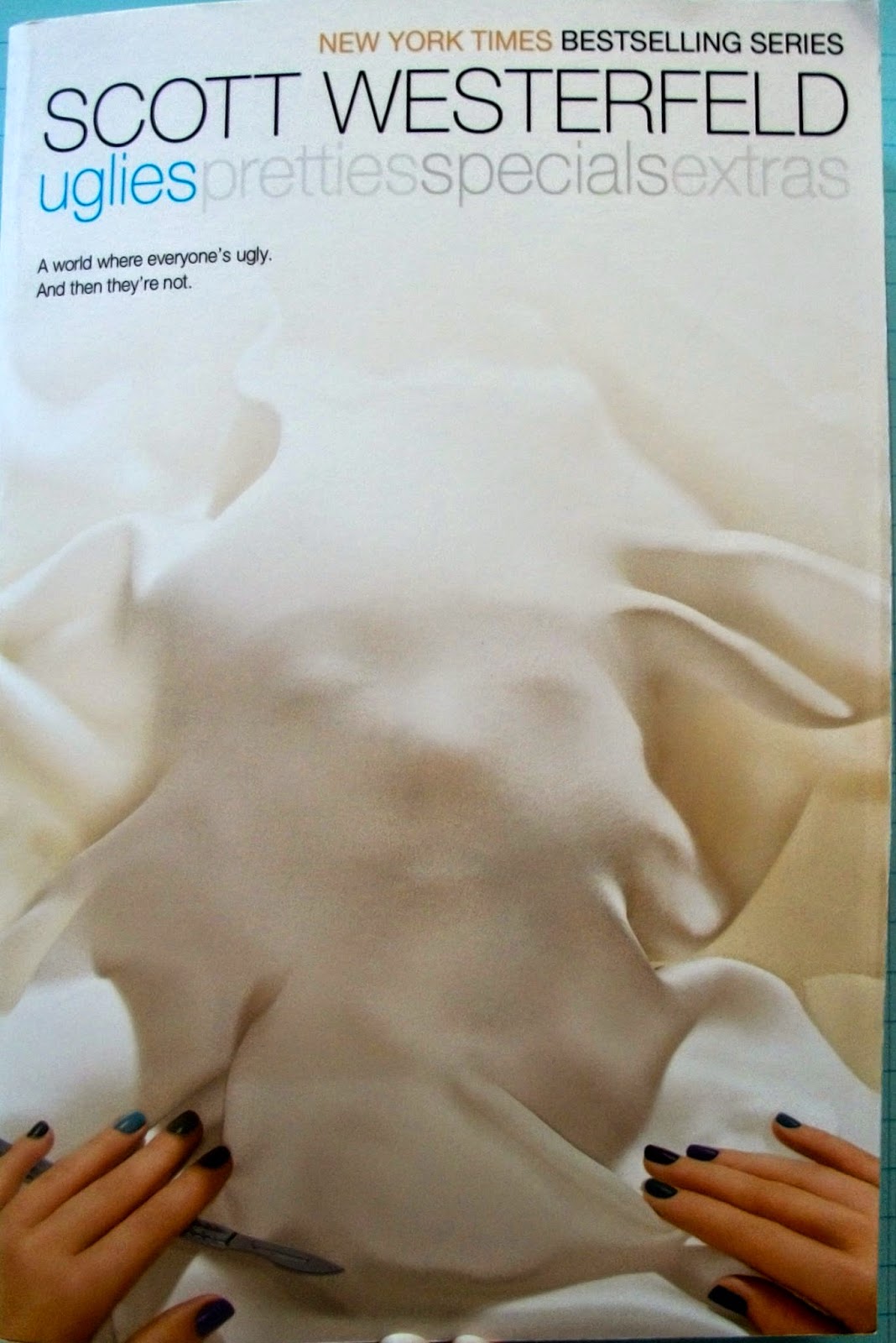
'Uglies' by Scott Westerfeld

Westerfeld, Scott. Uglies. New York: Simon Pulse, 2005. Print.

Photo by: L. Propes
If your image of a dystopian novel or film conjures up images of Blade Runner -- grimy, crumbling cities -- Uglies is quite a departure from the stereotypical dystopia.  Set in a distant future where hoverboards are a thing of reality and the cities run solely on solar power, Uglies is the first in a series of four novels that examine the perceptions of beauty, government control, and the role of the individual in society.

Tally lives in Uglyville, the area of the city where all teenagers live from the age of 12 until their 16th birthday, whereupon they will be taken to the hospital and undergo a brutal surgery that will not only make them "pretty", but radically change their bodies.  (The descriptions of the surgery are not for the faint of heart.  It's not terribly graphic, but if watching old episodes of ER make you squeamish, you might want to skim those lines in the book.)  Tally's best friend Peris had the surgery on his birthday, three months ago and now lives in New Pretty Town, a glittering community where the new Pretties live after their surgery.  Tally misses Peris, and sneaks into New Pretty Town to see him.  Needless to say, she isn't supposed to be there.  Tally manages to leave without being caught by the authorities for being out of bounds and runs into Shay, another Ugly waiting to become Pretty.  Shay is different from Tally: she is content with her looks, isn't waiting with bated breath to become a Pretty, and has plans to run away to a mystical place called the Smoke where people can choose to keep their original face and maintain control over their lives.

When Shay runs away just days before her 16th birthday, the consequences fall hard on Tally, who is brought into Special Circumstances where the sinister Dr. Cable offers her an ultimatum: find the Smoke and lead Special Circumstances to its location, or stay an Ugly forever.  To Tally, who has dreamed of nothing more than becoming a Pretty, this is a fate almost worse than death.  Tally manages to reach the Smoke where she discovers life in New Pretty Town isn't all it's cracked up to be.

In this novel, Westerfeld's gifts lie in the descriptions of the landscapes and the character's actions.  From the beginning, with the portrayal of life in New Pretty Town signals that this isn't your run-of-the-mill dystopia.  As the heroine, Tally isn't necessarily dissatisfied with her life.  She never contemplates leaving the city until forced to do so by the Special Circumstances.  Tally isn't going to rebel against the government initially, because to her, she has nothing about which to be rebellious.  The small details of government intrusion are part and parcel of her existence.  It doesn't occur to Tally to even consider the constant tracking of her person and activities might have a more ominous purpose other than safety.  Nor does it occur to Tally to question the need to make all the residents of the city uniformly beautiful.  At least not until she lands in the Smoke and encounters David, who was born in the Smoke and shows Tally there's another way to live life and gain satisfaction from it.  Unfortunately, as a character, Tally is somewhat passive.  She rarely acts on her own, unless someone forces her hand.  This isn't to say she isn't intelligent. She is.  Shay leaves Tally a cryptic message with directions to the Smoke that Tally successfully and easily interprets, and when presented with pieces of information, Tally can easily connect the dots and come to her own conclusions about things.

The setting in Uglies is one of the most well-done aspects of the book.  It's not too terribly difficult to picture towering houses that seem lighter than air, filled with shrieking, pretty teenagers.  The glimpse we see of life in New Pretty Town resembles a university fraternity straight out of Hollywood, in a never-ending cycle of fancy dress and formal parties.  It's also not hard to see the remains of the Rusty Ruins or the settlement at the Smoke, due to Westerfeld's vivid descriptions.

Other ways in which the setting provides the structure for another underlying theme of the novel are the Rusty Ruins and a field of genetically modified snow-white orchids.  The Rusty Ruins were once a major city, its inhabitants killed and structures left to moulder as a reminder of how ecologically destructive people used to be.  The explanation is that someone created a bacteria to infect petroleum, which would then render it unstable.  The petroleum (and its products) "exploded on contact with oxygen.  The spores were released on the smoke, and spread on the wind" (Westerfeld 329).  Society and life as the Rusties knew it was gone.  The orchids were a valuable flower, whose bulbs recall the tulip mania of seventeenth century Holland.  They were so valuable that someone tinkered with their genetic structure to make them adapt to various growing conditions.  The result is that the orchids are now a noxious weed that chokes out any other life form turning the area into a biological wasteland.

Finally, there's the reason why the people in the city undergo such extensive plastic surgery: "A million years of evolution had made it part of the human brain.  The big eyes and lips said: I'm young and vulnerable, I can't hurt you, and you want to protect me.  And the rest said: I'm healthy, I won't make you sick... It was biology, they said at school. Like your heart beating, you couldn't help believing all these things, not when you saw a face like this.  A pretty face" (Westerfeld 16).   There are echoes of Ray Bradbury's Fahrenheit 451 in Westerfeld's Pretty culture.  In Fahrenheit 451, books are banned so as not to upset people by the ideas in them.  In Uglies, "everyone is happy, because everyone looks the same: They're all pretty" (Westerfeld 254).  One of the clever bits is how the government succeeds in convincing every child that they are indeed Ugly.  They've been conditioned from birth to think they are ugly ducklings just waiting to become a swan when they turn 16.  Furthermore, they're taught in school that "Everyone judged everyone else based on their appearance.  People who were taller got better jobs, and people even voted for some politicians just because they weren't quite as ugly as everybody else... people killed one another over stuff like having different skin color... So what if people look more alike now? It's the only way to make people equal" (Westerfeld 43).  The government also does something to their brains during the initial plastic surgery to make the people seem "sure of themselves... confident, and at the same time disconnected from... ugly real-life problems" (Westerfeld 258).  It turns the teenagers into docile, contented people, who reinforce the status quo.  Jennifer Mattson's review in School Library Journal calls it an "eerily harmonious... society" (1287).

Westerfeld has also carefully appropriated technology from films, like the hoverboards from Back to the Future II, and added his own touches, like the crash bracelets Tally wears to keep from falling to the ground if she falls off her hoverboard or bungee jackets that mimic the experience of bungee jumping, but are used as a safety device in case of a fire.  Westerfeld doesn't allow the technology to overshadow the story, and it doesn't veer out of the realm of impossibility.  The hoverboards use a magnetic system that utilizes the metals in the earth and water.  It grounds the plot in a foreseeable future.  She can even control her wall screen (think really massive computer monitor) with eye blinks.

The characterizations are somewhat stereotypical.  Tally as the young adult who leaves home in search of something (Nilsen et al. 348).  David, the native Smokie, has the advantage of having grown up independent of the city, yet his parents are refugees from the city.  He's been taught everything Tally and Shay have, but his knowledge is heavily peppered with a dose of reality, not what the city wants him to believe.  Shay is the Friend archetype, whose actions ultimately propel Tally into action (Nilsen et al. 348).  David's parents, Maddy and Az, can be classified as Sages (Nilsen et al. 348).  It's their story that allows the puzzle pieces to fall together in Tally's mind.  The novel's main weakness to me is that the characters never quite rise above their archetypes and develop into complex characters.  This could change as the series continues.

The novel weighs in at just over 400 pages, which is not an insignificant amount to some readers.  Westerfeld keeps the pace up through his animated depictions of the action.  The book isn't very dialog-heavy, and the pace of the book rests on the action sequences.  I'd like to note here that when I say action, I don't mean it reads like an Indiana Jones movie.  It's the descriptions of Tally's life, what Shay and Tally do before Shay runs away, and Tally's journey to the Smoke that make up the action that keeps the book moving along briskly.  It does lag a bit in places, especially when Tally and Shay make repeated references to the selfish silliness that caused the destruction of the Rusties.  Westerfeld's ecological message becomes blunted after hearing yet again how dumb the Rusties were.

One thing that is interesting in the book is that today's fashion models are not considered the epitome of beauty in Tally's age.  Quite the contrary.  In a poignant scene after Tally arrives at the Smoke, Shay shows her magazines from our time, full of what we consider "pretty", or rather what the media tells us is pretty.  They're amazed at how thin these women are, how unhealthy they look.  This scene is a pointed jab at conventional ideas of beauty and leads a reader to question if someone like Nicole Kidman would be considered unhealthily thin, just what is the city's idea of perfect beauty and proportion?

The two overarching themes of ecological damage and standards of beauty seem to be fighting one another for supremacy in the novel.  Hopefully Westerfeld can link them together in the later books.  Seeing as how this is the first of four novels, there's a lot of exposition in this novel that hopefully lays a good foundation for the other three.

Teachers can use Uglies one of two ways.  They can use it to discuss body image and the definition of beauty and how it changes from culture to culture, and even from era to era.  Teachers can also use it as part of a unit on ecology and the environment.  Laura McConnell, a middle school librarian, uses the Uglies series in a display about environmental issues, pairing the books with non-fiction titles about renewable energy (School Librarian's Workshop 12).

Westerfeld's other novels include: the rest of the Uglies series -- Pretties, Specials, Extras; the Leviathan series --  Leviathan, Behemoth, and Goliath; the Midnighters series -- The Secret Hour, Touching Darkness, and Blue Noon.  Uglies was also turned into a graphic novel, but presented from Shay's point-of-view called Uglies: Shay's Story.

You can visit Westerfeld's webpage.  It has a schedule of his upcoming events, book trailers and discussion questions.

***********************************************

Works Cited
"Ideas on Display." School Librarian's Workshop 29.6 (2009): 12-. Education Source. Web. 27 June 2014.
Mattson, Jennifer. "Uglies (Book)." Booklist 101.14 (2005): 1287-. Education Source. Web. 27 June 2014.
Nilsen, Alleen Pace, et al. Literature for Today's Young Adults. Boston: Pearson, 2013. Print.
Westerfeld, Scott. Uglies. New York: Simon Pulse, 2005. Print.


Tuesday, June 24, 2014

'Eleanor & Park' by Rainbow Rowell

Rowell, Rainbow. Eleanor & Park. New York: St. Martin’s Griffin, 2013.

Photo by: L. Propes
You could pick Eleanor and Park off the pages of this book and drop them into a John Hughes movie or an Amy Sherman-Palladino television series.  They certainly wouldn’t be out of place among the misfits of The Breakfast Club or Pretty In Pink or the rapid-fire, pop-culture laden dialog of Gilmore Girls or Bunheads.  While the idea of two teenaged misfits finding each other and falling in love seems like it’s been done a million times before, Rainbow Rowell makes Eleanor& Park seem fresh and new, and it lies in the way her two titular characters are able to expose their vulnerabilities to one another without descending into a sea of cynicism and snark. 

Eleanor & Park begins in August 1986 and follows the tentative beginnings of Eleanor and Park’s burgeoning friendship that blossoms gradually into love.  They “don’t meet cute; they meet vexed” (“Eleanor & Park” Kirkus).  Eleanor is the new girl in their Omaha school. She’s zaftig, tall, with lots of curly red hair.  Her wardrobe choices make her look like she’s wearing a Halloween costume, and she has nowhere to sit on the bus.  Park is the half-Korean, punk and New Wave-loving, comic-book-reading outsider who grudgingly lets Eleanor sit next to him on the bus.  Park realizes Eleanor is reading his comic books over his shoulder and the foundations of their friendship are formed on the wordless bus rides to and from school, bonding over X-Men.  Eventually, Park begins to lend Eleanor his comic books (still without saying a word), and after weeks of silently trading comics, he breaks the ice by asking about the song titles Eleanor has written on the covers of her textbooks.  (Just so you know Rowell isn’t condoning vandalism, Eleanor has made protective covers for her textbooks using brown paper grocery bags.  That’s what she’s doodled on, not the actual book cover.) 

Eleanor and Park couldn’t be more different from one another on the surface.  Eleanor’s parents are divorced, and she hardly sees her father.  Her mother is married to a man who mentally and physically abuses her and makes life miserable for Eleanor and her four siblings.  In fact, Richie, Eleanor’s stepfather, kicked Eleanor out of the house for a year, and when the novel begins, has just “allowed” her to move back in with the family. The family is so poor they can’t afford things like toothpaste or regular shampoo, and Eleanor shares a room with her younger sister and three younger brothers.  Eleanor’s mother has expressly forbidden her to date or have contact with boys outside of school. It’s unclear if this is her mother’s wish, or if it’s something she’s done to appease Richie.  Eleanor is also deeply insecure about many things -- her weight, her appearance, and even her worthiness to be with a person she feels is as decent as Park.  She hides her insecurities under a cool and collected façade, but every so often a bullying incident creates a fissure and allows the anxieties to show.  She has a sharp wit and original insight of literature, even going so far as to challenge the entrenched opinion of Romeo and Juliet as a tragedy, viewing it as a satiric look at love (Rowell 44). 

Park’s parents are happily married, and are openly demonstrative with one another in front of Park and his younger brother.  Their house is always neat and tidy, and unlike Eleanor, Park isn’t worried about where his next meal will come from.  His mother is a beautician and sells Avon. Park thinks that she would be the most popular girl on the school bus (Rowell 118).  Park can have a difficult relationship with his father, mostly due to their clashing personalities and differing ideas about what it means to be a man, but it’s obvious that Park’s father loves and cares about him.  Park’s family life, which also includes his paternal grandparents who live next-door, is stable and solidly middle-class.  Park’s mother doesn’t want Park to have a girlfriend so he can focus on his studies, but accepts that Park is seeing Eleanor.  Park’s willingness to push the envelope of typical masculine behavior (like wearing black eyeliner to school) frustrates and bemuses his father.  Park tends to engage in low-level passive-aggressive behavior to display his rejection of the image of a stereotypical All-American Midwestern teenager that his father wants him to have.  Park isn’t a saint, though.  He’s plagued by his own insecurities about his ethnic heritage and his low social status in the neighborhood.  Sometimes, his insecurities come out in full force, and unfortunately, their target is sometimes Eleanor.  After an argument with Eleanor regarding Park’s previous (and long-ago) relationship with her nemesis Tina, Park admits to himself a part of him “didn’t want Tina to get over him” (Rowell 178).  As much as Park wants to project to the world that he doesn’t care what they think of him, as demonstrated by dating Eleanor, he admits to himself it does matter because “he [keeps] finding new pockets of shallow inside himself.  He [keeps] finding new ways to betray her” (Rowell 178). 

Throughout the year, Eleanor is haunted by small incidents of bullying, including filthy messages scrawled on the covers of her textbooks.  She comes to a horrifying realization about the author of the notes and must make a decision to stay in Omaha or run away to see if her uncle in St. Paul, Minnesota will offer her sanctuary. 

Rowell sets up the novel with a framing device, that’s almost repeated verbatim at the end, written in Park’s voice.  She alternates the rest of the narrative between Eleanor and Park, sometimes switching voices to give the reader their individual reactions to the same event.  When she switches between Park and Eleanor’s respective narration, Rowell notes it with a heading that simply says “Park” or “Eleanor”.   I found both of their voices to be quite distinct from one another.  Park, for example, has a much more lyrical voice.  The first time he holds her hand, he says, “Holding Eleanor’s hand was like holding a butterfly.  Or a heartbeat.  Like holding something complete, and completely alive” (Rowell 71).  Eleanor, on the other hand describes it this way: “Disintegrated.  Like something had gone wrong beaming her onto the Starship Enterprise.  If you’ve ever wondered what that feels like, it’s a lot like melting -- but more violent” (Rowell 72).  Eleanor’s voice has its own poetry, but she is much more straightforward about what she thinks, keeping her more intimate emotions tightly under wraps.  She often adds parenthetical comments to her own inner monologue. 

Their relationship is “chaste first love, authentic in its awkwardness -- full of insecurities, miscommunications, and sexual awakenings -- and life-changing for them” (Ritter 93).  The relationship, as viewed through the prism of their words is -- and there’s no other word for it -- intense.  This intensity, which a reader can feel from the first moment Park slips his fingers through Eleanor’s, shines through in their inner thoughts, and sometimes in their dialog with each other.  During a rare telephone conversation, Eleanor tells Park, “I don’t like you, Park,” she said, sounding for a second like she actually meant it.  “I…” -- her voice nearly disappeared -- “think I live for you” (Rowell 111).  Taken out of context, this could be the corniest bit of dialog ever written, but when placed within the backdrop of Eleanor’s chaotic home life and marginalized position inside her own family; it works and sounds nothing but natural coming out of Eleanor’s mouth.  The emotional flights of fancy the narrative takes are mostly in the inner monologues of the characters, so when they do utter a whimsical phrase, it feels organic, as if Eleanor or Park have loosened their Vulcan death grip on their own feelings.  Of course, exchanges like this also bring to light the question of whether or not Eleanor’s feelings for Park are genuine or whether she’s subconsciously using him to escape her family. 

The dialog between Eleanor and Park also reveal their wry sense of humor, especially during a discussion when Eleanor compares Cyclops from X-Men to Batman, stating how boring they both are.  When Park protests and tells her he’s going to loan her his copy of The Dark Knight Returns, he says it’s “Only the least boring Batman story ever” (Rowell 60).  Eleanor retorts, “The least boring Batman story ever, huh?  Does Batman raise both eyebrows?” (Rowell 60). 

Park’s parents -- Jamie and Min-Dae “Mindy” Sheridan -- aren’t relegated to the background of the novel.  They play an active role in the story and experience just as much growth and character development as Park and Eleanor.  In his review of the novel for the New York Times, John Green (yes, that John Green) calls Park’s parents “two of the best-drawn adults I can remember in a young adult novel” (“Two Against the World”).  Park’s father wants Park to be the kind of Midwestern man with which Mr. Sheridan is most familiar -- tough and brawny.  Oh, and able to drive a stick shift.  It’s clear Mr. Sheridan’s respect grows for Park and the way he quietly stands up for Eleanor, willing to do what it takes to protect her.  It’s Mrs. Sheridan who displays the most development out of the two.  She’s not fond of Eleanor when they first meet, but a chance glimpse of Eleanor with her mother and siblings at the grocery store on Christmas Eve reveals to Mrs. Sheridan the level of Eleanor’s struggles, and makes her realize she has more in common with Eleanor than at first glance.  Mrs. Sheridan met Mr. Sheridan when he was serving in Korea in the late 1960s.  They married in Seoul, South Korea, and Mrs. Sheridan proceeded to leave everything she knew behind.  Park mentions how she never talks about her life in Korea, but on Christmas Eve, Mrs. Sheridan recognizes the poverty and hunger behind the nervous and uncertain front Eleanor presents in the Sheridans’ home.  Coming from such dire straits, the Sheridan house might as well be a foreign country to Eleanor. 

I feel Rowell’s inclusion of a discussion of Romeo and Juliet isn’t an accident.  Park remarks that the play reminds “people… what it’s like to be young… and in love” (Rowell 45).  In her blog “Monkey See”, NPR correspondent Linda Holmes comments that for Park and Eleanor, who “feel lost -- because of bullying, because of abuse, because of race… being loved makes them feel less lost” (“True Love”).  Rowell doesn’t shy away from the harrowing abuse Richie hurls at Eleanor or the rest of her family.  Holmes, in particular praises Rowell for this saying, “Ugliness -- honesty about ugliness -- is important, because it gives shape and meaning to some important stories about not allowing it to swamp you” (“True Love").  In an interview with the online magazine The Toast, Rowell responds to people who feel her book should be banned because of its unflinching content.  She says, “When these people call Eleanor & Park an obscene story, I feel like they’re saying that rising above your situation isn’t possible.  That if you grow up in an ugly situation, your story isn’t even fit for good people’s ears.  That ugly things cancel out everything beautiful” (Ortberg “A Chat With Rainbow Rowell”).  Spending most of my teaching career working with kids who weren’t very different from Eleanor or Park, this is the kind of book they need to read, if for no other reason than to find out that there are people like them, who have found a way to survive their situation. 


Rowell is also the author of Fangirl, Landline, and Attachments. Eleanor & Park is a 2014 Printz Honor book. 

****************************************

Works Cited 
"Eleanor & Park." Kirkus Reviews 80.24 (2012): 149-. Academic Search Complete. Web. 22 June 2014.
Green, John. "Two Against the World." The New York Times, sec. Sunday Book Review: BR17. March 8 2013. Print.
Holmes, Linda. "True Love, Book Fights, and Why Ugly Stories Matter." Monkey See. September 18 2013.Web. 22 June 2014. <http://www.npr.org/blogs/monkeysee/2013/09/18/223738674/true-love-book-fights-and-why-ugly-stories-matter>.
Ortberg, Mallory. "A Chat With Rainbow Rowell About Love and Censorship." The Toast. September 17 2013.Web. 22 June 2014. <http://the-toast.net/2013/09/17/chat-rainbow-rowell-love-censorship/>.
Ritter, Cynthia K. "Eleanor & Park." Horn Book Magazine 89.3 (2013): 93-4. Education Source. Web. 22 June 2014.

Rowell, Rainbow.  Eleanor & Park. New York: St. Martin’s Griffin, 2013. Print.