Tuesday, February 2, 2016

"Grasshopper Jungle' by Andrew Smith

Smith, Andrew. Grasshopper Jungle. Dutton Books: New York, 2014. Print.

Image from:
www.authorandrewsmith.com

Andrew Smith tackles the end of the world in Grasshopper Jungle.  Literally. It all starts with a confluence of unconnected events, beginning when Austin and his best friend Robby are beat up by four boys from another high school in the alley known as Grasshopper Jungle behind a nearly-defunct shopping mall.  In an unrelated incident, the four boys break into the office of the thrift store in the mall and steal a mysterious, glowing, blue globe with something grotesque floating inside.  The boys drop the globe in Grasshopper Jungle, where the contents come into contact with drops of blood left by Austin and Robby after they had been beaten up.

And thus, begins the end of the world.  A world where a mutated plague turns humans into six foot tall praying mantises.  Who only want to do two things: eat and mate (although Smith uses a much more colloquial term).  Still, even with the end of the world looming, Austin must continue to deal with real life.  His brother Eric is serving with the Army in Afghanistan, and is injured by a roadside bomb later in the novel.  Austin has a longtime girlfriend Shann, who's been hinting that it might be time to take their relationship further.  At the same time, Austin spends much of the novel grappling with the idea that he might also be in love with, and sexually attracted to, Robby.  He can't break up with Shann to be with Robby without hurting Shann, but he can't repudiate Robby without devastating Robby.

And he still has to figure out how to eliminate the super-strong bugs, who find humans to be a tasty snack.

All throughout the novel, Austin ruminates on his family's history from his Polish great-great-great grandfather to his father and his own place in the universe.  While these side trips through Austin's family history might seem to be odd segues, Austin's relentless probing reminds us that as much as we want to believe we're in control of the history swirling around us, sometimes we're just pulled helplessly along in its eddies.

As science-fiction, this is reminiscent of a Twilight Zone or The Outer Limits episode.  Foreboding.  With a hefty dash of weird.  And strangely plausible.

Austin is a typical Smith protagonist.  He feels deeply, can be awfully introspective for a teenager, and thinks about sex and sexuality quite often.  Also in typical Smith fashion, Robby's sexuality is treated as a statement of fact, with absolutely no judgments. Austin's questions into his own sexuality is handled sensitively, but with no easy resolution.  This, I think, is one of things I like best about Smith as a writer.  He does tend to leave some plot strands wide open, while neatly tying others up.  In Grasshopper Jungle, what occurs outside of Austin's small town of Ealing, Iowa is a complete mystery, which adds to the Twilight Zone feel of the novel.

I highly recommend this for readers who like dystopia, science-fiction, or are fans of Twilight Zone.  It's a book that stays with you, long after you put it down.

Grasshopper Jungle received a 2015 Printz Honor.

Monday, January 25, 2016

'Fangirl' by Rainbow Rowell

Rowell, Rainbow. Fangirl. New York: St. Martin's Griffin, 2013. Print.

Cover image:
www.rainbowrowell.com


Cather has just moved into her dorm at the University of Nebraska.  So has her twin sister, Wren.

Get it?  Cather...  Wren...  According to Cather, or Cath as she prefers, their mother wasn't expecting twins and couldn't be bothered to come up with another name, so she split Catherine into two separate names.

Cath struggles to survive in college.  She's painfully shy and introverted. Wren lives in another dorm, and for the first time since they were born, Cath and Wren are not sharing a room.  The outside world puts Cath on edge so much, she can't make herself leave her room to find the cafeteria and lives on protein bars for the first few weeks of school until her roommate, Reagan, drags her to the cafeteria.

Cath wants to be a writer.  Correction.  She has been a writer for years at this point, writing fanfiction about her favorite series, Simon Snow, a fictional fantasy series that bears a passing resemblance to Harry Potter.  Writing about Simon Snow and his friends provides a much-needed a refuge for Cath. She cares so much about her fanfiction that she butts heads with her creative writing professor, Professor Piper, over whether or not fanfiction is actually a creative task in of itself.  Plus, the final Simon Snow book is due to be released soon, and Cath just has to finish her own fanfic work before the last book is out.  College, being what it is, interferes with Cath's ability to post updates as often as she would like.

Cath also has other personal issues.  In an ominous bit of foreshadowing, Rowell shares Cath's voice mail messages to her father when he won't pick up the phone.  Wren has thrown herself into the partying aspect of college life, creating another source of stress for Cath.  And then there are her burgeoning feelings for Levi, Reagen's friend/boyfriend.  Cath also has to deal with the fallout of developing a crush on her opportunistic writing partner.

Just like with Eleanor & Park, Rowell has created characters with a lot of depth.  Cath isn't just shy and introverted.  Rowell has written her as a passionately dedicated writer, with strong ideas of what makes good storytelling.  Reagen looks like the typical angry Goth chick, but her outward appearance belies Regan's sort of gooey center.  Wren isn't just a party girl, but she's using the partying and drinking as a coping mechanism.

Rowell also has a gift for writing complex adult characters.  Cath and Wren's father is more than an absentminded, distracted single father.  How it's revealed is one of Rowell's gifts as a writer.  She doesn't insult the audience's intelligence.  Instead of just telling us the root of Arthur Avery's issues, Rowell allows it to slowly unfold until it all comes to a head and lets the repercussions reverberate through the rest of the novel. Professor Piper even feels like a nod to Jane Austen.  She's published four novels, all set in her hometown, just as Austen published five novels all set in the locations she knew best.

Rowell respects fandoms and fanfiction in general and her respect for them shines through the book.  She's actually a fanfiction reader and she treats the act of writing fanfiction as an act of creativity, defending people to write fanfiction and create fanart with Cath's passionate defense of her own fanfiction writing.  For Rowell, fanfiction is an act of love for a book (or series) so intense that it inspires people to write alternative universe versions, speculative versions, or writing the moments that were mentioned or happened off-camera, so to speak.  Kudos to Rowell for not only writing an original novel, but writing a piece of fanfiction based on an entirely different imaginary YA series.

Rowell wrote Fangirl for a National Novel Writing Mont (NaNoWriMo) challenge.


Sunday, November 15, 2015

'The Shadow Hero' by Gene Luen Yang, Illustrated by Sonny Liew

Yang, Gene Luen. The Shadow Hero. Illustrated by Sonny Liew.  First Second: New York, 2014. Print.  ISBN: 978-1-59643-697-8


Cover image:
www.mcmillian.com
The Shadow Hero is based on a short-lived 1940s-era comic book series.  It is, essentially, an origin story of a superhero known as the Green Turtle.

Our story begins in 1911, as the "Ch'ing dynasty collapsed," sending China into political and social chaos (Yang 1).  Four spirits -- the Dragon, Tortoise, Pheonix, and Tiger -- meet to decide what to do, for their very survival rests with the fate of China.  The Dragon, Phoenix, and Tiger argue about what their best change for survival might be, while the Turtle remains silent. He later boards a ship headed to the West, where he meets a young man, and strikes a mysterious deal with him.

The narration shifts to his mother's tale and how she came to America as a little girl, where she believed life would be like the movies she saw.  Suffice to say, reality did not match her fantasies.  It was much, much worse, and quite tedious.  She ended up married to a grocer and had a son named Hank, our narrator.

Hank feels like he's had a fantastic childhood, learning to help his father run the grocery store and play mahjong with his father's friends..  Hank's mother doesn't feel the same way.  She wants Hank to become a superhero after a chance encounter with the Anchor of Justice.  She proceeds to make him a costume, then search for a way to imbue Hank with superpowers, by any means necessary (and I do mean any means necessary).  She subjects him to toxic waste, herbal infusions, bites from animals used for science research, and so on.  All that leads to nothing more than Hank becoming ill from the toxic sludge and his skin tuns a shocking shade of pink when it gets wet.  Next, his mother takes him to a family friend (Uncle Wun Too) to teach him kung fu.  When Uncle Wun Too deems Hank is ready to fight, Hank's mother takes him for a ride through Chinatown in search a crime in progress so Hank can save the day.

It doesn't go well.  Hank is beaten badly, and saved in the process by the the young lady he meant to save.

While Hank recovers from his injuries, he finds out his father has been making monthly payments to the Tong of Sticks*, just like all the other business owners in Chinatown.  The Tong punishes Hank's father, and Hank attempts to force the Tong to return a cherished family heirloom.  Members of the Tong then shoot and kill Hank's father in retaliation.

Remember the Turtle from the beginning of the book?  It turns out the young man he met on the ship was none other than Hank's father.  The Turtle makes a deal with Hank, promising him anything, as long as Hank allows the Turtle to live in his shadow, just as he did with his father.  Hank agrees, asking only that he can never be shot.  Hank decides to continue his fight against the Tong.  He manages to infiltrate the Tong of Sticks headquarters, and eventually is ordered by Ten Grand, the Tong of Sticks leader, to participate in a fight to the death with two others to determine who will become the next leader of the Tong.  Ten Grand challenges Hank to a duel when Hank refuses to kill one of the other combatants.  Ten Grand, though, has a secret weapon as his disposal, which he's used for decades to control the Tong of Sticks.

Like many of his other graphic novels, Yang writes stories of low fantasy, mingling Chinese folklore and traditional beliefs with the modern world.  Yang always manages to bring Chinese folklore into the modern day in a way that feels organic and unforced.  The Turtle in Yang's hands becomes a wry sidekick to Hank/Green Turtle, learning from his past mistakes, and allowing Hank to make mistakes and in turn, learn from them, as well.  The Turtle also offers pointed, but funny, commentary, which adds a humorous layer to the fight scenes. Hank is a bit two-dimensional in the way some comic book heroes have been traditionally written.  He's a good kid; kind to his parents, even if his mother exasperates him; and fully aware that he cannot use his powers for evil, or even low-level petty crime.  It's not really a bad thing.  It makes Hank an engaging hero, and you really do want to cheer for the good guy.  Hank's mother demonstrates the most character development, going from a stereotypical pushy mother to one who realizes her son has grown into a man, and stops ordering him around.

Sonny Liew's drawings evoke faded old comic books with muted colors.  The panels that recount Hank and his parents' pasts are drawn in nearly monochromatic blues and greys.  The drawings of the four spirits are stylized black shadows against a vivid red background.  For the most part, Liew manages to give each of the main characters a distinct look through facial features, hairstyles, and clothing.  The artwork also includes the classic comic book convention of employing onomatopoeic sound effects ("bang," "pow," etc.), which also enhances the vintage feel of the comic book as a whole.

Yang uses several traditional comic book tropes to explain the origins of the Green Turtle: violent death of a loved one; a mentor in the form of Uncle Wun Too and the Turtle; a secret identity, although Hank's lack of a mask early in the book makes it a not-so-secret identity; the acquisition of a superpower; the protagonist as a teenager with no driving ambition; the archnemesis and the hero deriving powers from similar sources.  But Yang also consciously seems to avoid several other tropes, like the hero having lots of money; cool gadgets or weaponry made through the miracle of science, even though the hero has few resources; the female characters (Red Center in particular) can take care of themselves quite nicely in a fight; and violence is not the answer a crime, or at least death is not, among others.  It does make a refreshing change that aside from the promise made by the Turtle to help Hank avoid bullets, Hank does it all with his own strength and wits, rather than with gadgets, superpowers, or genetic mutations.

The Shadow Hero fits in quite well in the current graphic novel/comic book landscape.  It's not so unusual to have a Chinese-American superhero these days.  After all, we have a African-American Hispanic Spiderman (Miles Morales), a Muslim Ms. Marvel (Kamala Khan), and a female Thor.

According to the afterword, the original Green Turtle comics were created by an obscure artist named Chu Hing (Yang 154).  Hing was one of the first Asian-American comic book artists (Yang 154).  Hing created a superhero to defend America's then-ally, China, who had no discernible superpowers, aside from "a knack for avoiding bullets" (Yang 154).  Yang goes on to say that's all we definitively know about Chu Hing and the Green Turtle (155).  The urban legend, so to speak, is that Hing wanted his superhero to be Chinese, but the publisher "didn't think a Chinese superhero would sell and told Hing to make his character white" (Yang 155).  The theory goes that Hing decided to subvert the publisher's wishes.  In the original comics, the readers hardly got "to see his face" (Yang 155).  Yang's investigations into the limited Green Turtle series revealed that the Green Turtle's back was to the 'audience' most of the time, and when he did turn around, his face was "almost always obscured by something" (155).  There was always a turtle-shaped shadow, though, that was never fully explained (Yang 156).  The Green Turtle was also colored by the publisher to be unnaturally pink, "as if to emphasize just how Caucasian this hero is supposed to be" (Yang 156). Yang states that the Green Turtle comics ended just after a mere five issues, leaving questions about his origins unanswered (158).

Yang and Liew have given the Green Turtle a well-thought out origin story, which dovetails nicely with its source material.  It's an engaging read, and should appeal to readers who love graphic novels and comic books and readers who don't routinely read graphic novels.


*"Tongs" were modeled after the Chinese organized crime organizations called "triads."  Initially, tongs were social organizations to protect Chinese immigrants in local Chinatowns, but they eventually turned to organized crime. 

*********************************************************************************
Works Cited

Yang, Gene Luen. The Shadow Hero. Illustrated by Sonny Liew.  First Second: New York, 2014. Print.

Sunday, October 18, 2015

'Stand Off' by Andrew Smith

Smith, Andrew. Stand Off. New York: Simon and Schuster BFYR, 2015. Print.
ISBN: 978-1-4814-1829-4

Image from:
www.simonandschuster.com
When we last saw Ryan Dean West, his best friend Joey Cosentino had just died under horrific circumstances, and Ryan Dean was struggling to grieve.  Fast forward to the following September, and it's Ryan Dean's last year at Pine Mountain.  It's his senior year, he's still dating Annie Altman, his dream girl, and hopefully, he can mend his relationship with his friends, Sean and JP.

Life has other plans for Ryan Dean.

Even though he's a senior, Ryan Dean has to room with Pine Mountain's newest child prodigy, Sam Abernathy in a tiny dormitory room with the other freshmen, and to add insult to injury, the only set of sheets Ryan Dean and his mother could find to fit the child-sized beds in the room are pink flannel with a winged unicorn called "Princess Snugglewarm."

Could it be any worse?

Oh, yes.  It can.

Sam (or the Abernathy as Ryan Dean calls him) is walking brochure for Pine Mountain.  Clean-cut, polite, an uncanny ability to create real food out of the bits and pieces left for the students on weekends, with a puppy-like eagerness to follow Ryan Dean around campus, who happens to need to sleep with the window wide open, as well as the door to their dorm room.  Sam confesses he cannot sleep without the window and door open, as he suffers from severe claustrophobia.

Oh, and there's N.A.T.E. (the Next Accidental Terrible Experience) who keeps following Ryan Dean around Pine Mountain, taking over his drawings, haunting his sleep.

There's also a chance encounter with Joey's parents and younger brother, Nico, who resembles Joey to such a degree, it's almost painful for Ryan Dean to be around him.  

On top of it all, Coach McAuliffe, the rugby coach, wants Ryan Dean to move from the left wing to the half-fly, which happened to be Joey's position, as well as take over as team captain, which was also Joey's position.  It's a bit much for Ryan Dean to handle.

He's not handling it well.  He's not handling it well, at all.  

The novel has a radically different mood than Winger.  In Winger, Ryan Dean is exuberant, flirtatious,  and a genuinely nice guy.  He's still a genuinely nice guy in Stand Off, albeit one still struggling with grief for his best friend.  Ryan Dean's world has drastically shrunk, especially since his two friends from rugby and Opportunity Hall (Chas and Kevin) graduated, and he's still estranged from Seanie and JP.  The novel appropriately feels claustrophobic, echoing not only the new influence of Sam Abernathy, but Ryan Dean's shrinking circle of friends.  The illustrations that provided so many of the humorous and whimsical moments in Winger have been reduced in number, and their tone has changed as well.  Most of the illustrations that do appear in the novel depict Ryan Dean's fight with N.A.T.E., although others depict some of his more humiliating moments. The book also covers a shorter time frame than Winger.  Whereas Winger took place over at least three months of school, Stand Off covers roughly three to four weeks, contributing to the overall compressed feel of the book.

This version of Ryan Dean is more mature, although he still has his endearingly awkward moments, such as when he deflects the amorous attentions of one of his rugby teammates, utilizing the lessons in consent they've learned from their sex-ed teacher.  Still, the more Ryan Dean faces his personal demons, the more he resembles the Ryan Dean we came to know and love in Winger, just one that's grown up a bit.  It's particularly evident in the scenes where his friend Seanie comes out to him, and the way he learns to cope with Sam's claustrophobia and accept Sam as a friend.

Smith does a really fantastic job depicting Ryan Dean's ongoing struggle to come to terms with Joey's death.  He also manages to send home the message that people often need a little help from their friends or professional therapists to manage things like grief or childhood-trauma-induced claustrophobia.  Rather than have other characters badger Ryan Dean, Smith lets their actions do the hard work of persuading Ryan Dean he doesn't have to face N.A.T.E. -- or indeed anything -- by himself without getting preachy.   As in Winger, Smith displays a deft and sensitive touch regarding characters' sexualities as a matter of fact.

If there are weaknesses in the book at all, they mostly lie in how Smith writes the girls, especially Annie.  They tend to be somewhat two-dimensional.  However, considering the source -- namely Ryan Dean's narration -- it's not necessarily a crippling weakness, or even a major one.  It's too easy to forget Ryan Dean is only fifteen years old, and that his attitudes often reflect his emotional maturity, which doesn't always mirror that of his intellectual maturity.  Smith manages to wrap up several of the loose ends introduced in the book, while decidedly NOT tying everything up in a nice, pretty bow.

This is a fine addition to anyone's collection of realistic YA fiction.  It's a lovely and refreshing break from the glut of paranormal fiction that's dominated YA in recent years.  I'm not sure if Smith is finished with the adventures of Ryan Dean West, but I, for one, would love to see Ryan Dean tackle college.

Tuesday, April 28, 2015

'Grumbles from the Forest: Fairy-Tale Voices with a Twist" by Jane Yolen and Rebecca Kai Dotlich, Illustrated by Matt Mahurin (LS 5663)

Yolen, Jane and Rebecca Kai Dotlich. 2013. Grumbles from the Forest: Fairy-Tale Voices with a Twist. Illustrated by Matt Mahurin. Honesdale, PA: WordSong.

Cover Image from
www.boydsmillpress.com
Happily ever after...  Three words that seemingly end the fairy tales of our childhood.  But haven't you ever wanted to know what happened after the last page turned?  Or maybe you might have wanted to know the story from another character's point of view?  Or maybe a little more from one of the myriad princesses that grace the pages (and screens) of our fairy tales.  I am a huge fan of Stephen Sondheim's musical Into the Woods that examines the before "happily ever after" and what would happen if there were another page after "happily ever after."  Jane Yolen and Rebecca Kai Dotlich's collection of poems, Grumbles from the Forest: Fairy-Tale Voices with a Twist, joins works like Into the Woods that take a peek behind the curtain and let the characters speak for themselves.

Yolen and Dotlich each contributed one poem for "fifteen of the most recognizable fairy tales in Western culture" (Yolen and Dotlich 2013, 5).  Some of their poems look at the events of the tale from the point-of-view of different character; some use the same character, but look at the tale through another person's eyes; while still others give a voice to the voiceless or a marginal character.  One poem appears on one page and the partner poem on the facing page.  They don't list the poet who wrote each particular poem with the title of the poem or on the table of contents.  You have to look at the verso title page in order to find out which poems were written by Yolen or Doltich.  At the end of the book, Yolen and Dotlich offer additional information about the fairy tales, generally alternate titles of the fifteen fairy tales or alternative versions (different cultures).  They also include a few websites where you can find more information: SurLaLune Fairy Tales, Hans Christian Anderson: Fairy Tales and Stories, and Yolen's own website (look under Works).

The fifteen fairy tales Yolen and Dotlich use for inspiration are: Sleeping Beauty, Hansel and Gretel, Beauty and the Beast, The Gingerbread Boy, Cinderella, The Little Mermaid, Jack and the Beanstalk, The Princess and the Pea, Rumplestiltskin, The Frog Prince, Snow White, Little Red Riding Hood, The Three Billy Goats Gruff, Thumbelina, and The Three Bears.  Most of them should be familiar to many students, especially those who have paid careful attention to their Disney films or can connect the dots in the Shrek series of films.  A couple of the fairy tales -- and I'm thinking particularly of The Frog Prince and The Three Billy Goats Gruff -- might not be as familiar to students as the ones like Cinderella or Beauty and the Beast that have been given the full Disney treatment, i.e. utter ubiquitousness via movie merchandising and membership in the Disney Princess pantheon.  Still, this could create an excellent opportunity to introduce students to some of the not-as-well-known fairy tales.

Yolen and Dotlich use a framing strategy to open and close the book.  The poem "Once" appears just after the endpapers at the beginning, and "Happily Ever After" closes the book before the endpapers at the end.  It's a clever way to begin and end the book, especially because Yolen wrote one of the poems and Dotlich wrote the other.  "Once" trots out all the tropes of a typical fairy tale, establishing the foundation of fairy tales in general and the themes of the poems to follow.  It says,
A girl, princess, mermaid, widow, witch, queen, wife,
A boy, king, solider, wizard, troll, giant,
....................................................................................
The tale turns, returns, confesses, confuses,
And all the hardships, spells, and stresses
End well in happy laughter
And we hope --
                        ever after. (Yolen 2013, 1)
"Happily Ever After" asks the readers to consider what happens "after all the plotting, after the ball, / after the spelling, / hopping, / sweeping, / grumping, grousing, mopping, sleeping, / from small glass shoe to nuisance pea (Dotlich 2013, 40).  Using those two poems to open and close the device is an elegant use of the device, not only because of their placement outside of the body of the book itself, but because they introduce the concept behind the book and conclude it by inviting readers to imagine the lives of fairy tale characters after the final page is turned.  Also, because Dotlich and Yolen each contribute one poem to every fairy tale they feature in the book, it should also follow that they each contribute a poem to the frame around the book.

Yolen and Dotlich don't go into much figurative language in their poems here.  They do rely on well-chosen adjectives and phrasing in order to convey meaning and emotion.  One of the best examples of this is in the two Beauty and the Beast poems, "Beauty's Daydream" and "Beauty and the Beast: An Anniversary."  In Dotlich's (2013) "Beauty's Daydream," she repeats certain words and phrases, like 'dream,' or 'dreaming' to emphasize all the wonderful things mentioned in the poem, like dancing, pink flowers in her hair, roses, and valentines only reside in her dreams (12).  Dotlich (2013) also repeats the phrase, "If I could" twice to illustrate the longing Beauty feels for her dreams and reality she faces in the Beasts "fangs, his roar" (12).  Yolen's "Beauty and the Beast: An Anniversary" is achingly poignant, due to the structure and word choice.  In it, an older Beauty narrates her supposedly happily ever after:
My father died last April;
my sisters no longer write
except at the turnings of the year,
content with their fine houses,
and their grandchildren.
.....................................................
Though sometimes I do wonder
what sounds children
might have made
running across the marble halls (Yolen 2013, 13)
By placing just a bit of Beauty's thoughts on each line, Yolen lets them stand alone so the reader has a moment to contemplate how many years have passed (her father's death and sisters' diminished communications) and her, at least to me, well-buried regret at never having children.  Yolen also uses language to give Cinderella a rueful tone in "Shoes."  Cinderella says, "I could have danced / all night in wooden clogs / or easy-peasy / runners" (Yolen 2013, 16).  Yolen uses the poem to mention all the different shoes Cinderella is supposed to have worn in different versions of Cinderella, and highlight how much more suitable they would be for dancing, as opposed to the glass shoes she did wear "that cut [her] feet to slivers" (Yolen 2013, 16).  Dotlich also uses the word choice to illustrate the metamorphosis the Little Mermaid underwent in "A Mermaid's Love."  The young mermaid changes her "fins to legs / arms to wings" as detailed in the Hans Christian Anderson tale, and Dotlich neatly summarizes the entire story with a few well-chosen words (Dotlich 2013, 19).  The quote follows her transformation from mermaid to human to a spirit drifting as foam upon the sea.  Dotlich uses short phrasing in "Little Red's Story" to denote the excitement Red feels during her inadvertent adventure when she discovers the Big Bad Wolf at her grandmother's house.  Similarly, Yolen's (2013) "About Grandma Wolf" is a short poem, in which the lines "Was I fooled? / Not a bit." carry the smug certainty of a child who knows she was right (31).  It's a short, triumphant 'HA!' of a poem.

Yolen and Dotlich also use memorable rhythm in their poems.  In "Jack," a poem delving into Jack and the Beanstalk,  Yolen appropriates two well-known nursery rhymes ("Jack Be Nimble" and "Rock-a-Bye Baby") for the rhythm of the poem.  Yolen uses "Jack Be Nimble" for the first stanza to parallel the other Jack's agility in bringing down the beanstalk.  The second stanza echoes the line in "Rock-a-Bye Baby" that says "Down will come baby / cradle and all" by describing the giant falling "Bottoms up in a crater, / Thus ending it all" (Yolen 2013, 21).  The rhythm of Yolen's "Gruff for Dinner", a poem written from the point-of-view of the troll in The Three Billy Goats Gruff reminds the reader of a man rubbing his hands together in anticipation of a good dinner.  The rhythm is so well thought-out, it might make an interesting exercise for a music class to set it to music.

Several poems have a rhyme scheme that draws attention to events, plot points, or a narrator's thought process.  in Yolen's (2013) "Gretel Spies the Magic House," the last four lines are written in an alternating rhyme scheme that draws a reader's mental eye from the house to the fence and the realization that things aren't going to end well:
We should have...
Taken the hint
From the marzipan bricks
And the fence posts made of bone rubble.
But it as only when we saw the witch
That we knew we were in deep, deep trouble. (10)
Dotlich's "A Mermaid's Love" also employs rhyme where the rhyming words are significant to the story and the emotional impact.  Dotlich also effectively uses rhyme in "The Pea Episode" (The Princess and the Pea).  The stanzas are a series of couplets, but the second line rhymes with the first line of the next stanza.  It helps tie events from the previous stanza to the next one.  Dotlich also uses a bit of internal rhyme within the individual lines of "Troll Lament" (The Three Billy Goats Gruff).  It certainly lends the poem a nice rhythm: "Whoosh! He pushed, / leaving me to shiver in the river. / No snack, no scrap" (Dotlich 2013, 33).

Both Dotlich and Yolen use a poetry form in order to reflect their subject matter.  The two poems about Thumbelina are both short poem formats -- cinquain and haiku.  Two short poems for "a bit / Of a proper young lady" (Yolen 2013, 35).

The two poems that highlight The Three Bears use fonts to reflect the different characters: Papa Bear, Mama Bear, Baby Bear, Officer Bruin, and Goldilocks.  In Yolen's (2013) "Three Bears, Five Voices," Papa Bear's font is printed in all caps, which mimics irate roaring, while Mama Bear's is an emphatic, but quieter, italic.  Baby Bear's smaller font makes the reader hear a younger voice in their head.  Goldilocks' font is a loopy, cursive font that perfectly fits Goldilocks' flighty nature.  Officer Bruin's plain, no-frills font communicates a tone of calm competence.  The same font used for Goldilocks in this poem is also used in Dotlich's "Goldilocks Leaves a Letter Stuck in the Door."  The font fits the frivolous nature of Goldilocks, who basically says, 'sorry, not sorry' in her letter, claiming,
I was minding my own business,
napping on the just-right bed,
when suddenly
those three growly ones showed up;
..........................................................
You'd think it was their house. (Dotlich 2013, 37).

In a couple of poems, Dotlich and Yolen also repeat phrases that emphasis the emotional content or reflect the often-conflicting nature of some of the fairy tale plots.  In "Just One Pea," Yolen (2013) repeats in the voice of the pea under the mattress, "I miss my dear pod, / My peeps and my peers... / I miss my dear pod, / And my seven green peers" (22).  It neatly illustrates the loneliness felt by the solitary pea, hiding under a pile of mattresses.  The best use of a refrain is in "Who Told the Lie?"  Each stanza ends with the same three lines: "Who told the lie? / 'Not I!' / 'Not I!'" (Yolen 2013, 24).  The poem cycles through each character in Rumplestiltskin, in a Rashomon-esque fashion, with each character telling their version of events.  In the end, who is telling the truth and who is lying?  Yolen doesn't say, and it's up to the reader to decide.

There are poems that will appeal to readers of all ages.  Some will appeal to more mature readers, like the Beauty and the Beast poems, but others, like The Princess and the Pea poems will appeal to younger readers.  This is a great book to have when you have a wide range of ages that use your library or have students who know a lot about fairy tales or have just received an introduction to them.

The poems are often succinct, wry retellings of the fairy tales or speculative peeks into what happened after the fairy tale ends.  In many cases, they may be emotional, but not saccharine-sweet or so sentimental that children or young adult readers will be turned off by the feelings in the poems.  Most of the poems are charming reflections of their source material.  The one or two that don't quite work are still good, and the reasons they don't quite work are minor, like a slightly abrupt ending.  Yolen and Dotlich are skilled poets, and their work here demonstrates this.

Matt Mahurin's illustrations range from surreal to dark and foreboding to luminous.  The illustrations cover the two-page spread devoted to both poems.  The more emotionally complex poems have muted illustrations that reflect the emotional state of the poems.  Some of the more comic or emotionally light poems have illustrations that are bright and airy, keeping with the tone of the poetry.    The cover art for the book is fantastic.  It's a dark, slightly scary forest, that has different elements from the fairy tales featured in the book scattered among the tree trunks.  A glass slipper sits in the middle of a path in the forest, surrounded by scattered candies.  It might be fun for students to identify the different fairy tales hinted at in the cover illustrations.

Writing twisted or updated fairy tales has been quite popular.  There are tons of novelizations that reexamine fairy tales from Yolen's contribution to the Tor Fairy Tale series, Briar Rose, to Gail Carson Levine's Newbery Honor book Ella Enchanted.  I suppose one of the reasons fairy tales are so easily updated, fractured, or twisted is due to their universality.  Nearly every culture as a version of many fairy tales, like Cinderella or Thumbelina, so this book can appeal to many readers.  Get this book for your library.  Promote it to students so they can read it.  Coax teachers into using if they do any sort of unit that involves fairy tales.  Encourage people to take Yolen and Dotlich's advice in the introduction that says, "Why not try writing fairy-tale poems yourself?  Pick a character or an object...  Imagine.  Enchant.  Write a poem that rewrites the tale.  Make a little magic" (Yolen and Dotlich 2013, 5).

*********************************************************************************

Spotlight on...


"Happily Ever After" 
Imagine them all
after the plotting, after the ball,
after the spelling, hopping, sweeping,
grumping, grousing, mopping, sleeping,
from small glass shoe to nuisance pea,
so ever after, all happily be --
enchanted with magic
from kingdoms
to seas
Now close your eyes,
and dream of these.
-- Rebecca Kai Dotlich (2013, 40)
*********************************************************************************

It seems a little easy to choose this poem as the gateway to an enrichment activity, but this makes twice in the book Yolen and Dotlich have exhorted their readers to use fairy tales as a springboard into creating their own poetry.

Students will be able to choose a fairy tale from any culture, and using Yolen and Dotlich's advice, choose a character, either main or background, or an object integral to the action of the poem, and  write their own poem about the action before, during, or after the fairy tale.  Students can use poetry forms, if they find they need a framework to get started.  They can use acrostics, biopoems, found poetry, list poems, or question poems.  Students can opt to do concrete poems (imagine doing one as Cinderella's shoe!) or epitaph or elegy poems.  If students feel so inclined, they can use a program like Storybird to inspire or illustrate their poems.  It would be fun to post students' poems (with their permission, of course!) around the school.

*********************************************************************************

Works Cited

Yolen, Jane and Rebecca Kai Dotlich. 2013. Grumbles from the Forest: Fairy-Tale Voices with a Twist. Illustrated by Matt Mahurin. Honesdale, PA: WordSong.


Wednesday, April 22, 2015

'Walking On Earth and Touching the Sky: Poetry and Prose by Lakota Youth at Red Cloud Indian School' edited by Timothy P. McLaughlin, Illustrated by S.D. Nelson (LS 5663)

McLaughlin, Timothy P., ed. 2012. Walking On Earth and Touching the Sky: Poetry and Prose by Lakota Youth at Red Cloud Indian School. Illustrated by S.D. Nelson. New York: Abrams Books for Young Readers.

ISBN: 978-4197-0179-5

Cover Image From:
www.abramsbooks.com
In the introduction to the anthology Walking On Earth and Touching the Sky: Poetry and Prose by Lakota Youth at Red Cloud Indian School, Timothy P. McLaughlin gives a brief history of the Pine Ridge Indian Reservation, the location of Red Cloud Indian School.  McLaughlin also discusses the myriad difficulties facing the children who attend the school and live on the reservation: severe poverty, addiction, substandard housing, violence, and high levels of unemployment.  Life, Laughlin (2012) notes, is difficult, but there is "a tremendous love for the land, a system of profound cultural ways, a sense of community that often supersedes the struggles, and a capacity for humor...and a source of joy" (12).  This particular collection of writings came from McLaughlin's (2012) experiences teaching writing and reading to grades five through eight over a three-year period (13).  What follows on the pages of the book are over one hundred brief reflections written in poetry and prose about how the children in McLaughlin's class at Red Cloud view themselves, their world, and their place within it.

McLaughlin divides the book between seven different themes: Natural World; Misery; Native Thoughts; Silence; Spirit; Family, Youth, and Dreams; and Language.  McLaughlin also includes a brief introduction for each theme and how it informs the students' writing.  The writings contained in each section are reflections on that theme.  Some of the poems are written in free verse, while others follow a more structured format.  Some of the prose is so lyrically composed, that it might as well be poetry, and I wonder how the book might have turned out differently if McLaughlin had worked with some of those pieces to try and go that extra step that would take it into poetry.

Many of the poems are written as list poems.  They appear in every theme of the book, and cover a variety of subjects.  In the section "Nature," Jessie Star Comes Out wrote a list poem about the sun, titled "The Sun."  It's short, but displays a fantastic understanding of the sun and its place in the universe.  Another effective list poem is J.J. Wilson's "Misery."  He lists all the small and large indignities he's suffered and seen others suffer as stereotypes crush their identity.  Andrew Herman also wrote a list poem titled "Misery" where his last two lines contain two "Indian misery is..." statements.  Structurally, it emphasizes the hopelessness Andrew sees in his world.  Kayla Matthews allows her poem "Misery" to illustrate the effect of addiction on the community.

Often, the list poems contain a great deal of figurative language in the form of metaphor or simile.  Julian Bear Runner's poem "Racism" demonstrates this with his striking choice of words.  Julian says, "Racism is like a gun in a child's hands / loaded with all the words a devil would say" (Bear Runner 2012, 31).  Dusty Black Elk uses metaphor in his list poem "Who Am I" to illustrate the feelings of alienation he feels.  The poem says,
I am a football player at a basketball game.
I am a cat with a bunch of dogs...
I am an angel around a bunch of devils.
I am a Walkman at a rock concert.
I am a block that tries to fit into a circle. (Black Elk 2012, 62).  

Other types of poems and prose excerpts offer beautiful uses of language to evoke an image.  Carmen Fourd's "Dawn" offers a dreamy depiction of the sunrise as "beautiful with pink, blue, and yellow all spreading like watercolors" (Fourd 2012, 18).  It's a simple, yet effective use of a simile, because who hasn't played with one of those sets of watercolor paints you can find in the arts and crafts aisle of the local big box store (or even the local five-and-dime) and watched the colors blend and spread as you painted on a piece of paper?  One poem, "Metaphor," by Clementine Boucheaux (2012), simply contains five lines of metaphor about nature, including the introspective phrase "stars are pieces of memory" (23).  Another astute turn of phrase is in Jon Decker's "Writing."  He says, "Writing is like flowing water... a constant stream of ideas being transformed into letters and words" (Decker 2012, 70).  Jon's piece is one of those written prose that could have easily been transformed into poetry, due to the strength of its use of language and imagery with just a little coaxing and revision.  Stephanie Sully offers a lovely reflection titled "Dreams of the Babies" with lush adjectives that make you see pink cheeks and swear the aroma of talcum powder is in the air.  Stephanie begins with
Young, sweet innocent souls dreaming of they came to be.  Sleeping in their beds with the moon, stars, sun, and clouds hanging over their heads.  Hate, jealousy, envy, racism, and sin revolving in the world, but they have no clue of it.  They just know when to smile, cry, laugh, and play. (Sully 2012, 66).  
This is another prose piece that I thought could have been easily nudged into poetry with some instructor-led guidance.

Some of the poems use other literary devices.  Larissa Ross' poem "Nature" uses personification to depict her narrator engaging Mother Nature in a conversation about the environmental devastation she sees.  It's also an interesting parallel to the cultural devastation of Aboriginal people.  Kathy McLaughlin's (2012) "Still I Cry" employs a refrain of "Still I cry" at the end of each stanza to encompass the collective sorrow at decades of of racism and mistreatment (32).  Rayleen Bickerstaff also uses refrain in her poem "Still I'm Loved."  Rayleen discusses the concept of unconditional love by describing all the terrible things she (or anyone) could do that would alienate her family or defile her community, but as her refrain states at the end of each line, "still I'm loved" (Bickerstaff 2012, 60).  Walker Thompson's "Despair" uses rhymed couplets to highlight certain characteristics.  Walker expresses a desire to "be like my dad, who is unafraid. / He is sharper than a razor blade" (Thompson 2012, 31).  Kathy McLaughlin also uses rhymed couplets in her poem "Tradition" to tie the ideas in the lines together.

One of the more sophisticated uses of poetic structure is David Wolfe's "The Battle," a historically-themed poem written from the point-of-view of a Lakota warrior fighting against European and American incursions on their land.  It consists of three stanzas, each four lines long with rhymed couplets.  The poem is a micro-story, a small nugget of an event with a clear beginning, middle, and end.  David manages to combine pride and a warrior's fierce spirit with an almost fatalistic acknowledgement that the warrior might not survive this battle.  Another emotionally complex piece of writing is Derrick McCauley's "Silence."  It's technically an example of prose, but Derrick's language describing how he felt when his mother presumable died makes you feel all the sound being sucked out of the room.  He says, "It was like I was on a beach and all I could hear were the waves coming onto the land" (McCauley 2012, 49).  So even without saying so explicitly, Derrick recalls the  sensation that hearing the blood roar in your ears from a traumatic personal event.  One of the other emotionally complex poems in this collection belongs to Kayla Matthews and her poem "Faith."  She describes a concept of home that doesn't rely on a physical place, but rather a spiritual location that relies on her faith in her community.

The book is illustrated with vibrant paintings by S.D. Nelson, a member of the Standing Rock Sioux. One painting accompanies the introduction for each section that also aligns with the theme of the section.  The paintings themselves are lovely meditations on the theme of the section.  Most of the paintings are done in acrylic, but there are a few in colored pencils.  The use of acrylic allows Nelson to create dynamic images that glow on the page.  They are lovely additions to the book.

The book includes several access features.  It has a table of contents, which lists the sections, like chapters.  It also has two indices, one which lists the tiles and their page numbers, and the other lists all the writers in the book.  Both of these indices also list the page numbers on which the poems or particular writers appear.  Nelson's paintings also have captions that contain the details of the painting or drawing (title, medium, size) and a line or two of poetry.  The captions also give an explanation of the themes or symbols in the paintings provided by Nelson.

The poems and prose are generally thought provoking and offer a unique window into the life of a group of children and young teenagers who navigate between their traditional world and the modern one, some with more success than others.  Several of the poems display a sense of resilience and defiance necessary for survival against terrible odds.  Some of the poems demonstrate a delicate and deft use of words, while others explore complex and deeply felt emotions.  Some of the poems are less well-thought out than others, and there are many prose pieces that should (in my opinion) have been transformed into poetry, as demonstrated by Georgia Heard's For the Good of the Earth and Sun: Teaching Poetry.  All those particular pieces would have needed were a few minor adjustments in phrasing and structure.  Still, the overall quality of the work is quite good, especially when you consider these are still young children.  Well, young, perhaps chronologically, but based on the words in these pages, it just proves that age can indeed be just a number.

*********************************************************************************

Spotlight on...


"Misery" 
Indian misery is when somebody takes you land.
Indian misery is when somebody kills your friends.
Indian misery is when your people turn against you.
Indian misery is being slaves to people.
Indian misery is being locked up in jail.
Indian misery is people killing your food for money.
Indian misery is fighting. Indian misery is no peace.
Indian misery is when you get killed. Indian misery is if you lose the fight.
-- Andrew Herman (2012, 29)
*********************************************************************************
One of the highlights of the revised BC curriculum is the integration of Aboriginal subjects and content into the curriculum.  With the initial findings of the Canadian Truth and Reconciliation Commission investigation into the abuses perpetuated in the residential school system published in 2012, this poem makes a perfect gateway into a unit about the issues facing Aboriginal people today. Many of the issues Andrew brings up in his poem can be directly traced to the policies of the US and Canadian federal and state/provincial governments regarding their Aboriginal populations.  As a form of formative assessment, it might be an interesting exercise to have students write poems based on what they've learned.

*********************************************************************************
Works Cited

Heard, Georgia. 1989. For the Good of the Earth and Sun: Teaching Poetry. Portsmouth, NH: Heinemann Educational Books.

McLaughlin, Timothy P., ed. 2012. Walking On Earth and Touching the Sky: Poetry and Prose by Lakota Youth at Red Cloud Indian School. Illustrated by S.D. Nelson. New York: Abrams Books for Young Readers.

Sunday, April 19, 2015

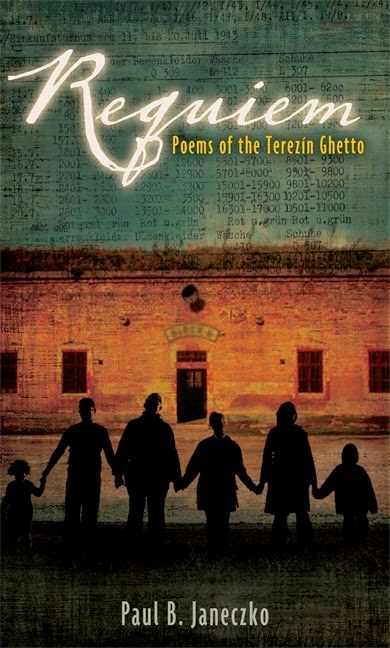
'Requiem: Poems of the Terezin Ghetto' by Paul B. Janeczko (LS 5663)

Janeczko, Paul B. 2011. Requiem: Poems of the Terezin Ghetto. Somerville, MA: Candlewick Press.

ISBN: 978-0-7636-4727-8 (hardcover)

Cover image from
www.candlewick.com
The Theresienstadt Ghetto became infamous for the lengths the Nazi government would go to in order to convince the world that its Jewish inmates were being well-treated.  As Paul B. Janeczko (2011) notes in his afterword, the ghetto was mostly populated at first by the artists and intellectuals of Prague, but by the end of World War II, over 140, 000 Jews entered Theresienstadt's gates, but most of them were eventually transported to Auschwitz or Treblinka, where they were gassed.  Ironically, the Nazis permitted, and even encouraged the Jewish prisoners to perform concerts and operas or deliver lectures.  When the Red Cross performed an inspection of Theresienstadt, the Nazis created a Potemkin village, showcasing how the Jews were treated for their inspectors and cameras.  Behind the curtains, however, it was a tale of despair, starvation, cruelty, torture, and abuse.  Janeczko's collection of poems, Requiem: Poems of the Terezin Ghetto, written in the voices of various prisoners and their captors, reveal the human face that is so often lost in the overwhelming enormity of the Holocaust.


Each poem is written from the point-of-view of a different person in Theresienstadt, so we get a variety of perspectives, from young children to older adults to members of the SS running the camp.  The characters, as Janeczko (2011) notes in his notes at the end of the book are largely fictional: "Some are composites based on [his] research.  Others are totally invented.  One exception is "Valter Eisinger/11956," a found poem taken from letters written by Eisinger, which [he] located in We Are Children Just the Same" (93).  As such, each poem is titled with the name of the narrator, or in a few cases, the name of the subject of the poem.  The Jewish prisoners' poems also contain their prisoner numbers.  To poems are arranged in chronological order, so the first poem takes place as the Nazis began to arrest and transport Jews from their homes to the concentration camps and ghettos, and the last few poems reflect the efforts by the Nazis to liquidate the ghetto and transport its prisoners to Auschwitz and other concentration camps.

Janeczko doesn't often use a great deal of figurative language once the narrative moves into the ghetto, which seems appropriate, given the subject matter.  In other works of literature I've read that depict a similar subject matter (Ruta Sepetys' Between Shades of Gray), the lack of figurative language allows the horror of the situation to become the focus of the text, rather than the language.  It also demonstrates that while figurative language has a place in poetry, sometimes all the poet needs is to let the ideas, feelings, and emotions speak for themselves.  Still, Janeczko uses figurative language when it would have the most impact.  It's quite startling to see the liberal use of simile and metaphor to describe a family's arrest to the last poems that have little to no figurative language at all.  It's as if the narrator of that particular poem has been ground down by the constant pain, hunger, and fear to the point where their mind is no longer capable of processing anything beyond its most concrete thoughts.  In "Margit Zadock/13597," Janeczko uses figurative language to describe the feeling of utter shock and disbelief at the family's arrest.  Margit describes her father as being "still as a lamppost / eyes locked on the nightmare / that had been his shop" (Janeczko 2011, 1).  Janeczko also has Margit juxtapose an exquisite image with a more desolate one to provide an immediate contrast to illustrate the sudden change in the family's circumstance.  Margit describes "Delicate handkerchiefs / now fallen white leaves" and "A white linen tablecloth... / flowed like a bride's train / from sidewalk to curb to gutter" (Janeczko 2011, 1; 2).  The enormity of the situation drops on Margit and her family when they see "black boot marks / crossing [the tablecloth] like sins" (Janeczko 2011, 2).  Janeczko (2011) uses metaphor to effectively evoke the image of hundreds of people moving from the trains into the ghetto in "Marie Jelinek/17789:" we joined the river of fear, / a current of shuffling feet, sobs, and whimpers (8).  It's not hard to create a mental image of raging fright and simmering hysteria.  In "Tomasz Kassenwitz/11850," Janeczko details the disintegration of a long friendship between Tomasz and Willi, who is not Jewish.  Tomasz describes how Willi reluctantly severs their friendship, where the absence of words and movement depicts how painful this forced separation truly is.  Janeczko (2011) writes, "He picked up the white king / then laid it softly on its side" (14).  The act of gently positioning the king into the pose that symbolizes checkmate, a loss, is elegiac in its simplicity.

A dual-voice poem, "SS Commandant Manfred Brandt & SS Sergeant Dieter Hoffmann," uses a rhythm that conjures both the musicality of the German language and the more familiar short, abrupt patterns of the language.  (Yes, spoken German can have a lyrical quality to it that is often obscured by the stereotypical harsh staccato shouts that have been seared into our collective memory.)  The short phrases spoken by Hoffmann exemplify the conventional brutish sounds of German, while also voicing contempt for Brandt's methods of keeping the Jews under control.  Hoffmann complains, "The Jews are playing music. / In the attics. Basements" (Janeczko 2011, 29).  Brandt brings Hoffmann to see his point of view, that allowing the Jews to play music maintains an illusion that they still have a measure of control over their fates and will minimize the chance for rebellion against their captors.  Brandt says,
So, let the Jews play their music, Dieter.
In fact, we will do what we can --
within reason, of course --
to assist...
Because, Dieter, the day will come
for all of them
when there will be no more music. (Janeczko 2011, 31)
The contrast between the rhythm of Hoffmann's staccato voice and Brandt's more lyrical one also reflects their philosophical differences.  In the poem, Janeczko uses their two voices to effectively  illustrate the logic employed by Kommandant Brandt to justify his actions, and to provide the questions under the voice of Sergeant Hoffmann that lead to the rationale.

One of the best examples of using white space and line breaks to help set the tone is "Hilda Bartes."  The poem is narrated from the point-of-view of a resident of the town of Terezin.  As Hilda begins to describe the town, she lists what she felt were its good qualities: "Quiet. / Isolated" (Janeczko 2011, 33).  The very qualities that made Terezin a good town in Hilda's estimation were also what made it an appealing location for a Jewish ghetto.  Placing the terms 'quiet' and 'isolation' on separate lines allows the reader to pause to let those two words meld in order to create an image of an idyllic valley.  The white space between stanzas signals a shift as the situation grows darker and more grim.

In "Josefine Rabsky/10890," Janeczko ends each stanza with the means by which a person left Theresienstadt.  Most of them list the transport that took them away to a concentration camp, and their likely death.  Two of the stanzas end with a death from disease or suicide.  It's a powerful refrain, and the relentless mentions of the transports evokes the relentlessness of death and dying.

Even with over twenty-five separate characters, Janeczko manages to make each voice sound unique in Requiem.  The irony nearly drips off the page in "SS Lieutenant Theodor Lang," who scoffs at the Red Cross inspection, but details all the 'improvements' to the ghetto so they can placate the Red Cross and the king of Denmark before he cynically remarks that, "We waited a few months / to resume the transports. / The town was getting crowded / and the ovens of Auschwitz waited" (Janeczko 2011, 58).  "Nicolas Krava/21389" sets a tone of stoic resignation as it details how delightful Nicolas was in the children's opera Brundibár, but his number came up just days after his stellar performance, and they replaced him as his transport "clattered toward death" (Janeczko 2011, 69).

The poems might not be entirely relatable to children and teenagers reading them today, but they are compelling.  The inclusion of poems written in the voices of the Terezin townspeople and the SS members running the ghetto means that students will gain a multi-faceted  perspective of the life in Terezin.  Janeczko avoids mawkishness, which is a definite skill when writing about a deeply emotional subject.  The sentiment present in the poems, such as that displayed in "Wilifred Becker/34507," comes from an authentic place, as Wilifred describes how he played his violin for a married couple spending their last hours together before the husband is taken away on a transport.  Janeczko also avoids using overly frilly language, letting the narrators of the poems simply describe what is happening to them.  The events are terrible enough without having to rely on a great deal of figurative language.

Janeczko also uses subtle hints throughout his poetry that national or cultural origin was not enough to shield one from the machinations of the Third Reich.  The narrator of "Hilda Bartes" mentions how they were commanded to leave their house in order to accommodate "the Führer's historic vision" (Janeczko 2011, 35).  Wilfred, upon hearing a request to play Johann Strauss for the couple smiles, and replies, "I am German, and I not?" (Janeczko 2011, 76).

Janeczko includes several drawings from Theresienstadt prisoners: Karel Fleischmann, Ferdinand Bloch, Bedrock Fritta, and Fritz Lederer.  The drawings seem to have been done in charcoal, graphite, or ink.  They are striking, but they're not entirely necessary to the book.  They do serve to connect the real people who were in Theresiestadt to Janeczko's fictional narrators, though.  However, I feel that the book would have been just as successful if the drawings were not in the book.

There are several access features in the book.  There is a table of contents, which I find helpful in verse novels or novellas, especially when you have a work with multiple characters like this.  Janeczko also includes an afterword that fleshes out some of the details about Theresienstadt the poems don't cover.  In the author's note, Janeczko talks about the origins of some of his narrators and some of the events he describes in the poems.  He reiterates that while the Red Cross inspection actually happened and the 'improvements' as described by Lieutenant Lang were real, Lang's words are "products of [his] imagination" (Janeczko 2011, 93).  Janeczko (2011) also mentions that as part of his research, he visited Terezin and the memorial and museums.  Janeczko includes a list of selected sources that includes several books and websites and a couple of DVDs.  He also includes a glossary of German and Czech words used in the text, translated into English.

It might make an interesting exercise to compare the poems of Janeczko with the compilation of poems and artwork by children who were in Theresienstadt called I Never Saw Another Butterfly, edited by Hana Volakova.  Not only would Requiem make an excellent resource for a history or humanities class studying the Holocaust, it adds another voice for students in Judaica classes engaging in a deeper study of the Holocaust.

*********************************************************************************

Spotlight on...

"Otto Black"

The Jews are weak.
They let the soldiers push them around.
I would never permit that,
not without throwing some punches.
That I know. (Janeczko 2011, 65).

*********************************************************************************

The poetry in Requiem is often thought-provoking, make no mistake, and one poem, "Otto Beck," can help open discussion.  In it, Otto declares, that he would not have allowed himself to be arrested and transported to the ghetto or a concentration camp.

When I was teaching, especially with some middle grade students, they would often make the same sort of statement as Otto.  This might be an interesting poem to open a unit about the Holocaust.  Once the students learn more, the class can revisit the poem and their feelings.  After knowing more about the systemic violence perpetuated against the Jews in Nazi Germany, and the Warsaw Ghetto uprisings, both by the Jews and Polish Resistance fighters, would those students still feel that they could have successfully fought back, as Otto claimed?

*********************************************************************************
Works Cited

Janeczko, Paul B. 2011. Requiem: Poems of the Terezin Ghetto. Somerville, MA: Candlewick Press.