Sunday, June 18, 2017

'Born a Crime: Stories From a South African Childhood" by Trevor Noah

Image from:
www.penguinrandomhouse.com
You probably know Trevor Noah from Comedy Central's The Daily Show.  Trevor was a surprise pick to replace the indomitable Jon Stewart, but the South African comedian has slowly come into his own and as you read his new memoir, Born a Crime: Stories From a SouthAfrican Childhood, you might start to think perhaps Jon Stewart had a very good reason to pick Trevor as his successor.

Noah's story doesn't begin with his birth.  It goes back much further than that, when the white South African government imposed the system known as apartheid on its inhabitants, hitting black South Africans the hardest with repercussions that continue to this day. Noah's mother, Patricia, rebelled against apartheid as much as possible, becoming a secretary and then making the momentous decision to have a child.  But not just with anyone.  Patricia turned to a friend, Robert, who also just happened to be a white Swiss expat.  In South Africa at that time, it was not only illegal for Trevor's parents to have a sexual relationship, it was punishable by several years in prison.  Trevor's very existence was, in fact, evidence of a crime.

Trevor describes his childhood in a series of eighteen essays, that cover everything from his mother's insistence they attend three different churches on Sundays to his laughably inept attempts to woo girls in high school to the difficult and often turbulent relationship Trevor had with his abusive stepfather.  The essays are by turns funny, moving, and heartbreaking.  Throughout the essays, Trevor is careful to not only describe the effect apartheid had on his family and other black South Africans, but to multi-racial people labeled as "Colored,"  Trevor also points out the often arbitrary rules of apartheid that sometimes popped up seemingly overnight, with no other purpose than to further divide South Africa's black and Colored peoples.  He even devotes several pages to how apartheid affected his father and other whites who disagreed with apartheid.

If Trevor is the star of the show, his mother, Patricia, often steals the spotlight as his determined supporting actress.  If nothing else in the world, Patricia is often the voice of Trevor's conscience and the force nudging him to reach for something better.

The book is an easy read in terms of readability.  Trevor's voice shines through the page, and he makes it sound like he's sitting at a table in a coffee shop regaling his friends with the most meaningful moments of his childhood.  His language does get a bit salty at times, but it never comes off as gratuitous.  Another thing to keep in mind is the book doesn't move in a straight line from Trevor's birth to his early 20s.  It meanders a bit, based on the theme for that particular section of essays.

I had a really hard time putting it down.  If you like memoirs, this is definitely one to read.

Tuesday, July 5, 2016

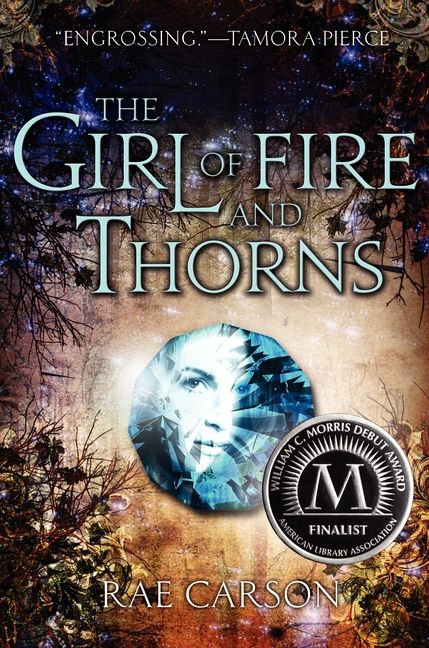
'Girl of Fire and Thorns' by Rae Carson

Carson, Rae. The Girl of Fire and Thorns. New York, Greenwillow Books, 2011. Print.

Lucero-Elisa de Riqueza, the younger princess of the kingdom of Orovalle, is wed in an arranged
(secret!) marriage to King Alejandro de Vega, of the neighbouring country of Joya d'Arena.  Joya d'Arena is embroiled in a war with another country, Invierene, and their situation is precarious.  Elisa has been marked by God with a blue gemstone (a Godstone) embedded in her navel since birth that signals she is to do somethig special.  No one really knows what.  Yet.  Mostly because people with a Godstone tend to die while in the process of fulfilling their prophecy.  Oh, and they almost always die young.  All this and Elisa is only sixteen years old.

Cover image:
www.harpercollins.com
After Elisa arrives at the palace in Joya d'Arena, she's kidnapped by a group of rebels, and dragged across the desert. Once they arrive at the rebel village, Elisa embraces their cause, and uncovers a treacherous plot against King Alejandro.  Can she save Joya d'Arena and King Alejandro in time?

One of the things I enjoyed the most about The Girl of Fire and Thorns was that Elisa wasn't a typical YA heroine.  She's not considered particularly good-looking, much less beautiful, and she's also quite overweight.  Fat, in Elisa's words.  She uses food as a coping mechanism until she no longer has that option and has to figure out how to deal with any problems that arise using her own wits and intelligence.  Another thing that sets this medieval-themed fantasy novel apart is that the marriage is not something Elisa looks forward to.  She's terrified, the people in Joya d'Arena look at her as an outsider, her husband is not the least bit interested in her, and most people treat her like the child she still is.  Carson presents a rather realistic view of what it must have felt like to end up in a dynastic marriage.

There are lots of Spanish-language influences in the book (Carson was learning Spanish when she started writing the novel), and Elisa's religion doesn't feel as if it only resides in an alien planet.  The familiar feel of the language and religion help ease you into the novel and quickly establishes the setting.  It think it's important to say here that you shouldn't let the heavy presence of the world's religion drive you away from the book.  It's absolutely integral to the plot and Elisa as a character.  Plus, Carson allows the characters to feel doubt and question their religious beliefs and faith. 

The Girl of Fire and Thorns is a great action-packed read with a relateable heroine, who repeatedly falls down, makes mistakes, and picks herself back up (a lot!), because it's the only thing she can do.

The one thing I hated about the book was the cover.  I despised it.  (*gets out soapbox*) Mostly because it insisted on glamorizing Elisa and portraying her as a lithe, conventionally pretty, Caucasian girl, when she is decidedly none of those things in the novel and says so quite often.  It's so glaringly wrong that the YALSA blog "The Hub" mentioned it in a post on the practice of whitewashing book covers (characters who are clearly written as people of color, but depicted as Caucasian on the cover).   Face it.  People judge books by their covers all the time.  I'm guilty of it.  But when we want teens to read for enjoyment and they want to read about people who look like they do, it must be incredibly disheartening to scan the shelves of their local library's teen/YA fiction section and only see covers with the stereotypical pretty white chick, who has hair that belongs in a shampoo commercial. (*puts soapbox away*) 

There are two more books in the series: The Crown of Embers and The Bitter Kingdom.

The Girl of Fire and Thorns was a finalist for a William C. Morris YA Debut award in 2012.

Wednesday, June 29, 2016

'Chains' by Laurie Halse Anderson

Anderson, Laurie Halse. Chains. New York, Simon and Schuster Books for Young Readers, 2008. Print.

cover image:
www.simonandschuster.ca
I'm a sucker for good historical fiction.  I noticed Chains and its sequel Forge on library shelves in 2013, and was intrigued by them, especially the cover artwork.  I had to set them aside in my "to-read" pile until I was done with library school, because well, unless you're enrolled in a children's literature class, outside reading in an MLS program tends to fall by the wayside.  I just so happened to enroll in my program's advanced YA literature class, and needed to do a booktalk.  Historical fiction is generally a hard sell to teenagers, but I like a challenge, and I jumped at the opportunity to read something in my ever-growing pile.  So...

Picture it.  New York City.  1776.  The Colonies are in the early throes of the Revolution.

Thirteen-year-old Isabel and her five-year-old sister Ruth are taken from their late owner's farm outside Newport, Rhode Island and sold to Elihu and Anne Lockton, visiting from New York City.  The Locktons, with Isabel and Ruth in tow, arrive to a New York City that's currently under the control of the Patriot army and General George Washington.  At this point, the tension in the novel is already quite palatable.  As soon as the Locktons, Isabel, and Ruth set foot in New York City, the stakes go up a few notches in a book with already incredibly high stakes.  Anne Lockton engages in an extremely public battle of wills with Mr. Bellingham, the harbormaster.  You see, the Locktons are staunch Loyalists, while Bellingham is a fierce Patriot, which echo the sharp divisions of New York City between Patriots and Loyalists.

Almost from the first moment Isabel arrives in New York, she finds herself in a tug-of-war between needing to stay on her owners' good side and an offer made by Curzon, a slave owned by Bellingham. If Isabel spies on her Loyalist master, Curzon promises the Patriots will give Isabel and Ruth their freedom.  Therein lies the central conflict of the novel: how far will Isabel go to gain freedom for herself and Ruth?

In Chains, Anderson presents her finest writing since Speak exploded onto the scene in 1999.  Every decision Isabel makes is fraught with dire consequences, creating layer upon layer of complexity.  Curzon neatly pinpoints the source of Isabel's initial hesitation in spying on the Locktons: she is dependent on them for everything -- food, shelter, clothes.  They literally hold Isabel's life in their hands.  That the Locktons view Isabel as something less than human is presented, ironically, as an advantage.  Curzon states, "You are a small black girl...  You are a slave, not a person.  They'll say things in front of you they won't say in front of white servants...  It happens all the time to me" (Anderson 41).  Isabel's position as a slave in the Lockton household puts her in a position to hear an all sorts of Loyalist plots, as Elihu and his cronies freely speak of a plot to assassinate George Washington while Isabel serves them food and wine.

Anderson presents a view of the American Revolution in all its shades of grey.  Nothing -- and I do mean absolutely nothing -- in this book exists as a simple binary of good versus evil.  As a villain, Anne Lockton is as chilling in her utter ruthlessness as they come.  Becky, the Locktons' paid servant, warns Isabel of Anne's temper through an anecdote about a former slave who displeased Anne.  Anne beat the previous slave so badly with a fireplace poker, she broke the girl's arm and it never healed properly, so Anne sold her. But even Anne is caught in a prison created by the social structure that gave women few rights of their own.  Early in the novel, Isabel notices an old bruise around Anne's wrist, a quick nod to the abuse Anne suffers at the hands of her husband, something Anderson explores a bit more later in the novel.  Isabel first tries to persuade the Patriot Army to purchase her away from the Locktons, if only to escape from Anne Lockton's cruelty.  When that fails, she tries to give information about the movements of the Patriot Army to the British, in the hopes that they will free her, as they've offered to other slaves.   Isabel's hopes are dashed to bits when the officer to whom she speaks informs her the British would only free her if she had been the slave of a rebel Patriot, and since she's the property of a Loyalist, they cannot free her.  There are Patriots who experience no cognitive dissonance at the idea of fighting for their freedom, while keeping other human beings enslaved.  There are also Loyalists, like Elihu Lockton's aunt, Lady Seymour, who are clearly uncomfortable with slavery, but for reasons known only to them, don't fight harder to free the slaves they can help.  People often switch sides from Patriot to Loyalist and back, depending on the fortunes of each side.  Or, like the Locktons, they act like Patriots in public while New York is occupied by the Patriots, but are dyed in the wool Loyalists behind closed doors.  All of these layers of moral complexity serve to create vivid, three-dimensional characters that a reader can easily imagine.

Anderson's language in Chains is vividly descriptive.  She -- in Isabel's voice -- describes New York as a "ball tossed between Loyalists and Patriots" (Anderson 39-40).  Even her description of New York in the summer is enough to make a reader wrinkle their nose in sympathy when Isabel says it "smelled like a garbage pit mixed with a fresh mountain of manure" (Anderson 125).  The dialog between Isabel and Curzon crackles as they butt heads, both equally stubborn and convinced what each is doing is the right course of action.

The text for the chapter headings and epigrams that begin each chapter is reminiscent of the printing style of the late eighteenth century.  Even the touch of using Roman numerals (which might make a reader want to brush up on those elementary math lessons) hearkens back to a more distant era.  It's the epigrams that really give the book the feel of the eighteenth century.  Anderson quotes sources various sources, like Abigail Adams' famous "Remember the ladies" letter to John Adams, letters from various Patriot and British army officers, and Thomas Paine's pamphlet Common Sense.  The epigrams cleverly offer a bit of a preview of the content of the following chapter.

The cover illustration perfectly encapsulates the theme of the novel.  A silhouette of Isabel, with her raised hands seemingly chained by a strip of parchment or paper that has the title on it.  On each side of the "chain" are birds that represent both the Colonies and Great Britain. Isabel rather vividly describes herself as being "chained between two nations" (Anderson 182).

Any history class that's studying the American Revolution should read this book.  Or even excerpts.  It gives such a unique point a view that usually isn't seen in tales of the Revolutionary War.  And, as noted earlier, it avoids separating characters into neat "good" or "evil" boxes.  The book is so good, that adult readers would enjoy it.  I've even recommended it to my history-loving dad.

Chains is part of Anderson's Seeds of America trilogy, which includes Forge and Ashes.  Fans of the trilogy have been waiting for years for Ashes.  It finally (!) has an expected publication date: October 4, 2016.

Chains was a finalist for the National Book Awards in 2008, and the winner of the Scott O'Dell award for historical fiction in 2009.

In April 2014, Anderson participated in a Reddit AMA.  In it she discusses Speak, as well as other books, and mentions the illness that prevented her from writing for a couple of years (hence the delay for Ashes).  Especially funny is her explanation of why she refers to her historical novels as "historical thrillers" not "historical fiction"  (Too many bad memories of Johnny Tremaine.)  There's another Reddit AMA where Speak features heavily, but it's also a wonderful conversation with Anderson.  Read them both.  She's an engaging conversationalist.  :)  And she loves librarians.


Works Cited

Anderson, Laurie Halse. Chains. New York, Simon and Schuster Books for Young Readers, 2008. Print.


Monday, May 30, 2016

'Symphony for the City of the Dead: Dmitri Shostakovich and the Siege of Leningrad'' by M.T. Anderson

Anderson, M.T. Symphony for the City of the Dead: Dmitri Shostakovich and the Siege of Leningrad. Somerville, MA, Candlewick Press, 2015. Print.

Truth is stranger than fiction sometimes.  Sometimes, the truth is so bizarre, so out in left field, so deliciously weird that even Muldar and Scully would have to investigate.

Image from:
www.penguinrandomhouse.com
Our tale begins with a spy-worthy journey, as a mysterious microfilm makes its way from Soviet Russia to Tehran, then on to Cairo, through northern Africa, where it crossed the Atlantic Ocean, landing in Recife, Brazil, where it was picked up by a U.S. Navy plane and flown to Florida, finally landing in Washington, D.C.  What is on this mysterious microfilm?  Battle plans?  Spy reports?  Wait, what?  A symphony?  All that for a symphony? You bet!

The following pages present a multi-layered biography, not just of the composer Dmitri Shostakovich, but also of the establishment of the Soviet Union and its often bloody and terrifying history under Joseph Stalin.  A dual biography is important for context here.  It's impossible to understand Shostakovich and his works unless you understand the circumstances under which he composed.  For this particular book, M.T. Anderson uses Shostakovich's Seventh Symphony -- the Leningrad Symphony -- as the lens through which he views not only Shostakovich, but the Soviet Union.  One of the most remarkable things about the Seventh Symphony is that Shostakovich composed most of it while living in Leningrad during the brutal Nazi siege (September 1941-January 1944) in World War II.  The Seventh Symphony became synonymous with the Soviet war effort during World War II, and was key in gaining material support from Western allies.  The symphony humanized the Soviets to Western audiences and was often played as part of fundraising efforts on behalf of Soviet civilians.

Anderson presents a well-researched book about one of the most well-known 20th century composers, who wrote music under unimaginable circumstances (the Russian Revolution, the purges under Stalin, the off-and-on repudiation of Shostakovich by people he considered friends, the middle of a siege). He also refuses to condescend to his intended audience, and never sugarcoats the torture under the Stalin regime or the privations in Leningrad under the siege.  Anderson doesn't dwell on it, either, but he offers more than enough detail to get the point across without gratuitous lingering over some of more gruesome aspects. (The torture of the theatre director Vsevolod Meyerhold during one of the Purges in 1938 stands out in particular.) Anderson is also mindful of his subject.  The Soviet Union was not a place where one could necessarily freely exchange ideas.  Every so often, Anderson reminds his readers that quotes attributed to Shostakovich might genuinely be Shostakovich's ideas, but there is a good chance Shostakovich spoke under duress.  After all, it wasn't uncommon for the Soviet government to allow artists to travel outside the Soviet Union, but keep their family home as "insurance" that the artist in question would not only toe the party line, but return home.  Anderson uses Shostakovich as a sort of shorthand to illustrate the raging paranoia that infiltrated every aspect of a person's life under Stalin, to the point where an artist of Shostakovich's caliber can be praised to the heavens by the critics on Tuesday, but then end up vilified and shunned on Thursday.

Anderson provides several photographs of Shostakovich, Leningrad during the siege, and production photos from the Soviet performing arts scene of the 1920s. In several photographs, Anderson's captions offer more information about the arts in the 1920s and 1930s or a little more background on a person in the photograph.  He also helpfully provides maps that outline the Nazi siege of Leningrad, delineating German and Soviet held territory.  Anderson also includes his extensive bibliography of works he consulted while he wrote the book.  There's also a table of contents and an index.  Anderson also sprinkles in a few footnotes to clarify certain topics, like the difference between "Bolshevik," "Communist," and "Socialist."

This book would be a great resource if you're studying World War II, and would like a different perspective.  To be honest (and I was a history teacher for many years before I earned my library degree), the Soviet side of things is somewhat forgotten in the larger narrative of World War II.  It would be also a good idea to track down some of Shostakovich's recordings and listen to them after you've read the book.  Google "Shostakovich Seventh Symphony," and you ought to find several recordings on YouTube.  You don't have to watch the video, just listen.  Shostakovich's symphonies really are as Anderson describes them: film scores without the film.  After reading Symphony for the City of the Dead, you don't really need a film to appreciate Shostakovich's music.

M. T. Anderson is the author of the award-winning books Feed and The Astonishing Life of Octavian NothingSymphony for the City of the Dead  was a longlist finalist for the National Book Award and was also a finalist for the YALSA Award for Excellence in Nonfiction.  Symphony for the City of the Dead has also been awarded a Horn Book Honor for 2016 in nonfiction.  NPR's program Here & Now interviewed Anderson about the book.  It's worth a listen.

*On a side note, if you look on a map of Russia today, you won't find a city called Leningrad.  You will find St. Petersburg, and Anderson traces how St. Petersburg became Petrograd, then Leningrad under Soviet rule.  It wasn't unusual for cities to have their names changed under Soviet rule, and they sometimes changed when almost as soon as a new leader came to power.  If you'd like, to look into things like this more in depth, you can research ways that new leaders of the Soviet Union tried to change historical records to remove people who had been executed during one of the Purges, especially other Party leaders who had fallen out of favor.  One of Stalin's methods was to remove former colleagues from photographs -- pre-digital Photoshop, if you will.

Saturday, May 14, 2016

'Mr. Wuffles!' by David Wiesner

Wiesner, David. Mr. Wuffles!. Illustrated by David Wiesner. New York, Clarion Books, 2013. Print.


Image from:
www.davidweisner.com
I'm a little late to the party to heap praise on David Wiesner's unbelievably charming, funny, gorgeously illustrated, and fantastic picture book Mr. Wuffles!  If you're a fan of his earlier book Tuesday, with its whimsical humor, then you'll enjoy Mr. Wuffles!.

Weisner introduces us to the titular Mr. Wuffles before we even see the title page.  In a single page, Wiesner is able to give us the primary conflict of the story: Mr. Wuffles, like many cats, is extremely disinterested in cat toys.  His owner (or if you live with a cat, his servant/food and treat provider) tries to entice him with a brand-new toy, the price tag still attached.  Mr. Wuffles turns his nose up at the latest offering and walks away.  Over the title page and title page verso, we can see the new toy of the introduction page was just the latest in a long line of failed attempts to coax Mr. Wuffles to play with cat toys.  Weisner includes the price tags on all the previous toys, too, to emphasize that Mr. Wuffles disdains all cat toys.  The next page zooms in on a row of abandoned toys, but one does not look like the others.  What looks like a kitchen gadget turns out to be a tiny spaceship, with five tiny green aliens, thrilled and elated to have landed on another planet.

They are soon discovered by Mr. Wuffles, his eyes looming ominously in their window.  In the next frame, Wiesner shows the aliens tumbling in their ship, and we turn to page to find Mr. Wuffles intently studying the small ship.  He proceeds to happily play with the ship, and breaks their power source (or warp drive, for you Star Trek fans out there) in the process.  When he suddenly decides to have a nap, as cats are wont to do, the aliens make a break for it, and find refuge under a radiator, aided by a ladybug, who distracts Mr. Wuffles.

The aliens discover a world inside the walls of the house, complete with murals depicting the struggle of ants, ladybugs, and a few poor mice against Mr. Wuffles.  The aliens add their part of the story to the mural, and soon, the ants, aliens, and ladybug are sharing food and stories.  They hatch a plan to fix the spaceship's warp drive, and draw Mr. Wuffles' attention away so that one of the aliens can install the repaired warp drive.

Mr. Wuffles knows they're under the radiator.  He waits intently for them to emerge.

Will the aliens escape?  Does their warp drive work? Read Mr. Wuffles! and find out!

Wiesner's illustrations in watercolor and India ink are beautifully done.  Wiesner is able to give the aliens, who don't have much in the way of facial features, expressions that convey their feelings of the moment.  He creates a wonderful textures of Mr. Wuffles' fur, so that you want to touch the page to rub his fluffy tummy.  (Of course, Mr. Wuffles will probably bite you for your troubles.)  Wiesner absolutely nails a cat's behavior.  The apathy with toys they don't like, the leaping shock when you surprise them, the moment when they can't decide where to look when there's a commotion, the rapt focus when they do find something with which they'd like to play.  Wiesner is even able to give ants facial expressions, which makes him an extraordinary artist, in my opinion.

There are beautiful bits of detail in the drawings, such as the reflection of Mr. Wuffles' paws in the hardwood floor; the texture in the fibers of a piece of twine or a cheese cracker in the ants' treasure stash behind the walls; or the translucence of a child's marble.  It's no wonder that Wiesner earned a Caldecott honor for this book.

Another thing that makes this book so fantastic, is that it's light on dialog.  Well, dialog in English, anyway.  It's limited to Mr. Wuffle's owner and few short sentences.  The dialog between the ants, ladybug, and aliens is done in symbols or a series of what appears to be small brushstrokes on the paper.  The differences in their communication styles doesn't seem to hurt the ants, ladybug, or the aliens.  They understand each other perfectly.

If you're teaching narrative structure to kids whose first language is something other than English, this would be a great way to introduce it.  The lack of dialog is an asset in this book.  If you want to teach kids how to write dialog, this is also a great resource, because the actions are so clearly shown on the page, that it would be easy to give the assorted characters words.  Plus, the format of single-panel pages, alternated with multi-paneled pages that can easily be distributed to students as a group project.

I recommend this to anyone that lives with a cat, likes cats, loves sci-fi, loves picture books, loves seeing Jerry outsmart Tom -- oh gosh, I'll recommend this to everybody!  I'm certainly adding it to my picture book collection.

David Wiesner is also the author and illustrator of Tuesday (1992 Caldecott medal), Flotsam, Sector 7 (2000 Caldecott honor), and Freefall (1989 Caldecott honor).

Wednesday, May 4, 2016

'Carry On' by Rainbow Rowell

Rowell, Rainbow. Carry On: A Novel. New York, St. Martin's Griffin, 2015. Print.


Image from
www.rainbowrowell.com
Simon Snow is your average foster kid in England, shuttled from care home to care home during his summer holidays from Watford School of Magicks.  Did I say average?  Simon's one of the most powerful mages in England.  Or he would be if only he could get his magic under control.  Usually when Simon uses his magic, the spells don't work or they work too well.  He suspects his roommate at Watford, Baz, is a vampire, and Simon and Baz don't get along very well.  Needless to say, Simon's afraid that Baz is going to sink his fangs into his neck while he sleeps.  To add insult to injury, Simon believes his girlfriend, Agatha, has thrown him over for Baz.  His best friend, Penelope, constantly breaks school rules by sneaking into Simon and Baz's room.  On top of all that, there have been attacks by the Insidious Humdrum and strange dead spots have been appearing all over England where magic has just disappeared.

A series of strange events marks the beginning of Simon's final year at Watford, namely the fact that Baz's dead mother, Natasha, appears to Simon and delivers a cryptic message about the circumstances of her death for Simon to give to Baz; and an obviously ill Baz doesn't show up to the school until eight weeks into the term.  Once Baz returns to Watford, he, Simon, and Penelope team up to try and uncover the tangled mystery surrounding Natasha's death, while also trying to figure out how to defeat the Humdrum.

Rowell first introduced us to Simon Snow in her novel Fangirl, where it's a fictional fantasy series that bears more than a passing resemblance to the Harry Potter phenomenon.  Rather than write the book as the fictional author might have, Rowell has basically written a fan-fiction novelization of a fictional fantasy series she created.  Got that?  The Harry Potter influence is so strong in Carry On, that for the first third of the book, it's impossible not to mentally tally all the bits and pieces that are literary cousins to their Harry Potter counterparts.  Once Baz arrives on the scene, though, the story really picks up and races to the frantic and satisfying conclusion.

It's worth mentioning that although Rowell's magical world somewhat resembles that of Harry Potter, it diverges in significant ways.  Rowell's witches and mages live in the world of Normals, use smartphones, and create savvy Google searches.  Spells are common catchphrases or quotes from popular movies or songs, and witches and mages don't always use wands.

I was a little disappointed that Rowell didn't delve as deeply into the emotional lives of Simon or Baz as she did in her award-winning novel, Eleanor & Park.  Still, Simon and Baz's inner monologues probe their emotional attachments to each other and their families and friends.  As in her other novels, characters are allowed to unfold slowly across the pages of the book.  Character development is not rushed or forced, which also helps keep the reader on their toes as the resolution of the book approaches.

Readers of Rowell's other YA novels, Eleanor & Park, and Fangirl will probably love this novel.  So will readers of the Harry Potter series, if they can help themselves from comparing it to Harry Potter.  There's enough mystery to keep mystery fans engaged, too.

Saturday, April 30, 2016

"Echo Echo: Reverso Poems About the Greek Myths" by Marilyn Singer, illustrated by Josee Masse

Singer, Marilyn. Echo Echo: Reverso Poems About the Greek Myths. Illustrated by Josee Masse. New York: Dial Books for Young Readers, 2016. Print.

Image from:
Dial Books for Young Readers
It's National Poetry Month.  So I was thrilled to see Marilyn Singer's new collection of poetry, Echo Echo: Reverso Poems About the Greek Myths, on the desk of the children's section of the library.  In fact, I did my best Phoebe Buffay impression and mentally yelled, 'POETRY!!!' when I saw it.  (Thanks, Dr. Vardell!)  I raced to check it out before anyone else could.

Singer created a form of poetry called "reverso."  It's the same poem, but written backward.   Singer basically writes one poem, then flips it upside down.  It drastically changes the tone, which allows Singer to show two sides of a story.  For example, the last poem in the book, "Gods and Mortals," goes a little something like this:

         These myths
         make sense of
         the world.
         We --
         tellers and listeners alike --
         enter these portals to
         gods and mortals.
         They can never again be closed,
         once our imaginations are opened.

        Once our imaginations are opened,
        they can never again be closed.
        Gods and mortals
        enter these portals to
        tellers and listeners alike.
        We,
        the world,
        make sense of
        these myths (Singer 24).

It's quite amazing to see how something as simple as changing a punctuation mark can subtly change the entire tone of the poem.  I can't even begin to imagine the amount of work Singer put into these poems.  Superficially, they look simple.  Then you read them.  Each word, each line, is crafted with exquisite care to ensure that the poem makes sense both directions.  It really does make you consider just how much work it takes to write just one of these poems.

Singer doesn't go for a consistent rhyme scheme in her poems, but when she does choose to utilize one, it draws attention to a specific set of lines.  In "Pandora and the Box" the few lines that do rhyme give the lines an extra bit of weight.  The first/last three lines, "Oh, how humans are weak! / 'Don't peek,' /  when a god speaks" come crashing down like a thunderclap from Zeus himself due the rhyming final words in each line (Singer 3).  She also rhymes the lines that point to Zeus' role in Pandora's story, but yet he escapes unscathed, while poor Pandora lives in infamy.  In "King Midas and His Daughter," Singer chooses to write, "so needy / so greedy" as a way to shine the spotlight on what was both Midas' triumph and downfall, as well as his daughter's longing for a loving touch, when he inadvertently turned her into gold (7).

Singer also structures her poems so that a line is made up of a single word.  In "Pandora and the Box" the word "alone" appears by itself, just after/before the line, "holding on to hope." (Singer 3).  In the first iteration of the poem, having "alone" come hard on the heels of "hope" illustrates the concept that the only thing left in the box was hope.  In the second version of the poem, "alone" precedes the phrase "holding on to hope," giving a powerful image of Pandora standing all by herself in the face of contempt, but still hanging on to hope.  Again, the structure demonstrates just how Singer is able to switch tones just by changing the order of the lines.  It's a concept illustrated well in "Icarus and Daedalus" where the switch from elation (Icarus) to sorrow (Daedalus) leaps off the page.  In "Narcissus and Echo" Singer's use of single word lines evokes an echo reverberating off the pages.

Singer doesn't employ flights of figurative language fancy in Echo Echo and generally stays away from metaphor and simile.  She does use her language well, choosing adjectives with care.  It creates wry turns of phrase in "Perseus and Medusa" when she muses that anyone would be "scared stiff. / Petrified indeed" to face Medusa (Singer 9).  The mirroring of phrasing between the idea of being petrified with fear and being actually petrified into stone makes a reader who catches such things smile. The classification on the verso title page might say juvenile poetry, but there's plenty of layers for adult readers to appreciate.

Josee Masse's illustrations are simply gorgeous.  Done with acrylic paints, the saturated blues and greens can take you away from a dreary grey day to a sun-drenched Grecian shore.  Often the drawings show both sides of the story, to great effect.  I really enjoyed the illustration that accompanied "Demeter and Persephone."  Masse divides the page into four panels, the top half representing earth, while the bottom half --  naturally -- represents the Underworld.  The top left shows Demeter with Persephone, while the top right shows Demeter during winter.  The bottom left shows Hades, bereft of the company of Persephone, and in the bottom right, his obvious joy at having his wife with him.  Masse also draws Persephone with careful attention to detail.  She's obviously happy to see her mother, but she doesn't seem to be overjoyed about it.  Conversely, Persephone seems positively miserable with Hades.  It's a complicated illustration.  Masse also draws Persephone as the source of light and warmth in both the earth and the Underworld.  The illustration for "Narcissus and Echo" features not only Narcissus, but the flower named for him, but also a ghostly outline of the girl who loved him, Echo, that fades into ripples of sound that expand through the entire drawing.

There's no table of contents because this is a pretty short book.  There are also no page numbers, which would have been helpful.  Singer does include a brief summary of the myth that inspired the poem at the bottom of the page that contains the poems.  She also suggests a few of the usual mythology sources: Mythology by Edith Hamilton and Bullfinch's Mythology: The Age of Fable.  Those would be great sources if you want to read the myths Singer used for inspiration.  Rick Riodan, of Percy Jackson fame, has also published a book in which Percy Jackson offers his take on the Greek myths from Aphrodite to Zeus, which would be a better option for kids who have been lead to Greek myths through Rick Riordan's books.

I would highly recommend this book, not just for the poetry, although the poetry is really well done.  The book as a whole is terrific.  It's a great way to further examine the Greek myths or use to introduce them in a classroom setting.

*******************************************************

Works Cited


Singer, Marilyn. Echo Echo: Reverso Poems About the Greek Myths. Illustrated by Josee Masse. New York: Dial Books for Young Readers, 2016. Print.